LM-79 Moving Detector Goniophotometer (Mirror Type C)
LSG-6000
High Precision Rotation Luminaire Goniophotometer
LSG-1890B
High Precision Rotation Luminaire Goniospectroradiometer
LSG-1890BCCD

Goniophotometer for Automotive and Signal Lamps
LSG-1950
Goniophotometer for Traffic Signal Lamps
LSG-1950S
VAD Fire Alarm Visual Alert Device Goniophotometer
LSG-1930

Compact Goniophotometer
LSG-1200A
LED Goniophotometer
LSG-1100
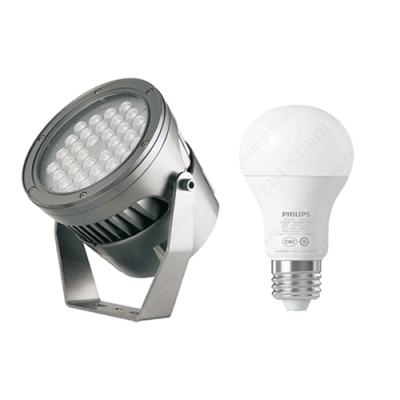 LEDs and Luminaire Test Solutions
 LM-79 and LM-80 Test Solutions
 LED Driver Test Solutions
 Household Appliances Test Solutions
 Mobile and Network Test Solutions
 Automotive Electronics Test Solutions
 Audio-Video and IT Test Solutions
 Cable and Wire Test Solutions
 Plugs and Sockets Test Solutions
 Power Switch Test Solutions
 Transformer Test Solutions
 Electric Toys Test Solutions
 Energy Meter Test Solutions
 Motor-Operated Tool Test Solutions
Select an organization
to browse standards
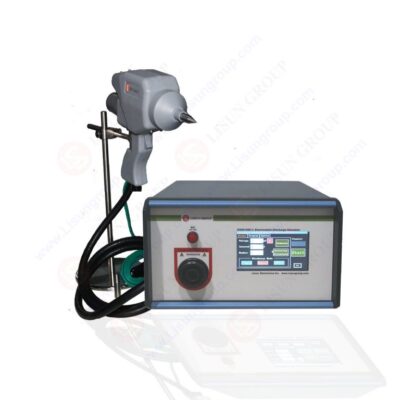
The validation of electrostatic discharge has now become a compulsory step to most of the electronic products, industry assemblies, smart appliances, battery run modules as well as devices that require safety. In the real-world unforeseen cases of static discharge can break gates of semiconductors, destroy microprocessor control logic, corrupt sensor values or cause intermittent resets in electronic boards. Such failures are recreated by engineers in the controlled conditions with the help of ESD simulator gun replicating IEC-defined shapes and energy levels of discharges. Nevertheless, the accuracy of the tests is significantly related to the proper operation of the simulator and other factors. The simulator can give wrong results when running out of specification and the actions taken are made to correct the wrong parts of the product.
The difficulty is that an ESD evaluation is not a single energy discharge event, its waveform, rise time, polarity, discharge mechanism, operator handling and grounding integrity all affect the outcome. Minor deviations bring about inconsistent failures. Thus, it is valuable to know the typical fallacies of the ESD guns and address them adequately.
Another issue in any simulation process that is most serious is lack of consistency in waveform stability. The waveform of the IEC-standard has to be accurately determined within the form of rise time and peak value. Internal capacitor wear, reduction of charging circuitry, or contamination of electrodes cause a drift in waveform. When this occurs, either peak current rises over the specified level or falls considerably, artificially becoming overly sensitive or inadequately obscuring device sensitivity.
In case of occurrence of unstable patterns, engineers first suppose that the product will possess intermittent immunity characteristics. As a matter of fact, there might be failures by the simulator to recreate the same discharges. The cure involves checking waveforms by calibrating current shunt and oscilloscope. In case of deviation more than tolerance values, change of the internal capacitor block or charging control board within the gun is done. The diagnostics incorporated with the more sophisticated versions of an ESD testing machine also provide the opportunity to directly record the waveforms.
ESD testing must be done with switching polarity since negative polarity has a different effect on the breakdown of junctions in semiconductors than positive polarity. Another problem that seems prevalent is the failure of polarity indicators brought about by worn internal switching relays. The operators might feel that they are applying alternating polarity when in reality, there are repeated discharges that use the same polarity.
There is a false operator timing, which brings about further inconsistency. When the user releases too rapidly when the trigger is released, then the internal charge cycle can be incomplete giving weak voltages.
The biggest role in ESD evaluation is played by grounding. Failure to ensure that the simulator housing is in a low-inductance bonding path with the grounding plane causes reflections of discharge energy, which appear as spikes even higher or lower than indicated. The user can touch the DUT itself or be too close to the discharge point, and change coupling paths unwillingly.
The correction involves checking of earth continuity resistance between chassis and ground reference of the simulator. The position of the ground straps is very important– straps should not circulate around tables or metal structures they should be running straight without any circles. Most labs perform traditional multimeter checks; high frequency currents require impedance-centered checking i.e. inductance should be kept at a minimum.
At high voltage of Air discharge, inner switching elements are stressed. Other simulators are designed over 25-30 kV, which exposes it to internal flashover and erosion at the relay. Switching contacts internal contacts wear out, and eventually lack the ability to hold constant potential. This type of damage does not necessarily cause instant malfunction, but only manifests intermittent fault at high voltages.
Service logs become useful. Designs of high-end ESD testing machine designs contain cycle counters that count the number of discharges to allow hardware replacement to be done according to some pre-established maintenance standards.
Table: Common failure patterns and corrective actions
| Failure Observation | Possible Condition | Recommended Fix |
| Weak discharge even when high voltage is set | Incomplete capacitor charge cycle | Repair charging board or adjust timing |
| Peak spike shorter than standard | Oxidized contact electrode reducing current shaping | Replace needle and recalibrate waveform |
| Discharge not triggering continuously | Relay fatigue after repeated switching | Replace polarity switching module |
| Device fails only when operator stands close | Incorrect body coupling path | Use distance markers and grounded shoes |
| Sudden internal spark sound or burnt smell | Air-path flashover in switching section | Immediate service and insulation replacement |
ESD discharge does not purely rely on the instrument, humidity and air concentration also has significant impact on effective spark gap. At lower humidity, there is less breakdown voltage and arc will start sooner. When the humidity falls below 60% the products might not pass the test at low humidity below 30%. Labs erroneously guide DUT instability, when the environment drift is in actuality root cause.
Repeated tests are better in maintaining environmental stability. Temperature and humidity logging are still included in the evaluation record in several professional laboratories. The more sophisticated ones have a plasma suppression filter stabilizing discharge even in the conditions when the humidity is low.
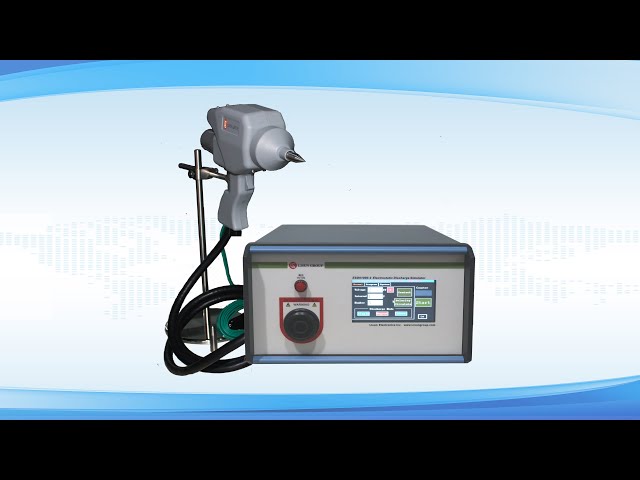
Within an ESD simulator gun, the charging current takes alternating turns in the accumulation and high-speed release of energy. The loss as a result of capacitor film deterioration affects the charge holding time. When the charge retention decays too soon then peak discharge gets low. Service teams do not change capacitors individually, but change whole charge modules since capacitance tolerances are set to repeat the waveforms exactly.
Deterioration of the charging circuit also affects the accuracy of polarity-reversal. Modern test instruments use balance of charges that is controlled by software which ensures that there is a symmetry in both forward and reverse discharge. Hardware slowly becomes less symmetric.
In the case of a double discharge residual charge is left in the tip of the gun and is discharged earlier than the desired discharge event. This deceives engineers that there is product weakness. Root cause is usually caused by the contamination of insulation of the tip, damaged discharge path or water on electrode surfaces.
Unintended double triggering can be removed by cleaning the electrode tip, drying the outer case, or by substituting the head assembly. In worse situations, there may be electrostatic build up within the coupling mechanism. To maintain a discharge pad, the manufacturers suggest taking off residual charge with the help of discharge pads and then repeating the cycle.
There is a problem that was overlooked which is in the way the operators hold the instrument. In case the user places his hand on grounded metal or leans to the DUT, the coupling changes significantly. It necessitates perpendicular and stable contact with discharge. Most of the failures blamed on the weakness of the devices are operator-angle errors.
Movement geometry is not an automatic requirement of an ESD testing machine. The latter needs procedural training, fixed positioning cues, and a standard discharge distance to use in assessing air-based evaluations. There are labs that have automated positioning with robotic fixtures thereby removing operator variability to a large extent. LISUN provides the best ESD simulator guns.
A discharge gives the component of DUT a transient rise in temperature. When repeated very rapidly, cumulative heating causes breakdown which is not a feature of the real world. Well-spaced interval between consecutive discharges is used in preventing false occurrences of failures.
ESD simulator gun includes internal cooldown timing, but external cooldown of surface of DUT is required. Housing of the sensitive plastics has longer heat retention which changes the life of the next arcs.
An ESD simulator gun is by far the best reproduction of a real-world electrostatic failure. Stability of measurement however, is determined by the stability of the waveforms, electrode performance, integrity of the grounding path, continuity of the environment, discharge shape and operator effects. The faulty inferences are not necessarily caused by bad products but damaged equipment.
Relying on the right ESD testing device, confirmation of waveforms, switching system, environmental factors that are controlled and documented discharge placement can provide correct evaluation. These systems will expose actual design weaknesses when properly maintained and calibrated instead of being unnaturally bizarre, and this enhances both safety and long-term performance of the product.
Lisun Instruments Limited was found by LISUN GROUP in 2003. LISUN quality system has been strictly certified by ISO9001:2015. As a CIE Membership, LISUN products are designed based on CIE, IEC and other international or national standards. All products passed CE certificate and authenticated by the third party lab.
Our main products are Goniophotometer, Integrating Sphere, Spectroradiometer, Surge Generator, ESD Simulator Guns, EMI Receiver, EMC Test Equipment, Electrical Safety Tester, Environmental Chamber, Temperature Chamber, Climate Chamber, Thermal Chamber, Salt Spray Test, Dust Test Chamber, Waterproof Test, RoHS Test (EDXRF), Glow Wire Test and Needle Flame Test.
Please feel free to contact us if you need any support.
Tech Dep: Service@Lisungroup.com, Cell/WhatsApp:+8615317907381
Sales Dep: Sales@Lisungroup.com, Cell/WhatsApp:+8618117273997
Your email address will not be published. Required fields are marked *

 English
 中文简体
中文简体 English
 Русский
 Español
 Português
 Türkçe
 العربية
 Deutsch
 Polski
 Italiano
 Français
 한국어
한국어 ไทย
ไทย Tiếng Việt
 日本語
日本語