LM-79 Moving Detector Goniophotometer (Mirror Type C)
LSG-6000
High Precision Rotation Luminaire Goniophotometer
LSG-1890B
High Precision Rotation Luminaire Goniospectroradiometer
LSG-1890BCCD

Goniophotometer for Automotive and Signal Lamps
LSG-1950
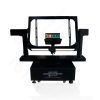
Goniophotometer for Traffic Signal Lamps
LSG-1950S
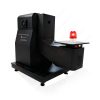
VAD Fire Alarm Visual Alert Device Goniophotometer
LSG-1930
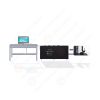
Compact Goniophotometer
LSG-1200A
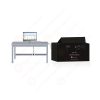
LED Goniophotometer
LSG-1100
 LEDs and Luminaire Test Solutions
 LM-79 and LM-80 Test Solutions
 LED Driver Test Solutions
 Household Appliances Test Solutions
 Mobile and Network Test Solutions
 Automotive Electronics Test Solutions
 Audio-Video and IT Test Solutions
 Cable and Wire Test Solutions
 Plugs and Sockets Test Solutions
 Power Switch Test Solutions
 Transformer Test Solutions
 Electric Toys Test Solutions
 Energy Meter Test Solutions
 Motor-Operated Tool Test Solutions
Select an organization
to browse standards
The flicker meter has emerged as a critical instrument in modern optical testing, particularly for LED and lighting applications where temporal light modulation directly impacts visual comfort and health risks. This comprehensive study explores the fundamental principles, technical standards, and practical applications of flicker meters in the assessment of light source quality. Focusing on IEEE 1789 standards and advanced measurement methodologies, this paper examines how modern flicker detection systems integrate with spectroradiometric analysis to provide comprehensive optical performance evaluation.
Through detailed analysis of measurement parameters including flicker percentage, flicker index, and modulation depth, this research demonstrates the essential role of flicker meters in ensuring compliance with international lighting standards and mitigating health risks associated with light source flicker. The study also evaluates the integration capabilities of portable CCD spectroradiometers with flicker measurement functions, highlighting their significance in professional lighting quality assessment and LED product development.
Light flicker represents a significant challenge in modern illumination technology, particularly with the widespread adoption of LED lighting systems that often incorporate pulse-width modulation (PWM) dimming techniques. The temporal variations in light output can cause visual discomfort, headaches, fatigue, and potentially serious health effects including photosensitive epilepsy. With the global LED lighting market experiencing substantial growth and regulatory bodies implementing stricter standards for light quality, the demand for accurate flicker measurement instruments has increased dramatically.
The flicker meter serves as the fundamental tool for quantifying temporal light modulation parameters, enabling manufacturers and quality assurance professionals to ensure their products meet international safety and performance standards. This challenge is particularly acute in applications such as automotive lighting, display technology, and architectural illumination where flicker perception can significantly impact user experience and safety.
This paper aims to provide a comprehensive technical framework for understanding and implementing flicker meter technology in modern optical testing applications. The primary objectives include analyzing the fundamental principles of flicker measurement, examining international standards and compliance requirements, evaluating technical specifications and measurement methodologies, and exploring practical applications in LED and lighting product development.
By integrating spectroradiometric analysis with flicker measurement capabilities, this study demonstrates how advanced measurement systems provide comprehensive optical performance evaluation. The research specifically addresses the technical requirements for accurate flicker detection, the interpretation of measurement parameters, and the implementation of quality control protocols in manufacturing environments. Through this comprehensive analysis, engineers and researchers will gain essential knowledge for selecting and utilizing appropriate flicker meter technology for their specific testing requirements and ensuring optimal flicker meter performance in their applications.
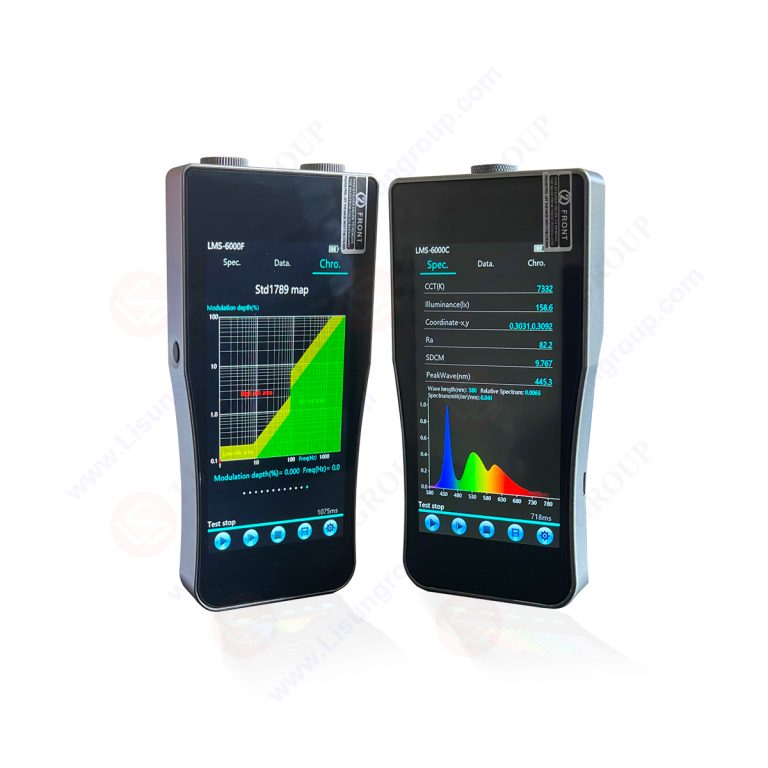
Portable CCD Spectroradiometer
The evolution of flicker measurement standards reflects growing recognition of light flicker’s impact on human health and visual comfort. The IEEE 1789 standard, published in 2015, represents a comprehensive framework for recommended practices in modulating current in high-brightness LEDs to mitigate health risks to viewers. This standard emerged from extensive research demonstrating the correlation between flicker frequency and amplitude with human physiological responses including brain wave activity and potential seizure induction. Prior to IEEE 1789, various organizations including CIE (Commission Internationale de l’Éclairage) and IEC (International Electrotechnical Commission) addressed aspects of temporal light modulation, but lacked unified criteria for acceptable flicker levels.
The development of IEEE 1789 incorporated research from medical studies, lighting engineering analysis, and psychophysical evaluations to establish quantitative criteria for flicker acceptability. The standard defines two critical risk categories: no observable effect level (NOEL) and low risk level, with specific frequency and modulation depth thresholds for each category. This standardization effort has provided manufacturers with clear guidelines for LED driver design and lighting product testing, establishing flicker meter as an essential tool for compliance verification.
IEEE 1789 establishes specific measurement protocols and acceptability criteria that require precise flicker meter implementation. The standard defines key parameters including flicker percentage, modulation depth, and flicker index, each calculated through specific mathematical formulations. The flicker meter must be capable of detecting modulation frequencies from below 1Hz to several hundred Hz, with sufficient sensitivity to measure modulation depths as low as 1% across the frequency range. The standard specifies two critical compliance thresholds: a no-risk threshold requiring modulation depth below 0.08% at frequencies below 90Hz, and a low-risk threshold allowing modulation depth up to 0.08% at frequencies below 90Hz with decreasing requirements at higher frequencies.
Accurate flicker meter implementation requires appropriate sampling rates, photometric sensor calibration, and signal processing capabilities to capture high-frequency variations without introducing measurement artifacts. The standard also addresses measurement conditions including environmental lighting, sensor positioning, and integration time settings that affect flicker meter accuracy. Compliance testing using properly calibrated flicker meters ensures that LED products meet health and safety requirements while providing manufacturers with documented evidence of compliance for regulatory submissions and customer assurance.
Flicker meters operate on the principle of detecting temporal variations in light output through high-speed photometric sampling and signal analysis. The fundamental measurement involves continuously sampling the instantaneous luminous flux from the light source using a photodetector with appropriate spectral response matching the human photopic vision curve. Advanced flicker meters incorporate high-sensitivity CCD or photodiode sensors capable of sampling rates exceeding 10kHz to capture high-frequency modulation patterns.
The acquired time-domain signal undergoes digital signal processing to extract key parameters including flicker percentage, calculated as (Lmax – Lmin) / (Lmax + Lmin) × 100%, where Lmax and Lmin represent maximum and minimum luminance values respectively. Flicker index, another critical parameter, represents the ratio of the area above the average luminance to the total area under the luminance-time curve.
Modern flicker meters implement sophisticated algorithms for filtering noise, detecting periodic and non-periodic flicker patterns, and distinguishing between different modulation types including sinusoidal, rectangular, and complex waveforms. The integration of spectroradiometric capabilities enables flicker meters to correlate temporal variations with spectral characteristics, providing comprehensive analysis of how color changes occur simultaneously with luminance modulation.
The technical performance of flicker meters is characterized by several critical specifications that determine measurement accuracy and application suitability. High-performance flicker meters such as those integrated into the LMS-6000F and LMS-6000SF spectroradiometer systems offer frequency measurement ranges from DC to 1kHz or higher, with sampling rates exceeding 20kHz for detailed waveform analysis. Modulation depth measurement accuracy typically ranges from ±0.1% to ±0.5% depending on the frequency range and signal characteristics.
The photometric accuracy, typically better than ±2% across the measurement range, ensures reliable correlation with human perception. Advanced flicker meters feature multiple measurement modes including instantaneous peak detection, continuous monitoring, and statistical analysis over extended periods. The integration time, adjustable from microseconds to milliseconds, allows optimization for different flicker characteristics and applications. Connectivity options including USB, RS485, and wireless communication enable data transfer and remote monitoring capabilities.
The dynamic range, often exceeding 100dB, accommodates measurements from very low light levels to extremely bright sources without range switching or sensitivity loss. These technical specifications collectively determine the flicker meter’s capability to meet diverse testing requirements across various lighting applications.
Flicker meter analysis generates multiple parameters that provide comprehensive characterization of temporal light modulation characteristics. The flicker percentage (FP) represents the relative magnitude of luminance variation and serves as a primary indicator of flicker severity. Flicker index (FI) provides additional insight by considering the shape of the modulation waveform, making it more sensitive to asymmetric modulation patterns. Modulation depth (MD), closely related to flicker percentage, is particularly useful for comparing against IEEE 1789 compliance criteria. The flicker meter may also calculate percent flicker, which expresses the modulation as a percentage of the average luminance.
For advanced analysis, flicker meters can determine the modulation frequency with high precision, enabling correlation with known sensitivity thresholds for human perception and health effects. Some sophisticated flicker meters implement frequency domain analysis using Fast Fourier Transform (FFT) to identify multiple modulation frequencies and harmonics, particularly useful for complex waveforms from multiple-source illumination systems. Temporal metrics including jitter and transient analysis capabilities enable detection of irregular flicker patterns that may indicate driver instability or compatibility issues. The comprehensive parameter set provided by modern flicker meters enables thorough characterization of temporal light quality beyond simple pass/fail compliance assessment.
Advanced flicker meters incorporate sophisticated signal processing algorithms to ensure accurate and reliable measurement results across diverse operating conditions. Digital filtering techniques remove high-frequency noise above the flicker frequency range while preserving the temporal modulation characteristics of interest. Anti-aliasing filters implemented prior to analog-to-digital conversion prevent spurious signals from affecting measurement accuracy.
The flicker meter typically employs windowing functions and averaging techniques to improve measurement repeatability, particularly for signals with stochastic components or irregular modulation patterns. Adaptive sampling algorithms optimize the sampling rate based on detected modulation frequency, ensuring sufficient resolution for accurate parameter extraction while managing computational requirements. Some flicker meters implement machine learning algorithms to identify and classify different flicker types, providing enhanced diagnostic capabilities for troubleshooting lighting system issues. Real-time processing enables immediate feedback during product development and manufacturing, while data logging and statistical analysis support comprehensive quality control and long-term monitoring applications.
The integration of spectroradiometric analysis with temporal measurement enables correlation of flicker characteristics with color parameters, providing complete optical performance assessment. These advanced signal processing capabilities distinguish professional-grade flicker meters from basic measurement instruments and enable comprehensive analysis of complex lighting behaviors.
The optical system design of flicker meters incorporates several critical elements to ensure accurate photometric measurement across varying light conditions and spectral distributions. The photodetector selection represents a fundamental design consideration, with silicon photodiodes commonly used for their linear response across the visible spectrum and fast temporal response characteristics. Advanced flicker meters may incorporate CCD sensors with high pixel density to enable simultaneous spectral and temporal analysis. The optical path includes precision apertures and diffusers that ensure consistent acceptance angles and minimize angular sensitivity variations. Calibration of the photopic response filter to match the CIE 1931 standard observer function is essential for accurate correlation with human visual perception.
The optical system must maintain stable performance across environmental conditions including temperature variations and humidity changes, requiring temperature compensation and protective coatings. For portable flicker meters, the optical design must balance performance with size and weight constraints, necessitating compact optical assemblies without sacrificing measurement accuracy. Integration with spectroradiometric systems adds complexity, requiring optical elements that can perform both broadband photometric measurement and high-resolution spectral analysis without cross-interference between these functions.
The electronic architecture of flicker meters requires careful design to achieve high-speed signal acquisition and processing while maintaining measurement accuracy and stability. The analog front-end incorporates low-noise preamplifiers with bandwidth exceeding 100kHz to capture high-frequency modulation components. Analog-to-digital converters with resolution of 16 bits or higher and sampling rates exceeding 20kHz ensure adequate dynamic range and temporal resolution.
Digital signal processors or field-programmable gate arrays (FPGAs) implement real-time processing algorithms for flicker parameter calculation and analysis. The mechanical design must provide stable mounting for optical components while protecting sensitive electronics from environmental factors. Portable flicker meters require robust enclosures that maintain optical alignment during transportation and field use.
Thermal management systems ensure stable operation across environmental temperature ranges, with critical components receiving active temperature control if necessary. Power supply design must provide stable, low-noise power to sensitive analog circuits while supporting extended battery operation for portable applications. User interface design, including displays and control inputs, must enable intuitive operation in various lighting conditions while providing clear visualization of measurement results and system status. The integration of these electronic and mechanical subsystems creates a flicker meter capable of reliable, accurate performance across diverse applications and operating conditions.
The LMS-6000 series of portable CCD spectroradiometers from Lisun Group represents a comprehensive family of measurement instruments incorporating advanced flicker meter functionality across multiple model variants. The base model LMS-6000 provides fundamental photometric and colorimetric parameters including illuminance, correlated color temperature, color rendering index, and TM-30 metrics. Building upon this foundation, the LMS-6000F variant adds dedicated flicker measurement capabilities, enabling comprehensive temporal light analysis alongside spectral characterization.
For applications requiring extended spectral range and additional specialized measurements, the LMS-6000BF variant incorporates blue light hazard assessment according to GB/T20145 and CIE S009/E:2002 standards alongside flicker testing. The flagship LMS-6000SF model offers the most comprehensive functionality, combining all LMS-6000S parameters including PAR and PPFD measurements for horticultural lighting applications with advanced flicker meter capabilities.
Each model in the series maintains the portable design philosophy enabling field measurements and laboratory applications, with connectivity options supporting integration into automated test systems. The modular architecture enables selection of appropriate feature sets for specific application requirements while maintaining consistent measurement methodologies and user interface conventions across the product family.

5. Dual-Mode Operation Design and Operational Safety Assurance
The LMS-6000 series flicker meter implementations provide comprehensive measurement capabilities with specifications suitable for professional applications. The flicker measurement range spans frequencies from below 1Hz to 1kHz, with modulation depth measurement accuracy better than ±0.5% across the frequency range. The photometric accuracy of ±2% ensures reliable correlation with human visual perception and compliance with international standards.
The spectral measurement range varies by model from 380-780nm for standard visible light analysis to 350-950nm for extended range models including UV and near-IR regions. Measurement parameters include illuminance up to 500,000 cd/m², luminance up to 500,000 cd/m², and PPFD up to 500,000 μmol/m²·s depending on model configuration. Data acquisition rates exceeding 20kHz ensure accurate capture of high-frequency modulation patterns. The flicker meter calculates and displays multiple parameters including flicker percentage, flicker index, modulation depth, and modulation frequency in real-time. Connectivity options include USB for data transfer and RS485 for integration into automated test systems.
The instruments operate on Windows 7, 8, 10, and 11 platforms, with software supporting comprehensive data analysis and reporting capabilities. Calibration certificates and test reports demonstrate traceability to international standards, providing documented evidence of measurement accuracy for quality assurance and regulatory compliance.
Table 1: LMS-6000 Series Flicker Meter Technical Specifications
| Parameter | LMS-6000F | LMS-6000BF | LMS-6000SF | LMS-6000UV | Unit |
| Spectral Range | 380-780 | 350-800 | 350-950 | 200-400 | nm |
| Flicker Frequency Range | 0-1000 | 0-1000 | 0-1000 | – | Hz |
| Modulation Depth Accuracy | ±0.5 | ±0.5 | ±0.5 | – | % |
| Sampling Rate | ≥20k | ≥20k | ≥20k | – | Hz |
| Luminance Measurement Range | 0.1-500k | 0.1-500k | 0.1-500k | – | cd/m² |
| Blue Light Hazard Assessment | No | Yes | Yes | – | – |
| PPFD Measurement | No | No | Yes | – | – |
The LMS-6000 series flicker meter instruments serve diverse applications across multiple industries requiring precise optical measurement and temporal light analysis. In LED product development and manufacturing, these instruments enable comprehensive quality control including spectral characterization, color rendering assessment, and flicker evaluation according to IEEE 1789 standards. Automotive lighting applications require rigorous testing of headlamps, interior lighting, and signal lights to ensure visual comfort and regulatory compliance across varying operating conditions. Display and screen manufacturers utilize flicker meter capabilities to evaluate back-lighting systems and ensure visual comfort for extended viewing periods.
Horticultural lighting facilities employ models with PAR and PPFD measurement capabilities to optimize plant growth conditions while ensuring stable, flicker-free illumination. Architectural lighting designers use these instruments for site analysis, commissioning verification, and performance optimization of installed lighting systems. Research laboratories utilize the comprehensive measurement capabilities for lighting research, photobiology studies, and human factors investigations.
The portable design enables field measurements in existing installations and on-site validation, while the USB and RS485 connectivity options support integration into automated test systems for high-volume manufacturing environments. The combination of spectroradiometric analysis and flicker meter functionality provides complete optical performance characterization in a single instrument platform.
Selecting the appropriate flicker meter requires careful consideration of multiple technical and application-specific factors. The measurement frequency range must encompass all relevant modulation frequencies expected in the application, with particular attention to the frequency range specified in applicable standards such as IEEE 1789. Modulation depth accuracy and resolution determine the instrument’s ability to detect low-level flicker that may affect sensitive individuals, with professional applications typically requiring accuracy better than ±0.5%. The integration of spectroradiometric capabilities provides valuable additional information correlating flicker characteristics with color parameters, particularly important for applications where color constancy during modulation is critical.
Portability requirements vary between laboratory use and field applications, with battery operation and rugged construction essential for field measurements. Connectivity options including USB and RS485 interfaces enable integration into automated test systems for manufacturing quality control. Software capabilities including data analysis, reporting, and compliance verification significantly enhance productivity and ensure consistent measurement practices across organizations. Calibration requirements and traceability to international standards provide documented evidence of measurement accuracy essential for regulatory compliance and customer assurance. The total cost of ownership including calibration services, software updates, and maintenance should be evaluated alongside initial acquisition cost when making selection decisions.
Implementing flicker meter measurements in practical engineering environments requires attention to several critical factors affecting measurement accuracy and reliability. Environmental conditions including ambient lighting and electromagnetic interference can significantly affect measurements, requiring appropriate shielding and measurement protocols to minimize external influences. The measurement geometry including sensor positioning, distance from the light source, and acceptance angle must be carefully controlled and documented to ensure reproducible results. Measurement integration time represents a critical parameter, with shorter integration times providing higher frequency resolution but potentially increased noise, while longer integration times improve signal-to-noise ratio but may miss high-frequency components.
The flicker meter’s linearity across the measurement range must be verified, particularly for applications with wide dynamic range requirements. Regular calibration against reference standards ensures ongoing accuracy and traceability, with calibration intervals determined by usage patterns and accuracy requirements. Data analysis protocols must be established to ensure consistent interpretation of flicker parameters across different operators and measurement sessions. For automated testing systems, integration timing and synchronization with other measurement instruments require careful design to ensure data consistency and avoid measurement artifacts. These engineering considerations ensure that flicker meter measurements provide reliable, actionable data for product development and quality assurance applications.
Practical applications of flicker meter technology across various industries demonstrate its value in addressing real-world challenges. In automotive headlamp development, manufacturers implemented comprehensive flicker testing using portable spectroradiometers with flicker meter capabilities to address visual comfort complaints from drivers. The testing revealed flicker levels exceeding IEEE 1789 low-risk criteria at specific PWM frequencies, leading to driver redesign and improved visual comfort without sacrificing energy efficiency. Display manufacturers employed flicker meters to optimize back-lighting PWM frequencies and duty cycles, achieving significant improvements in user-reported comfort during extended viewing sessions.
Horticultural lighting facilities utilized flicker meter analysis to identify and eliminate flicker from LED grow lights that was causing plant stress and inconsistent growth patterns, resulting in measurable yield improvements. Architectural lighting projects incorporated flicker meter measurements during commissioning to verify that installed systems met specification requirements, particularly in healthcare facilities and educational environments where visual comfort is critical. These case studies demonstrate that flicker meter technology provides essential diagnostic capabilities that enable product improvements and optimization across diverse applications, with tangible benefits in terms of user comfort, product performance, and regulatory compliance.
The evolution of flicker meter technology continues to advance in response to emerging applications and regulatory requirements. Enhanced signal processing incorporating artificial intelligence and machine learning algorithms promises improved automatic flicker classification and diagnostic capabilities, enabling more sophisticated analysis of complex modulation patterns. Miniaturization of optical and electronic components will enable integration of flicker meter functionality into smaller form factors including portable handheld devices and potentially smartphone-based measurement solutions. Expanded frequency ranges addressing both lower frequency flicker below 1Hz and higher frequency components above several kHz will accommodate emerging applications and provide more comprehensive characterization of temporal light behavior.
Integration with other optical measurement parameters including ultraviolet and infrared analysis will provide even more complete optical performance assessment. Enhanced connectivity and cloud-based data management will facilitate large-scale data collection and analysis, enabling predictive quality control and long-term performance monitoring. Regulatory developments may establish more stringent flicker requirements across additional applications, driving demand for advanced flicker meter capabilities.
The continued evolution of LED and solid-state lighting technology, including new driver architectures and dimming techniques, will require corresponding advancements in flicker meter measurement methodologies and analysis capabilities. These future developments will expand the applicability and value of flicker meter technology across an even broader range of applications.
The flicker meter has established itself as an essential instrument for comprehensive optical performance assessment in modern lighting and LED applications. This paper has demonstrated that accurate flicker measurement, when implemented with proper technical specifications and measurement protocols, provides critical insights into temporal light quality that directly impact visual comfort, health risks, and product performance. The integration of flicker meter functionality with spectroradiometric analysis, as exemplified by the LMS-6000 series instruments, enables comprehensive characterization of both spectral and temporal optical characteristics in a single measurement platform.
Compliance with international standards including IEEE 1789 ensures that flicker meter measurements provide meaningful, actionable data for product development, quality assurance, and regulatory compliance. As lighting technology continues to evolve and regulatory requirements become increasingly stringent, the flicker meter will remain a critical tool for ensuring that light sources meet performance and safety requirements while providing optimal user experiences across diverse applications. The continued advancement of flicker meter technology will enable even more sophisticated analysis and enhanced capabilities to address the evolving challenges in modern optical testing and lighting quality assessment.
Tags:LMS-6000Your email address will not be published. Required fields are marked *

 English
 中文简体
中文简体 English
 Русский
 Español
 Português
 Türkçe
 العربية
 Deutsch
 Polski
 Italiano
 Français
 한국어
한국어 ไทย
ไทย Tiếng Việt
 日本語
日本語