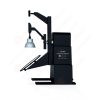
LM-79 Moving Detector Goniophotometer (Mirror Type C)
LSG-6000
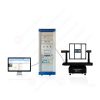
High Precision Rotation Luminaire Goniophotometer
LSG-1890B
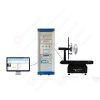
High Precision Rotation Luminaire Goniospectroradiometer
LSG-1890BCCD

Goniophotometer for Automotive and Signal Lamps
LSG-1950
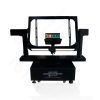
Goniophotometer for Traffic Signal Lamps
LSG-1950S
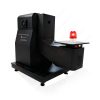
VAD Fire Alarm Visual Alert Device Goniophotometer
LSG-1930
Compact Goniophotometer
LSG-1200A
LED Goniophotometer
LSG-1100
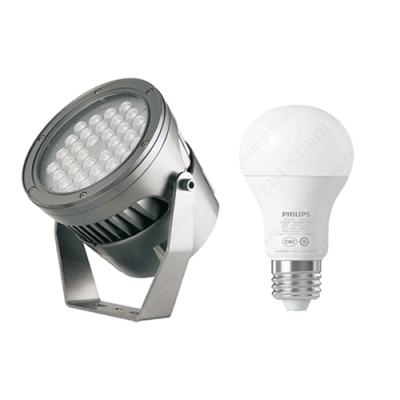 LEDs and Luminaire Test Solutions
 LM-79 and LM-80 Test Solutions
 LED Driver Test Solutions
 Household Appliances Test Solutions
 Mobile and Network Test Solutions
 Automotive Electronics Test Solutions
 Audio-Video and IT Test Solutions
 Cable and Wire Test Solutions
 Plugs and Sockets Test Solutions
 Power Switch Test Solutions
 Transformer Test Solutions
 Electric Toys Test Solutions
 Energy Meter Test Solutions
 Motor-Operated Tool Test Solutions
Select an organization
to browse standards
Since the development of LED technology, recent lighting fixtures are generating a high level of luminous intensity, which in most cases are tens or even hundreds of thousands of lumens. Such strong sources of light need special photometric systems to measure accurately. Specifically, a large integrating sphere has been developed to deal with these high-lumen conditions with a stable and accurate measurement. Combined with a professional led tester it has offered an accurate solution in assessing luminous flux, efficiency and a optical uniformity of industrial and commercial LED fixtures. Measurement errors are easily arrived at, either through thermal effects, saturation or spatial non-uniformity without proper considerations of design.
LED fixtures with high lumens pose special problem which cannot be adequately solved with smaller photometric systems. The integrating sphere should be well-designed as the size of the fixtures and power is increased because the distribution of light, the cooling of heat, and the responsiveness of detectors require some attention. These design considerations dictate whether the measurement actually gives a true indication of actual optical performance or gives false information.
The essence of an integrating sphere is to spatially integrate light into such a way that beam angle and beam direction is no longer included in the measurement. Sphere diameter becomes a critical factor with LED fixtures of high lumen level. The high level of lighting can be evenly distributed in a large integrating sphere to avoid the formation of hot spots on the inner coating.
With too small a sphere, intense LED lighting may saturate the reflective material and produce non-linear detector response resulting in inaccurate responding. Greater spheres expand the gap between the source of light and the measuring detector to enable several reflections to equalize light to be detected. This makes sure that the led tester gets a constant representative signal as opposed to actual illumination.
The inner surface of a major integrating sphere should have a high reflectance in the spectrum of light so as to have lots of light being integrated. In high-lumen testing, the coating durability is also of paramount importance to reflectance value. Low-quality coatings can be ruined after some time by a bright light and in high temperatures.
High-performance spheres contain precise-specialized diffuse platforms keeping their reflectance constant despite extended reflects of the potent sources of LED. Accuracy is also influenced by uniformity of coating. Any spatial inconsistency due to reflectivity causes spatial bias, and causes drift in measurements. The carefully designed spheres have a constant reflectance throughout the operation period, which can be used in long-term testing reliability.
The fixtures with high luminance produce a lot of heat which may influence the device being tested and also to the integrating sphere itself. This thermal load must be allowed to be absorbed into a large integrating sphere that does not allow internal temperature to rise too high. High temperatures are likely to change the output of LEDs and detectors. Thermal effects are controlled using proper ventilation, heat resistant materials, and controlled measurement time.
Even large integrating sphere systems, in which manufacturers like LISUN design large systems with optimized thermal management, are designed to guarantee the maintenance of the same level measurement conditions even in long test cycles.
The design of the ports is important in the determination of accuracy. Ports have to be large and placed to allow a minimal light leakage and ensure that the detector is not directly illuminated. With fixtures of high lumen, a large port can be needed to fit the size of the fixtures, however, large ports will lower effective reflectance.
The geometric balancing is done carefully not to distort the incorporated light field by the ports. Mechanisms should also be used to ensure heavy fixtures are mounted in stable positions without giving rise to shadowing or reflective artifacts. A large integrating sphere that is well-designed is symmetrical and the port has little influence on the measurement’s outcomes.
The detector in a large integrating sphere should be placed so as to not be exposed directly to the source of the light but capture the integrated light field. In the measurement of high-lumen LEDs, especially when sensitivity has not been carefully regulated, detector saturation is a prevalent risk.
Quality led tester systems have adjustable gain, optical attenuation or replaceable detectors to control a broad dynamic range. The flexibility enables to properly measure the range of output levels without losing the resolution of lower-lumen products.
In addition to the total luminous flux, spectral and colorimetric data are needed in many applications. To have a precise measurement of color, a wide integrating sphere will be required. High-lumen LEDs typically possess complicated spectral distributions which depend on temperature and drive current.
Similarity in internal reflectance permits spectral measurements of the complete emitted light not local areas. The sphere can be used to determine reliable assessment of the correlated color temperature, color consistency, and spectral power distribution when the integrations occur with spectroradiometric modules.
The calibration is of essence to accurate high-lumen measurement. Massive integrating spheres have to be calibrated by means of reference LEDs or traces of standard lamps, which are within the anticipated output variety. The calibration processes should consider; sphere size, port arrangement and detector features.
Mechanical design of stability guarantees that the design is valid with time. Reconfiguration or mechanical drift can often affect traceability. The strong sphere building will lead to the maintenance of regular calibration periods and test-session comparison.
The LED output is ever growing with the changing technology. A large integrating sphere that is designed with enough capacity will make sure that the system is not wasted in the designing phase of the future products. The brief oversizing of the sphere beyond present needs like additional lumen in the sphere allows redesign freedom.
Scalability Integration of led tester models is scalable so that laboratories can build measurement and add new sophisticated detectors or software modules. This will safeguard investment as well as accommodate changing testing requirements.
Large integrating spheres are highly utilized in the testing of streetlights, high-bay luminaires, floodlights, as well as stadium lighting. These fixtures require precise flux metering to serve efficiency assertion, vessel verification documentation, and optimization of products.
Large integrating spheres have the benefit of capturing total output unaffected by beam geometry thereby giving consistent data that can be used to compare whose performance across designs. This is critical among the manufacturers in the high-performance lighting markets.
Photometric systems are subjected to high-lumen testing and are stressed. A huge integrating sphere has to be mechanically stable, have integrity of coating, as well as accuracy of the detectors over several years of use. Periodic maintenance is aimed at port cleaning, checking of coating status and checking detector activity.
LISUN large integrating sphere systems have been designed to last in laboratories, and have a balance of measurement accuracy with durability and serviceability.
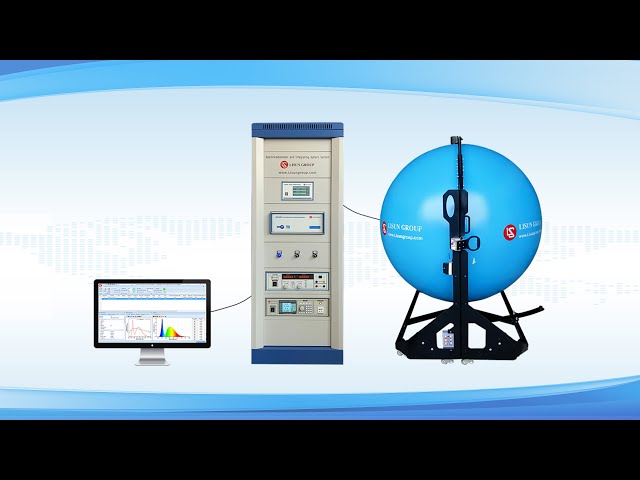
The high-lumen LED fixtures require a large integrating sphere, which determines the integration of light accurately and at a uniform level that cannot be integrated by smaller systems. It can facilitate accurate measurements of the luminous flux, efficiency, and spectral properties between operating conditions can be performed with a capable led tester. The design of consideration taken includes sphere size, coating durability, thermal management, control of detector and the stability of calibration as to whether the measurements are actually reflective of product performance or not.
When carefully designed remedies are offered by the manufacturers such as LISUN, the laboratories can be sure to test the present high-output LED fixtures, but are ready to keeping up with new developments. An effective large integrating sphere is not only a test instrument but a platform to successful repeatable and significant photometric research of the high-lumen age.
Your email address will not be published. Required fields are marked *

 English
 中文简体
中文简体 English
 Русский
 Español
 Português
 Türkçe
 العربية
 Deutsch
 Polski
 Italiano
 Français
 한국어
한국어 ไทย
ไทย Tiếng Việt
 日本語
日本語