LM-79 Moving Detector Goniophotometer (Mirror Type C)
LSG-6000
High Precision Rotation Luminaire Goniophotometer
LSG-1890B
High Precision Rotation Luminaire Goniospectroradiometer
LSG-1890BCCD

Goniophotometer for Automotive and Signal Lamps
LSG-1950
Goniophotometer for Traffic Signal Lamps (Economical Model)
LSG-1950S
Goniophotometer for Airfield Lighting
LSG-1940
VAD Fire Alarm Visual Alert Device Goniophotometer
LSG-1930
Compact Goniophotometer
LSG-1200A
LED Goniophotometer
LSG-1100
Near Field Moving Detector Goniophotometer
LSG-1900B
 LEDs and Luminaire Test Solutions
 LM-79 and LM-80 Test Solutions
 LED Driver Test Solutions
 Household Appliances Test Solutions
 Mobile and Network Test Solutions
 Automotive Electronics Test Solutions
 Audio-Video and IT Test Solutions
 Cable and Wire Test Solutions
 Plugs and Sockets Test Solutions
 Power Switch Test Solutions
 Transformer Test Solutions
 Electric Toys Test Solutions
 Energy Meter Test Solutions
 Motor-Operated Tool Test Solutions
Select an organization
to browse standards
Abstract: In the optical characterization of transparent and translucent materials, optical scattering phenomena serve as core metrics for evaluating material clarity and purity. However, confusion frequently arises between the concepts of “turbidity” and “haze” across industrial and academic communities. This paper aims to provide an in-depth analysis from the dual perspectives of fluid physics and solid-state optics to address the question: What is the difference between turbidity and haze?
By examining international standards such as ASTM D1003 and ISO 13468, this study analyzes the scattering trajectories and integral geometric structures of light passing through different mediums (including films, glass, and liquids). Incorporating the technical specifications of the LISUN HM-120 Haze Meter/Turbidity Meter, this paper demonstrates the value of dual-standard compatible measurement systems in modern industrial inspection, providing quantitative technical parameter comparisons.
In optical material quality control workflows, engineers are frequently asked abovequestion. Although both terms describe “opaque” or “cloudy” conditions in everyday language, they possess fundamentally distinct definitions, application scopes, and measurement standards in the field of precision testing.
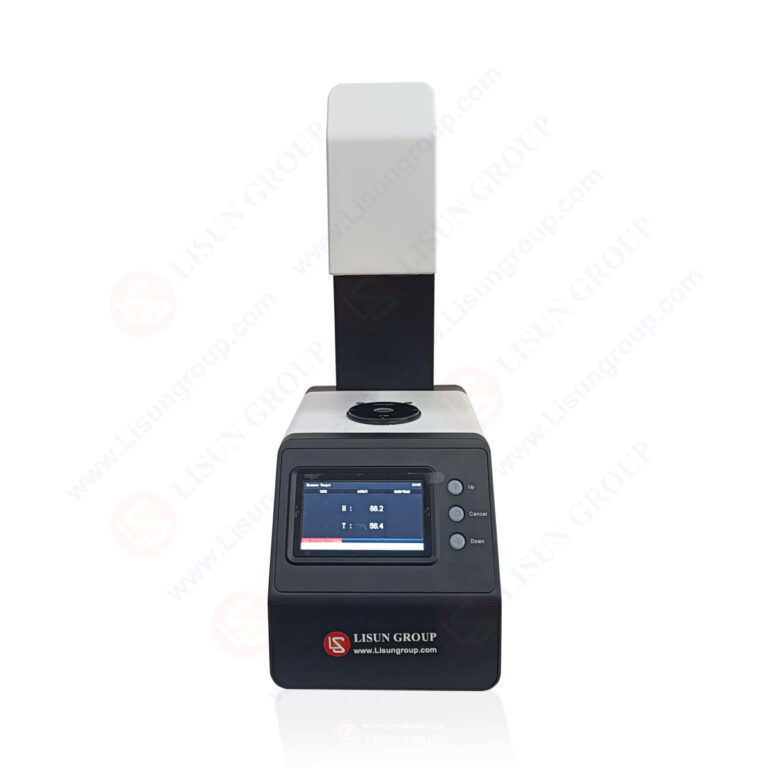
With the rapid advancement of display technologies, photovoltaic encapsulation, and high-end chemical processing industries, quantitative analysis of light scattering characteristics has become crucial for product development. As a leading brand in optical inspection, LISUN has developed the HM-120 Haze Meter/Turbidity Meter, which integrates multiple standard illuminants (CIE-A, C, D65) with precision integrating sphere architecture, providing scientific hardware support for distinguishing and accurately measuring these two parameters.
According to the ASTM D1003 standard, haze is defined as the percentage of transmitted light that deviates from the incident beam direction by more than 2.5° due to forward scattering effects, relative to the total transmitted light flux.
Its mathematical expression is:

Where Td represents diffuse transmittance (scattered light) and Tt represents total transmittance. Haze is primarily used to characterize the transparent quality of solid materials (such as plastics, glass, films, and LCD screens). Higher haze values indicate stronger light scattering by the material, resulting in visually “cloudier” appearance.
Turbidity is primarily applied in fluid dynamics to describe the degree to which suspended particles (such as sediment, organic matter, and microorganisms) in a liquid obstruct and scatter light. In academic research, turbidity is typically associated with liquid clarity, with common units including NTU (Nephelometric Turbidity Units). Although its physical essence is also scattering, measurements often focus on 90° scattered light or transmitted light attenuation.
After understanding the difference, inspection personnel must select appropriate instrumentation based on specific international standards.
ASTM standards are widely adopted in North American and Asian plastics processing industries. The standard requires instruments capable of rapidly switching between open-port conditions. The LISUN HM-120 fully supports ASTM D1003 and D1044 protocols, accurately capturing scattering data at 21 mm or 7 mm measurement apertures.
ISO standards impose stricter requirements on light source consistency and integrating sphere wall reflectivity during measurement. The HM-120 Haze Meter meets the rigorous requirements of ISO 13468 (total transmittance) and ISO 14782 (haze) through its oversized Φ 154 mm integrating sphere.

As LISUN’s flagship optical measurement device, the HM-120 not only addresses the theoretical question of the difference, but also achieves high-efficiency and precision in engineering practice.
The HM-120 employs a transmission 0/d configuration—parallel light vertical illumination with diffuse reflection reception. This architecture minimizes interference from ambient stray light, ensuring results within 1.5 seconds without warm-up time.
To demonstrate the HM-120’s performance advantages, the following table compares the technical differences between LISUN’s two core models:
| Technical Parameters | HM-100 (Basic Model) | HM-120 (High-End Universal Model) |
| Test Standards | ASTM D1003, JIS K7105, etc. | Full compatibility with ASTM + ISO dual standards |
| Standard Light Sources | CIE-A, CIE-C | CIE-A, CIE-C, CIE-D65 |
| Measurement Aperture | 21 mm | 21 mm and 7 mm optional |
| Repeatability | ≤ 0.1% | ≤ 0.05% (industry-leading precision) |
| Operating System | 5-inch TFT LCD screen | 7-inch touchscreen, Android OS |
| Data Storage | 10,000 data entries | Massive storage (built-in + USB expansion) |
| Measurement Time | ~2 seconds | 1.5 seconds (instant measurement) |
| Integrating Sphere Diameter | Φ 154 mm | Φ 154 mm |
| Spectral Range | 400 ∼ 700 nm | 400 ∼ 700 nm |
Compared to traditional models, the LISUN HM-120 incorporates the CIE-D65 standard illuminant. D65 simulates the spectral characteristics of average daylight, which is critically important for industries requiring visual clarity assessment under natural lighting conditions (such as architectural glass and automotive films).
In the display manufacturing industry, the HM-120 is used to detect haze in liquid crystal panel cover glass. Excessive haze reduces screen contrast, while controlled trace haze (such as anti-glare AG treatment) effectively minimizes ambient reflection.
In food, beverage, and packaging industries, the HM-120’s open measurement space easily accommodates transmittance and turbidity measurements of liquids in cuvettes. With no warm-up required, laboratory personnel can complete large-volume sample quality verification in minimal time.
High-precision measurement depends not only on the instrument itself but also on environmental stability.
In summary, when researchers or laboratory technicians explore the question “What is the difference between turbidity and haze?”, they should clarify that haze focuses on evaluating the light diffusion capability of transparent solid components, while turbidity emphasizes scattering effects caused by particles in fluid mediums.
The LISUN HM-120 Haze Meter/Turbidity Meter, with its superior Android interaction system, compatibility with ISO/ASTM dual standards, and repeatability precision of ≤ 0.05%, successfully breaks through the technical limitations of traditional instruments. It serves not only as an ideal tool for complex optical inspection challenges but also as powerful support for enterprises establishing international quality management systems and overcoming technical trade barriers. Whether in glass, film, plastics processing, or liquid transparency inspection, the HM-120 perfectly embodies the core essence of precision measurement through its 1.5-second ultra-fast response capability.
Tags:HM-120Your email address will not be published. Required fields are marked *

 English
 中文简体
中文简体 English
 Русский
 Español
 Português
 Türkçe
 العربية
 Deutsch
 Polski
 Italiano
 Français
 한국어
한국어 ไทย
ไทย Tiếng Việt
 日本語
日本語