LM-79 Moving Detector Goniophotometer (Mirror Type C)
LSG-6000
High Precision Rotation Luminaire Goniophotometer
LSG-1890B
High Precision Rotation Luminaire Goniospectroradiometer
LSG-1890BCCD

Goniophotometer for Automotive and Signal Lamps
LSG-1950
Goniophotometer for Traffic Signal Lamps (Economical Model)
LSG-1950S
Goniophotometer for Airfield Lighting
LSG-1940
VAD Fire Alarm Visual Alert Device Goniophotometer
LSG-1930
Compact Goniophotometer
LSG-1200A
LED Goniophotometer
LSG-1100
Near Field Moving Detector Goniophotometer
LSG-1900B
 LEDs and Luminaire Test Solutions
 LM-79 and LM-80 Test Solutions
 LED Driver Test Solutions
 Household Appliances Test Solutions
 Mobile and Network Test Solutions
 Automotive Electronics Test Solutions
 Audio-Video and IT Test Solutions
 Cable and Wire Test Solutions
 Plugs and Sockets Test Solutions
 Power Switch Test Solutions
 Transformer Test Solutions
 Electric Toys Test Solutions
 Energy Meter Test Solutions
 Motor-Operated Tool Test Solutions
Select an organization
to browse standards
Abstract
What is the burning test? The burning test, or flame retardance performance test, is the core collective term for a series of standardized experimental methods that scientifically evaluate a material’s reaction characteristics, fire hazard, and safety level under simulated, specific ignition source conditions. For industries such as automotive, rail transportation, aerospace, and construction, the burning test of materials is the cornerstone for ensuring life and property safety and meeting mandatory regulatory compliance. This article systematically explains the fundamental principles of burning tests, their core evaluation metrics (e.g., burning rate, flame spread, self-extinguishing properties), and their application logic within mainstream international safety standards (e.g., FMVSS 302, ISO 3795, GB 8410). Focusing on automotive interior materials, the article provides an in-depth analysis of their unique burning test requirements and introduces how reliable, repeatable compliance verification can be achieved through high-precision, automated specialized burning testers (such as the LISUN ZRS-4H), offering a crucial technical perspective for material R&D, quality control, and safety certification.
Introduction
Burning testis not merely a routine inspection in the laboratory but a rigorous discipline bridging materials science, fire safety, and product engineering. For many industrial products, especially within vehicles closely tied to public safety, the behavior of interior materials when exposed to potential ignition sources (e.g., electrical short circuits, passenger-left embers) directly determines the likelihood and speed of fire spread. The burning test is precisely the standardized experimental method that quantifies key safety attributes such as whether a material is “easily ignitable,” “how quickly flames spread after ignition,” and “whether it self-extinguishes after the ignition source is removed.” This article aims to provide an in-depth interpretation of the scientific essence of the burning test, particularly the mandatory assessment system for automotive interior materials, and to clarify how modern testing instruments translate abstract safety standards into precise, reliable data, thereby offering solid technical support for building a safer transportation environment.
1. Fundamental Principles and Core Evaluation Dimensions of the Burning Test
The essence of a burning test lies in reproducing and evaluating material behavior during the initial stages of a real fire within a controlled laboratory setting. Its scientific basis is the precise control of the three elements of combustion (fuel, oxidizer, ignition source) and the observation/recording of the material’s response. A complete burning test typically focuses on the following core dimensions:
• Ease of Ignition: Characterizes the time or minimum ignition energy required for a material to be ignited under a standard flame.
• Flame Spread Rate: This is one of the most critical quantitative metrics in a burning test, referring to the distance the flame front travels along the material surface per unit of time (common unit: mm/min). It directly reflects the speed of fire development in its early stages.
• Self-Extinguishing Property: The duration for which a material continues to burn after the ignition source is removed. A short self-extinguishing time is a key indicator of high flame retardance.
• Melt Dripping Behavior: Some materials (e.g., thermoplastics) produce molten drips when burning. The test must assess whether the drips carry flames and could ignite other materials below (e.g., carpet beneath a car seat).
Through the systematic measurement of these dimensions, materials can be assigned clear flame-retardant ratings, providing direct input for product design, regulatory compliance, and risk assessment.
2. Specificity and Standardization System for Automotive Interior Material Burning Tests
The interior of a vehicle is a special space: relatively enclosed, densely occupied, and difficult to escape from. Consequently, the burning performance of its interior materials is subject to the most stringent global regulations. The burning test for automotive interiors is characterized by a high degree of standardization and mandatory enforcement, primarily employing a “specific flame application – observation of spread” mode on a horizontal or slightly angled specimen.
Core Logic: Simulates a small ignition source potentially caused by a cigarette or electrical spark, applied to one end of the material, observing whether and how quickly the flame spreads within a limited time (typically 15 seconds). The fundamental goal is to control fire development, buying precious escape time for occupants.
Major Standards:
• FMVSS 302 (U.S. Federal Motor Vehicle Safety Standard No. 302): The most globally influential standard for automotive interior flammability, requiring that horizontally placed materials have a burning rate not exceeding 102 mm/min.
• ISO 3795 / GB 8410: The international standard and its corresponding Chinese national standard, largely harmonized technically with FMVSS 302. They typically require a burning rate ≤100 mm/min, with the specimen tested at a 30° angle to the horizontal (some versions also specify horizontal).
• Other Regional Standards: Such as relevant ECE regulations in Europe, Germany’s DIN 75200, Britain’s BS 6853 (covering rail transport), etc. While the testing principles are similar, there may be differences in specimen dimensions, flame application time, and pass/fail criteria details.
3. Key Instrument Requirements for Performing Compliant Burning Tests
To obtain legally valid and comparable test data, the equipment used for burning tests must meet extremely high technical requirements to ensure extreme consistency in test conditions and repeatability of results.
• Precise and Stable Flame: The ignition source must be a standardized premixed gas burner (typically propane). The flame height (e.g., 20±2mm) and temperature (e.g., ≥820℃ at a specified distance from the tip) must be maintainable and calibratable via flow meters and gauges.
• Accurate and Controllable Specimen Orientation: For standards requiring a 30° test angle, the specimen fixture must allow precise adjustment and locking. Any deviation can significantly affect flame spread behavior.
• Isolated and Controlled Environment: Testing must be conducted within a sealed combustion chamber to completely isolate external air disturbances, and the chamber must be equipped with an effective fume extraction system.
• Process Automation and Objectivity: Automatic ignition, timing, and flame cut-off minimize human operational error. Clear observation windows and scientifically designed residue collection facilitate objective recording of the entire burning process and subsequent analysis.
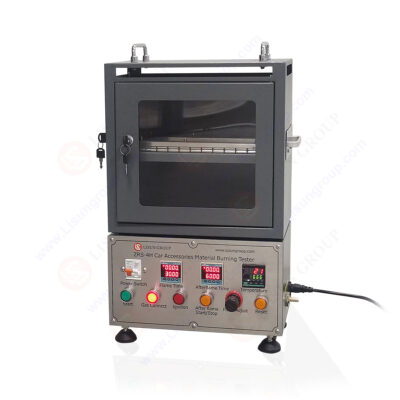
4. Integrated Solution: The LISUN ZRS-4H Car Interior Material Burning Tester as an Example
To meet these stringent requirements, modern burning testers are evolving toward high integration, automation, and intelligence. The LISUN ZRS-4H Car Interior Material Burning Tester is a typical solution designed specifically to address the challenges of burning tests for automotive interior materials.
This device integrates a standard combustion chamber, a precision gas control module, a high-accuracy timing system, and dedicated specimen fixtures. Its core design revolves entirely around “precision, repeatability, compliance”: maintaining a constant standard flame height of 20±2mm through imported flow valves and visual gauges; allowing the specimen stage to be precisely adjusted and locked at the standard 30° angle; effectively isolating environmental interference with a fully enclosed chamber and windbreak structure; and enabling the operator to complete burning rate determination, self-extinguishing time recording, and melt-drip ignition assessment in one go via an automated “ignition – 15-second (adjustable) burning – cut-off” process, combined with a built-in scale and a bottom absorbent cotton placement device.
| Key Parameter Item | Instrument Configuration & Performance | Corresponding Standard Test Requirement & Value |
|---|---|---|
| Specimen Size & Fixing | Fixtures accommodate standard 356mm×100mm specimens, thickness ≤13mm; angle precisely adjustable, default lock at 30°. | Strictly complies with the core stipulations of GB 8410, ISO 3795, FMVSS 302, etc., regarding specimen size and test angle, ensuring correct test premises. |
| Ignition Source System | Propane burner, nozzle diameter 9.5±0.5mm; flame height 20±2mm, calibratable; flame temperature (at 20mm) ≥820℃. | Provides a standard, stable heat source, meeting the strict definition of flame physical characteristics in standards, forming the basis for result comparability. |
| Time Control | Digital timer, burning time adjustable from 0~999.9s, supports automatic ignition and cut-off control. | Enables the precise 15-second (or other set time) flame application required by standards like FMVSS 302. Automation reduces human error. |
| Combustion Chamber Environment | 1000*500*800mm sealed chamber, built-in windbreak structure, equipped with high-temperature-resistant observation window (≥300*400mm) and fume outlet. | Provides a controlled, undisturbed test environment, ensuring airflow does not affect flame spread path. Observation window facilitates real-time monitoring and recording. |
| Result Determination Aid | Chamber equipped with millimeter scale; preset absorbent cotton placement position 300mm below specimen. | Directly measures flame spread distance to calculate burning rate; standardized cotton position allows scientific determination of igniting melt drip occurrence. |
| Applicable Standards | Design comprehensively covers GB 8410, FMVSS 302, ISO 3795, ASTM D5132, DIN 75200, etc. | A single instrument supports compliance testing for major global automotive markets, facilitating international certification. |
Conclusion
Returning to the fundamental question: What is the burning test? It is far more than simply “lighting something on fire.” It is a rigorous methodology that quantifies the fire risk of materials into comparable data through precise control and scientific observation. Especially in the automotive industry, the mandatory burning test for interior materials is an indispensable technical gatekeeper for preventing vehicle fires and protecting occupant safety. Understanding the safety logic behind testing standards and employing burning test instruments like the LISUN ZRS-4H, which can accurately replicate standard conditions and provide reliable data, is a necessary step for material suppliers, component manufacturers, and vehicle OEMs to meet compliance requirements and, more importantly, to fulfill their product safety responsibility. In the foreseeable future, as new energy vehicles demand more complex fire resistance from materials around battery packs and new lightweight materials emerge, the methods and equipment for burning tests will continue to evolve. However, their core objective will remain constant: to curb risks before they ignite, through scientific assessment.
Your email address will not be published. Required fields are marked *

 English
 中文简体
中文简体 English
 Русский
 Español
 Português
 Türkçe
 العربية
 Deutsch
 Polski
 Italiano
 Français
 한국어
한국어 ไทย
ไทย Tiếng Việt
 日本語
日本語