LM-79 Moving Detector Goniophotometer (Mirror Type C)
LSG-6000
High Precision Rotation Luminaire Goniophotometer
LSG-1890B
High Precision Rotation Luminaire Goniospectroradiometer
LSG-1890BCCD

Goniophotometer for Automotive and Signal Lamps
LSG-1950
Goniophotometer for Traffic Signal Lamps
LSG-1950S
VAD Fire Alarm Visual Alert Device Goniophotometer
LSG-1930
Compact Goniophotometer
LSG-1200A
LED Goniophotometer
LSG-1100
 LEDs and Luminaire Test Solutions
 LM-79 and LM-80 Test Solutions
 LED Driver Test Solutions
 Household Appliances Test Solutions
 Mobile and Network Test Solutions
 Automotive Electronics Test Solutions
 Audio-Video and IT Test Solutions
 Cable and Wire Test Solutions
 Plugs and Sockets Test Solutions
 Power Switch Test Solutions
 Transformer Test Solutions
 Electric Toys Test Solutions
 Energy Meter Test Solutions
 Motor-Operated Tool Test Solutions
Select an organization
to browse standards
Abstract
In the modern display technology and lighting industries, spectrum testers, also known as spectroradiometers, have become indispensable tools for measuring color, luminance, and spectral power distribution. Their performance is critical for quality control, research and development, and standards compliance. This article delves into the technical principles of fast CCD array-based spectrum testers, systematically analyzes their key performance parameters, and details the exceptional capabilities of instruments like the LISUN LMS-6000 series Portable CCD Spectroradiometer in practical applications. Through comparative data and scenario-based analysis, this guide provides an effective framework for selecting and applying spectrum testers for display manufacturers, lighting engineers, researchers, and quality control teams.
1. Introduction: Why Accurate Spectral Measurement is Foundational
From the OLED screen of your smartphone to high-end LCD monitors, and from museum conservation lighting to automotive interior ambient lights, color accuracy and light quality stability are now key determinants of product value and user experience. The light perceived by the human eye is essentially a combination of electromagnetic radiation at different wavelengths. While traditional photometers measure only total luminous flux or luminance, a spectrum tester decomposes and measures the intensity of light emitted by a source or display at each individual wavelength, obtaining a complete “optical fingerprint.”
This capability makes spectrum testers essential tools in the following fields:
• Display Industry: Precisely measuring screen gamut coverage, white point color temperature, color uniformity, and spectral power distribution to ensure compliance with stringent standards like sRGB, DCI-P3, and Rec.2020.
• Lighting Industry: Evaluating LED light sources for Color Rendering Index (CRI), color tolerance, blue light hazard factors, and spectral stability to achieve healthy and smart lighting solutions.
• Research & Testing: Used for analyzing the transmission/reflection characteristics of optical materials, measuring laser power spectra, and assessing the Photosynthetic Photon Flux Density (PPFD) of plant growth lights.
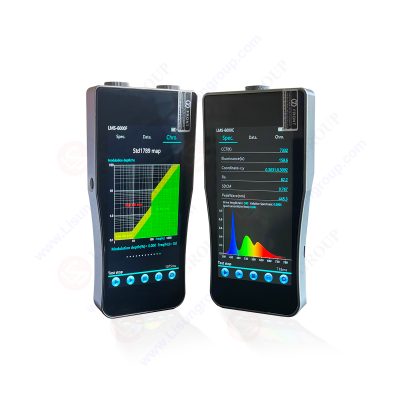
LMS-6000 Portable CCD Spectroradiometer
2. Core Technology of Spectrum Testers: From Dispersion to Detection
A spectrum tester consists primarily of an optical input, a dispersion system, a detector array, and a signal processing unit. Its working principle can be summarized in these steps:
• Light Collection: The light to be measured enters the instrument’s entrance slit via an optical fiber or lens.
• Spectral Dispersion: The light enters a monochromator, where a diffraction grating (the core dispersive element) spatially spreads the composite light according to wavelength, forming a continuous spectrum.
• Array Detection: The dispersed spectrum is projected onto a high-sensitivity detector array. Modern portable instruments primarily use CCD (Charge-Coupled Device) or CMOS sensor arrays. Each pixel corresponds to a specific narrow wavelength band, allowing for the simultaneous capture of light intensity signals across the entire spectral range.
• Digitization & Processing: The electrical signal from the detector is amplified, converted from analog to digital, and processed by an internal processor to generate a spectral power distribution graph. From this, hundreds of photometric and colorimetric parameters—such as luminance, chromaticity coordinates, correlated color temperature (CCT), and CRI—are derived.
The primary advantage of a spectrum tester utilizing CCD array technology (like the LMS-6000) is speed. It can complete a full spectral measurement in milliseconds without mechanical scanning, making it particularly suited for dynamic image measurement, fast production line inspection, and flicker analysis.

3. Analyzing the Tool: Key Features of a High-Performance Portable CCD Spectroradiometer
Using the LISUN LMS-6000 Portable CCD Spectroradiometer as a benchmark, we can identify the core characteristics a professional-grade spectrum tester should possess.
3.1 High Accuracy and Wide Dynamic Range
The instrument’s accuracy is built upon its CCD detector and optical platform. The LMS-6000 employs a high-performance back-illuminated CCD, known for high sensitivity and low noise, paired with a high-quality holographic grating. This combination ensures measurement accuracy across the entire wavelength range (typically covering 380-780nm visible light, or wider). A wide dynamic range allows it to accurately measure both very high and very low luminance sources simultaneously, avoiding errors and delays associated with range switching.
3.2 Superior Measurement Speed and Portability
Thanks to the full-spectrum simultaneous capture capability of the CCD, the LMS-6000 can achieve measurement times as short as milliseconds, supporting high-speed continuous measurement modes. This is crucial for analyzing transient optical phenomena like PWM dimming flicker and display dynamic response. Its portable design integrates the spectrometer, processor, display, and battery into a single unit, enabling on-site measurements with immediate results without a computer, significantly boosting workflow efficiency.
3.3 Powerful Software and Functionality
While hardware is the foundation, software is the soul. Professional spectrum testers are equipped with robust analysis software that should:
• Measure Multiple Parameters Instantly: Simultaneously display the spectral graph and all key photometric/colorimetric data.
• Perform Comparative Analysis: Easily compare measurement data against target standards.
• Conduct Spatial & Temporal Analysis: Support advanced functions like color uniformity mapping and time-dependent measurements.
• Offer Comprehensive Accessories: Include various measurement lenses, cosine correctors, optical fibers, and fixtures to adapt to different measurement targets like displays, point sources, and surface sources.
4. Core Performance Data Comparison: What Defines Professional Grade?
To quantitatively assess performance, the table below compares the core capabilities of a professional portable CCD spectrum tester with those of a basic scanning spectroradiometer.
| Feature | Professional Portable CCD Spectrum Tester (e.g., LMS-6000) | Basic/Legacy Scanning Spectroradiometer |
|---|---|---|
| Measurement Principle | Fixed Grating + CCD Array, Full-Spectrum Simultaneous Capture | Rotating Grating + Single-Point Detector, Sequential Scanning |
| Measurement Speed | Extremely Fast (milliseconds per measurement) | Slow (seconds to tens of seconds per measurement) |
| Dynamic Range | High (Typically > 3.0 OD) | Moderate |
| Vibration Resistance | Excellent (No moving parts) | Poor (Mechanical scanning is prone to interference) |
| Portability & Ease of Use | Superior (All-in-one, touchscreen operation, instant results on-site) | Poor (Usually requires a computer, inconvenient for field use) |
| Typical Application | Fast production line inspection, dynamic image measurement, field acceptance, R&D debugging | Laboratory analysis of steady-state light sources |
5. Practical Application Scenarios
The value of a spectrum tester like the LMS-6000 is fully realized across diverse scenarios:
• Display Device Production Lines: After display module assembly, use the spectrum tester with an automated robotic arm for rapid spot-checking. This ensures every screen’s color temperature, luminance, and gamut coordinates are within standard tolerance, enabling 100% product quality control.
• Lighting Project Acceptance: At construction sites for office lighting, hotels, or museums, engineers can use the handheld device to directly measure the actual photometric and colorimetric parameters of installed luminaires, verifying compliance with design specifications and ensuring the intended lighting effect is achieved.
• Healthy Lighting Research: Research institutions use its precise spectral measurements to calculate non-visual biological effect indicators, such as melanopic irradiance and blue light hazard weighted irradiance, providing data to support the development of healthier lighting products.
• Content Creation & Post-Production: Film and production studios use it to calibrate professional monitors, ensuring end-to-end color consistency from shooting and post-production to final output—achieving true “what-you-see-is-what-you-get” (WYSIWYG) workflow.
6. How to Choose the Right Spectrum Tester for Your Needs
When evaluating options in the market, consider the following dimensions:
• Core Specifications: Prioritize wavelength range, wavelength accuracy, spectral bandwidth, dynamic range, and measurement speed. For display measurement, high accuracy and fast speed are critical.
• Application Fit: Clearly define your primary measurement targets (e.g., self-emissive displays, projected/reflected light) and select the corresponding accessories (e.g., luminance measurement lenses, cosine receivers).
• Operational Efficiency: Consider whether an all-in-one portable design with a touchscreen and offline operation capability is needed to address both lab and field requirements.
• Software & Expandability: Evaluate if the analysis software is comprehensive and user-friendly, and whether the instrument supports secondary development or integration into automated systems.
• Compliance & Traceability: Verify if the instrument’s calibration is traceable to national/international standards, which is essential for trade and certification purposes.
7. Conclusion
In the field of optical measurement, data is the sole language of decision-making. A high-performance spectrum tester acts as the engineer’s “optical eye,” translating subjective perceptions of light and color into precise, objective, and reproducible data. Modern portable spectroradiometers centered on CCD technology, such as the LISUN LMS-6000 series, are driving the display and lighting industries toward higher quality and smarter development. By fusing speed, accuracy, and convenience, they bring laboratory-grade precision to production floors and integration sites, becoming an indispensable piece of infrastructure.
Investing in a professional spectrum tester is more than purchasing an instrument; it is building a reliable technical defense for product quality and installing a powerful data engine for research and innovation.
Tags:LMS-6000Your email address will not be published. Required fields are marked *

 English
 中文简体
中文简体 English
 Русский
 Español
 Português
 Türkçe
 العربية
 Deutsch
 Polski
 Italiano
 Français
 한국어
한국어 ไทย
ไทย Tiếng Việt
 日本語
日本語