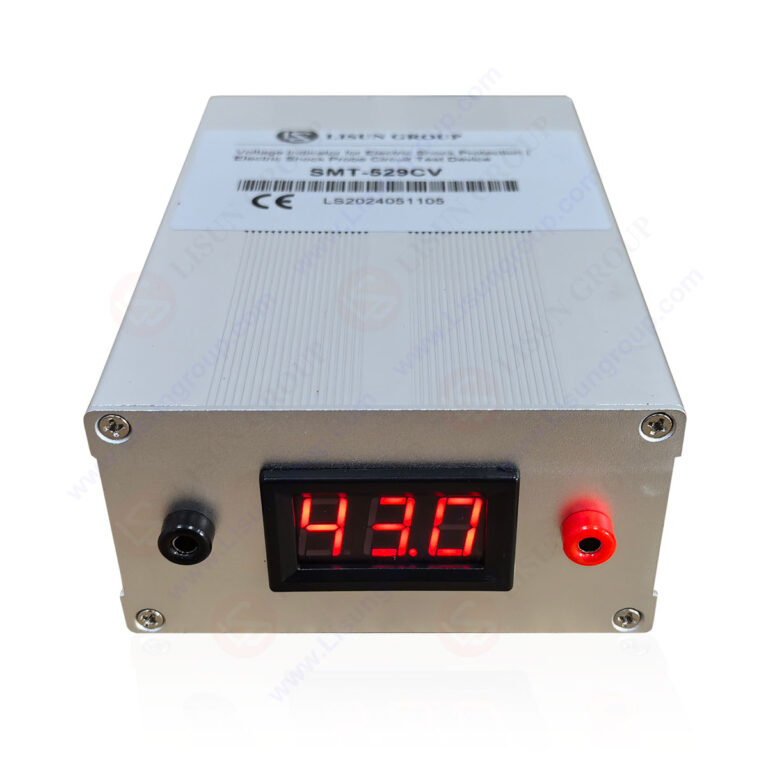
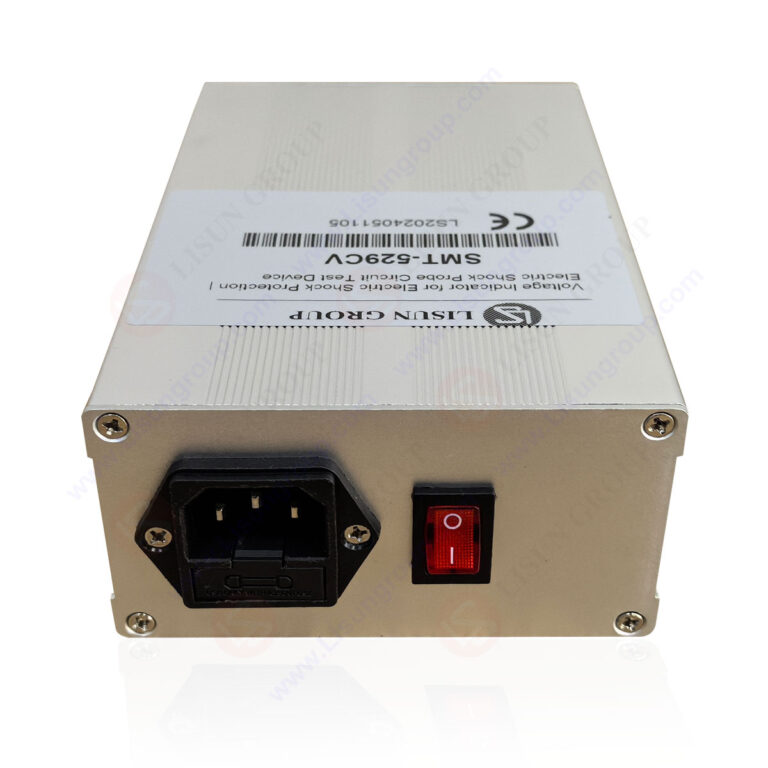
Product No: SMT-529CV
The Voltage Indicator for Electric Shock Protection (Circuit Test Device) is a critical tool for validating electric shock safety in electrical equipment—from household appliances to industrial gear. It provides a controlled 40–45V power source (max 48V) to simulate human finger, tool, or metal wire contact during IP protection and hazardous part testing. Compatible with most test probes, it features a simple design for easy operation, accurate voltage output, and reliable performance (backed by a 2A fuse for safety). Ideal for manufacturers and labs, it ensures equipment meets global shock protection standards, preventing accidental electric injury.
Specifications:
Tool Type: Voltage Indicator for Electric Shock Protection (circuit test device; for IP protection and hazardous part shock testing)
Standards: IEC 61032:2017; IEC 60335-1:2023
Input Voltage: AC 180–250V (wide range to adapt to global power supplies)
Maximum Electrode Output Voltage: 48V (standard working range: 40–45V, simulates low-risk contact for shock testing)
Fuse Rating: 2A (overcurrent protection to prevent device damage and ensure operator safety)
Compatibility: Works with most test probes (e.g., IEC 61032 Test Probe B, UL 60335-1 articulated probes)
Core Application: Provides power for simulating finger/tool/metal wire contact in electric shock protection and IP testing
Operational Features: Simple plug-and-play design; accurate voltage stability (±2% tolerance); durable, heat-resistant casing
Test Procedures:
1. Power on the equipment under test (EUT) and the voltage indicator.
2. Connect one end of the indicator to the EUT’s plug; attach the ground wire per applicable standards.
3. Link the indicator’s other end to the test probe (e.g., articulated finger probe).
4. Apply the standard-specified thrust with the probe to EUT gaps (vents, control slots).
5. Check the indicator for voltage signals (indicating contact with hazardous live parts).
6. Record results: Pass if no signal; Fail if hazardous contact is detected.
Applications:
1. Electric shock protection testing for household refrigerators (per IEC 60335-1:2023) to verify live part isolation.
2. Powering test probes for IP protection checks on industrial control boxes (per IEC 60529:2013) to simulate contact hazards.
3. Validating shock safety in laptop chargers (per IEC 60950-1:2023) by simulating metal wire contact with internal circuits.
4. Quality control for electric ovens during manufacturing, using 40–45V output to test hot/live part accessibility.
5. Lab testing of portable fans (per UL 60335-1:2023) to ensure compliance with global electric shock protection rules.

 中文简体
中文简体 English
 Русский
 Español
 Português
 Türkçe
 العربية
 Deutsch
 Polski
 Italiano
 Français
 한국어
한국어 ไทย
ไทย Tiếng Việt
 日本語
日本語