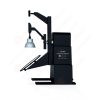
LM-79 Moving Detector Goniophotometer (Mirror Type C)
LSG-6000
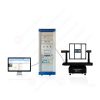
High Precision Rotation Luminaire Goniophotometer
LSG-1890B
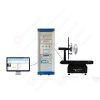
High Precision Rotation Luminaire Goniospectroradiometer
LSG-1890BCCD

Goniophotometer for Automotive and Signal Lamps
LSG-1950
Goniophotometer for Traffic Signal Lamps (Economical Model)
LSG-1950S
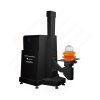
Goniophotometer for Airfield Lighting
LSG-1940
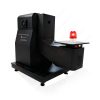
VAD Fire Alarm Visual Alert Device Goniophotometer
LSG-1930
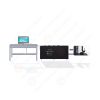
Compact Goniophotometer
LSG-1200A
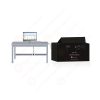
LED Goniophotometer
LSG-1100
Near Field Moving Detector Goniophotometer
LSG-1900B
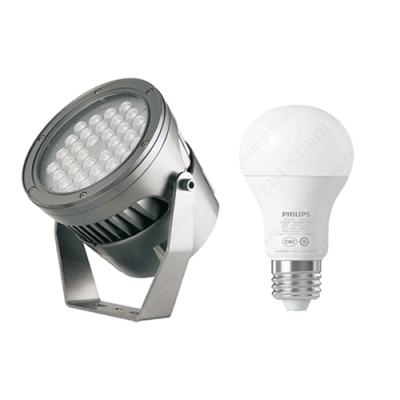 LEDs and Luminaire Test Solutions
 LM-79 and LM-80 Test Solutions
 LED Driver Test Solutions
 Household Appliances Test Solutions
 Mobile and Network Test Solutions
 Automotive Electronics Test Solutions
 Audio-Video and IT Test Solutions
 Cable and Wire Test Solutions
 Plugs and Sockets Test Solutions
 Power Switch Test Solutions
 Transformer Test Solutions
 Electric Toys Test Solutions
 Energy Meter Test Solutions
 Motor-Operated Tool Test Solutions
Select an organization
to browse standards
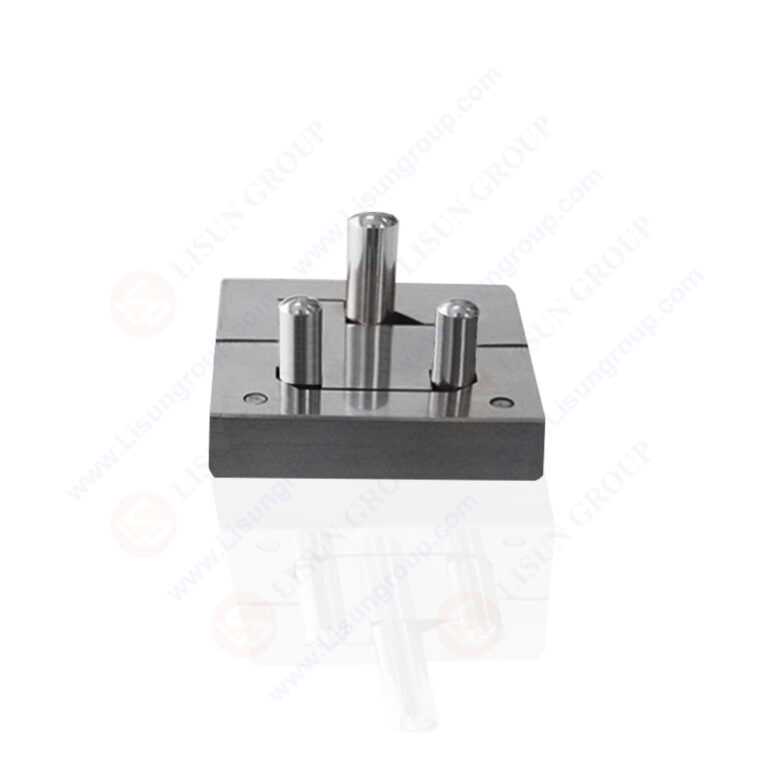

Product No: GNGPL-5405
Minimum Go Gauge for Socket-Outlet of BS 546 Figure 5 is a specialized testing tool engineered to validate the structural and dimensional compliance of socket-outlets with BS 546 standards, as detailed in Figure 5 of BS 546 (“Two-pole and earthing-pin plugs, socket-outlets and adaptors. Specification”). It adheres strictly to the standard’s requirements for dimensions, tolerances, material properties, hardness, and surface roughness, featuring a precision design tailored to verify the minimum acceptable size and fit of socket-outlets. With a material hardness exceeding 50HRC and a low thermal expansion coefficient, the gauge ensures exceptional dimensional stability and reliable performance, providing accurate confirmation that socket-outlets meet the critical “go” criteria for compatibility and safety.
Specifications
• Compliance standard: BS 546 (“Two-pole and earthing-pin plugs, socket-outlets and adaptors. Specification”) Figure 5
• Gauge type: Minimum Go gauge (for socket-outlet dimensional and structural verification)
• Material hardness: Over 50HRC
• Material thermal expansion coefficient: Low
• Key attributes (dimensions, tolerances, material, surface roughness): Fully compliant with BS 546 standard requirements
• Dimensional stability: Stable and reliable due to low thermal expansion coefficient
• Design: Precision-engineered to match the minimum acceptable size parameters for socket-outlets as specified in the standard
Test Procedures
• Prepare the socket-outlet sample for testing, ensuring it is free from damage, debris, deformation, or wear that could impact test accuracy.
• Inspect the minimum Go gauge to confirm its surface is clean, free from scratches or misalignment, and all specifications meet BS 546 Figure 5 requirements.
• Align the gauge with the socket-outlet’s contact slots and structural features, ensuring proper positioning in accordance with the standard’s guidelines.
• Attempt to insert the gauge into the socket-outlet smoothly, verifying that the gauge can fully engage without excessive force (core “go” gauge testing principle).
• Check for proper seating of the gauge within the socket-outlet, confirming that the socket’s internal dimensions meet the minimum acceptable standards.
• Ensure there is no binding, resistance, or incomplete insertion that would indicate dimensional non-compliance.
• Record the test results comprehensively, indicating whether the socket-outlet successfully meets the “go” criteria and complies with BS 546 standards.
Applications
• Dimensional and structural compliance testing of socket-outlets to verify adherence to BS 546 Figure 5 requirements.
• Quality control processes in the electronics industry for socket-outlet components.
• Compliance verification in the electrical appliance industry to ensure the safety and compatibility of socket-outlets with BS 546-compliant plugs and adaptors.
• R&D and production quality assurance for manufacturers of two-pole and earthing-pin socket-outlets.
• Conformity assessment for electrical component manufacturers requiring adherence to BS 546 standards.
• Routine inspection of socket-outlets in commercial, industrial, or residential applications relying on BS 546-compliant electrical systems.
• Pre-market and pre-shipment quality checks to ensure socket-outlets meet regulatory and market access requirements for BS 546 compliance.
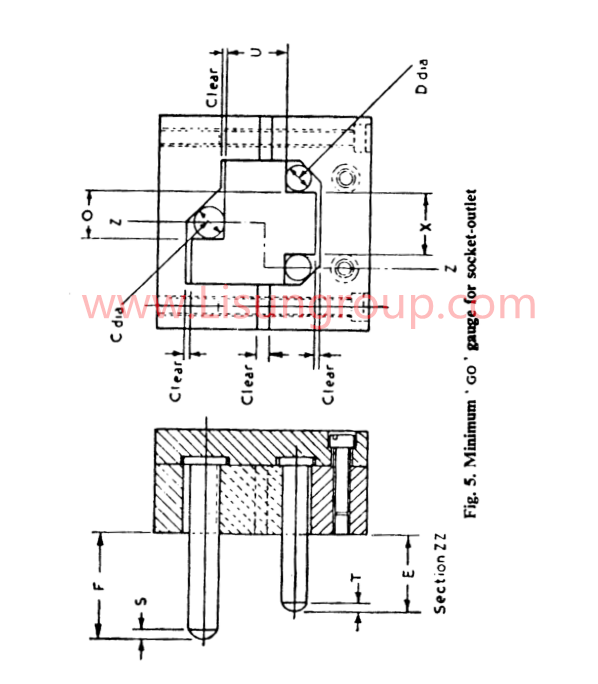
Minimum GO Gauge for Socket-Outlet of BS 546 Figure 5
SECTION NINE. GAUGES 40a. The gauges illustrated in figures 2, 3, 4 and 5 in BS546 shall be...

 English
 中文简体
中文简体 English
 Русский
 Español
 Português
 Türkçe
 العربية
 Deutsch
 Polski
 Italiano
 Français
 한국어
한국어 ไทย
ไทย Tiếng Việt
 日本語
日本語