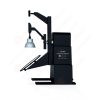
LM-79 Moving Detector Goniophotometer (Mirror Type C)
LSG-6000
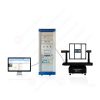
High Precision Rotation Luminaire Goniophotometer
LSG-1890B
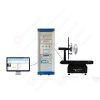
High Precision Rotation Luminaire Goniospectroradiometer
LSG-1890BCCD

Goniophotometer for Automotive and Signal Lamps
LSG-1950
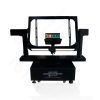
Goniophotometer for Traffic Signal Lamps (Economical Model)
LSG-1950S
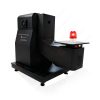
VAD Fire Alarm Visual Alert Device Goniophotometer
LSG-1930
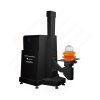
Goniophotometer for Airfield Lighting
LSG-1940
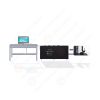
Compact Goniophotometer
LSG-1200A
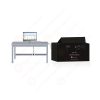
LED Goniophotometer
LSG-1100
Near Field Moving Detector Goniophotometer
LSG-1900B
 LEDs and Luminaire Test Solutions
 LM-79 and LM-80 Test Solutions
 LED Driver Test Solutions
 Household Appliances Test Solutions
 Mobile and Network Test Solutions
 Automotive Electronics Test Solutions
 Audio-Video and IT Test Solutions
 Cable and Wire Test Solutions
 Plugs and Sockets Test Solutions
 Power Switch Test Solutions
 Transformer Test Solutions
 Electric Toys Test Solutions
 Energy Meter Test Solutions
 Motor-Operated Tool Test Solutions
Select an organization
to browse standards

Product No: GNGPL-57C27
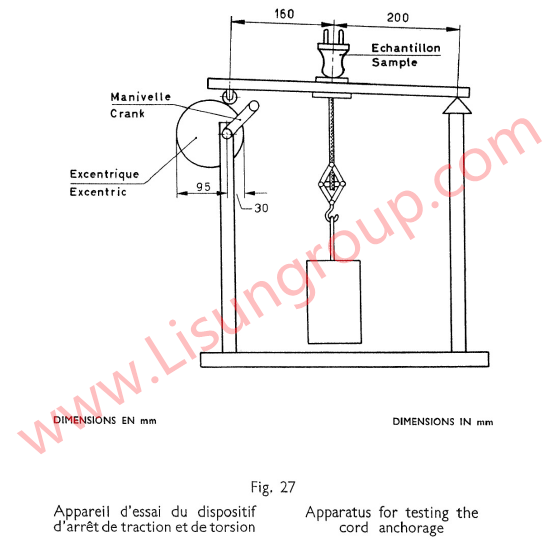
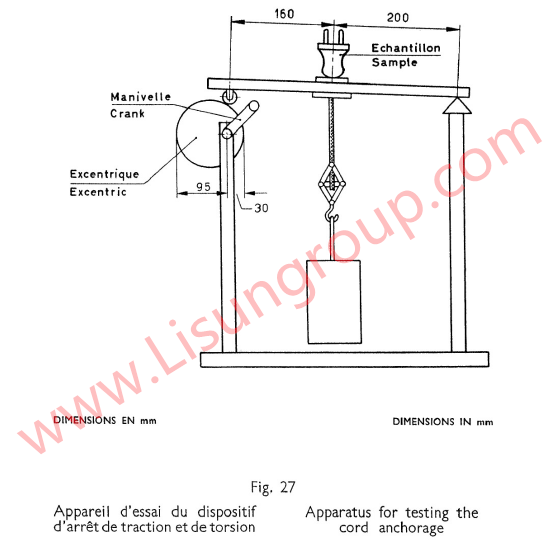
This CEE 7 Fig. 27 Gauges C27 Apparatus for Testing the Cord Anchorage is precision-engineered in strict compliance with the specifications outlined in IECEE CEE-7 Figure 27, a key standard for domestic and similar-purpose plugs and socket-outlets. It is specifically designed to evaluate the reliability of cord anchorage in electrical products, verifying the component’s ability to resist traction and torsion forces. By simulating real-world stress on the cord anchorage, this apparatus ensures that plugs and socket-outlets maintain secure cord retention—preventing loose connections, wire damage, or electric shock hazards—thus meeting the rigorous safety and performance requirements of CEE 7.
Specifications:
• Fully conforms to IECEE CEE-7 standard requirements, aligning with Figure 27 specifications for cord anchorage testing
• Engineered to test both traction and torsion resistance of cord anchorage systems
• Key dimensional specifications (in millimeters): 30mm, 95mm, 160mm, 200mm (as per standard diagram)
• Features a crank (Manivelle) and eccentric (Excentrique) mechanism for controlled force application
• Designed to accommodate standard plugs and socket-outlets for domestic and similar applications
• Manufactured from high-strength, durable materials to withstand repeated testing and maintain structural stability
• Precision-calibrated to ensure consistent force delivery and accurate test results
• Compatible with standard cord types used in CEE 7-compliant electrical products
Test Procedures:
• Inspect the test apparatus for any damage, wear, or mechanical malfunctions, and confirm its dimensions and mechanisms comply with CEE 7 Figure 27 specifications.
• Prepare the test sample (plug or socket-outlet with integrated cord anchorage) and ensure the cord is properly installed and secured per the product’s design.
• Mount the sample securely on the apparatus’s designated fixture, aligning the cord anchorage with the apparatus’s force application points.
• Secure the free end of the cord to the apparatus, ensuring it is taut but not pre-loaded with excessive tension.
• Traction test: Use the crank to apply a controlled axial traction force to the cord, following the force and duration requirements specified in CEE 7.
• Torsion test: Operate the eccentric mechanism to apply a controlled torsional force to the cord, simulating twisting stress as outlined in the standard.
• Observe the cord anchorage during and after both tests, checking for signs of slippage, damage, or reduced retention (e.g., cord movement, loosening of anchorage components).
• Verify if the sample maintains secure cord anchorage without failure, meeting the pass criteria defined in CEE 7.
• Record test results, documenting force values, duration, and any observations of anchorage performance, and classify the sample as compliant or non-compliant.
Applications:
• Quality control testing of plugs and socket-outlets in manufacturing facilities to verify cord anchorage reliability per CEE 7 standards.
• Compliance assessment by certification bodies and third-party testing laboratories for IECEE CEE-7 certification of electrical products.
• R&D testing for the design optimization of cord anchorage systems in plugs and socket-outlets, enhancing resistance to traction and torsion.
• Routine inspection of production lines producing domestic and similar electrical products requiring CEE 7 compliance.
• Performance verification of cord anchorage components supplied by third-party vendors to meet CEE 7 specifications.
• Post-production quality audits to confirm the safety and durability of electrical products before market release in regions requiring CEE 7 compliance.
• Safety validation for electrical equipment manufacturers integrating CEE 7-compliant plugs and socket-outlets with cord anchorage systems.
CEE 7 Fig. 27 Gauges C27 Apparatus for Testing the Cord Anchorage

 English
 中文简体
中文简体 English
 Русский
 Español
 Português
 Türkçe
 العربية
 Deutsch
 Polski
 Italiano
 Français
 한국어
한국어 ไทย
ไทย Tiếng Việt
 日本語
日本語