LM-79 Moving Detector Goniophotometer (Mirror Type C)
LSG-6000
High Precision Rotation Luminaire Goniophotometer
LSG-1890B
High Precision Rotation Luminaire Goniospectroradiometer
LSG-1890BCCD

Goniophotometer for Automotive and Signal Lamps
LSG-1950
Goniophotometer for Traffic Signal Lamps (Economical Model)
LSG-1950S
Goniophotometer for Airfield Lighting
LSG-1940
VAD Fire Alarm Visual Alert Device Goniophotometer
LSG-1930
Compact Goniophotometer
LSG-1200A
LED Goniophotometer
LSG-1100
Near Field Moving Detector Goniophotometer
LSG-1900B
 LEDs and Luminaire Test Solutions
 LM-79 and LM-80 Test Solutions
 LED Driver Test Solutions
 Household Appliances Test Solutions
 Mobile and Network Test Solutions
 Automotive Electronics Test Solutions
 Audio-Video and IT Test Solutions
 Cable and Wire Test Solutions
 Plugs and Sockets Test Solutions
 Power Switch Test Solutions
 Transformer Test Solutions
 Electric Toys Test Solutions
 Energy Meter Test Solutions
 Motor-Operated Tool Test Solutions
Select an organization
to browse standards
Abstract
As the core testing equipment for simulating artificial salt spray corrosion environments, salt spray cabinet is a key tool for evaluating the corrosion resistance of metallic materials, coatings and protective layers of industrial products, which is widely used in automotive, electronics, marine engineering and other fields. Taking LISUN YWX/Q-010 salt spray cabinet as the research object, this paper systematically expounds the working principle, technical standards and core specifications of the salt spray cabinet, analyzes its performance advantages in salt spray corrosion testing, and illustrates the testing value and operation key points of the salt spray cabinet combined with practical application scenarios, so as to provide technical references for relevant industries to carry out corrosion performance testing. Research shows that LISUN YWX/Q-010 salt spray cabinet can accurately simulate neutral, acidic and copper-accelerated salt spray environments with the characteristics of multi-standard compatibility, high-precision control and multi-test type adaptation. Its test data is of important guiding significance for product corrosion resistance evaluation and process optimization.
1. Introduction
In the atmospheric environment, salt spray corrosion is one of the main causes of failure of metallic materials and industrial products. Chloride ions penetrate the surface oxide layers and protective layers of materials and undergo electrochemical reactions with substrates, resulting in reduced material strength and functional failure. The global economic loss caused by salt spray corrosion accounts for 3%-5% of GDP every year. As the core equipment of the salt spray test room, the salt spray cabinet realizes accelerated detection of product corrosion resistance by artificially simulating the salt spray corrosion environment. Its test results can quickly reflect the service reliability of products in harsh conditions such as marine environments and industrial saline-alkali environments, greatly shortening the product development and quality verification cycle.
As a mature testing equipment in the industry, LISUN YWX/Q-010 salt spray cabinet has been commercially applied for more than 10 years. It is compatible with a number of domestic and foreign mainstream salt spray test standards and can complete three types of salt spray tests: neutral, acidic and copper-accelerated. It is suitable for the protective layer performance testing of electronic parts, metallic materials, automotive accessories and other products. Focusing on this model of salt spray cabinet, this paper analyzes its working principle, technical standards, specification parameters, performance advantages and application value, and deeply discusses the application key points of salt spray cabinet in material corrosion performance testing.
2. Working Principle of Salt Spray Cabinet and Salt Spray Corrosion Mechanism
2.1 Core Working Principle of Salt Spray Cabinet
The salt spray cabinet simulates the salt spray corrosion environment artificially, and conducts corrosion tests on samples in a closed test room by using salt fog formed by atomizing salt solution. Its core working process is as follows: inject the prepared salt solution into the brine tank, pressurize the salt solution through the air source to atomize it through a special nozzle, forming uniform salt spray particles to fill the test chamber; maintain the temperature of the test chamber and saturation barrel through the temperature control system to ensure the settlement rate and stability of salt spray; salt spray continuously settles on the sample surface to simulate the salt spray corrosion process in the natural environment. By setting different test times and salt spray types, accelerated detection of product corrosion resistance is realized.
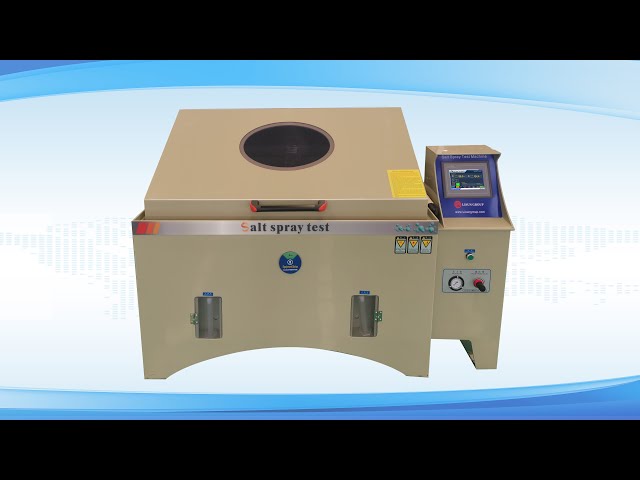
LISUN YWX/Q-010 salt spray cabinet adopts direct steam heating, with fast heating speed and uniform temperature distribution. The saturation barrel can heat and filter compressed air, reducing nozzle crystallization and ensuring the continuity and stability of salt spray. At the same time, it is equipped with three spraying modes: continuous, intermittent and programmable, which can be flexibly adjusted according to test standards and requirements.
2.2 Essential Mechanism of Salt Spray Corrosion
Salt spray corrosion is a type of atmospheric corrosion, and its core corrosive component is chloride ions decomposed from sodium chloride. Chloride ions have strong permeability, can be adsorbed at pores and cracks on the metal surface, displace oxygen in the oxide layer, convert insoluble metal oxides into soluble chlorides, and transform the passive state of the metal surface into an active state, thus triggering electrochemical reactions. Meanwhile, the hydration energy of chloride ions makes them easy to combine with metal ions to form corrosion products that continuously fall off, leading to continuous corrosion of the metal substrate, and eventually pitting corrosion, rust, coating peeling and other phenomena, affecting the structural strength and service function of products.
The salt spray cabinet accelerates the above corrosion process by increasing salt spray concentration and controlling ambient temperature, achieving the effect of “short-term laboratory testing replacing long-term natural environment exposure”. For example, 24 hours of neutral salt spray testing is approximately equivalent to one year of corrosion in the natural environment, greatly improving the efficiency of product corrosion resistance detection.

3. Technical Standards and Specification Parameters of LISUN YWX/Q-010 Salt Spray Cabinet
3.1 Multi-Standard Compatible Technical System
The standardization of salt spray testing directly determines the validity of test results. LISUN YWX/Q-010 salt spray cabinet is fully compatible with mainstream domestic and foreign salt spray test standards, covering the standard requirements of three test types: neutral salt spray (NSS), acetic acid salt spray (ASS) and copper-accelerated acetic acid salt spray (CASS). It includes not only Chinese national standards such as GB/T 2423.17 and GB/T 10125, but also American Society for Testing and Materials standards such as ASTM-B117 and ASTM-B368. It is also compatible with standards of the International Electrotechnical Commission, International Organization for Standardization and military standards such as IEC, ISO and GJB. The core compatible standards are shown in Table 1.
Table 1 Core Compatible Test Standards of LISUN YWX/Q-010 Salt Spray Cabinet
| Test Type | Core Standards | Application Scope |
| Neutral Salt Spray Test (NSS) | GB/T 2423.17, GB/T 10125, ISO 3768 | Testing of conventional metal plating and coating protective layers |
| Acetic Acid Salt Spray Test (ASS) | QB/T 3827, ISO 3769, ISO 9227 | Testing of coatings and electroplated layers with high acid resistance requirements |
| Copper-Accelerated Salt Spray Test (CASS) | ASTM-B368, ISO 3770, CNS 4159 | Testing of products with high corrosion resistance requirements such as marine engineering and auto parts |
| Military/Industrial General | GJB 150, MIL-STD-202, EIA-364-26 | Testing of military electronic equipment and electrical connectors |
3.2 High-Precision Core Specification Parameters
LISUN YWX/Q-010 salt spray cabinet achieves high-precision control in key parameters such as working chamber size, temperature control and salt spray settlement rate. The comparison of its core specification parameters with other models of the same series is shown in Table 2. With a test chamber volume of 480L and a stainless steel gas spring assisted cover opening method, this model takes into account the testing needs of large samples and operational convenience, suitable for salt spray testing of medium and large parts.
Table 2 Comparison of Core Specification Parameters of LISUN Series Salt Spray Cabinets
| LISUN Model | YWX/Q-150 | YWX/Q-250 | YWX/Q-750 | YWX/Q-010 | YWX/Q-016 | YWX/Q-020 |
| Working Chamber Size (mm) | 600×450×400 | 900×600×500 | 1100×750×500 | 1200×800×500 | 1600×1000×600 | 2000×1000×600 |
| Test Chamber Volume (L) | 108 | 270 | 412 | 480 | 960 | 1200 |
| Brine Tank Volume (L) | 15 | 25 | 30 | 32 | 40 | 45 |
| Power Supply/Power | Single-phase 220V/1.5KW | Three-phase 380V/2.0KW | Three-phase 380V/2.5KW | Three-phase 380V/2.5KW | Three-phase 380V/5.0KW | Three-phase 380V/6.0KW |
| Sample Placement Space (mm) | 500×300×250 | 800×450×250 | 900×600×300 | 1000×600×300 | 1400×800×350 | 1800×800×350 |
| Cover Opening Method | Manual | Manual | Manual | Stainless steel gas spring assist | Cylinder assist | Cylinder assist |
| Test Chamber Temperature Range | Ambient~+55℃ | Ambient~+55℃ | Ambient~+55℃ | Ambient~+55℃ | Ambient~+55℃ | Ambient~+55℃ |
| Salt Spray Settlement Rate (ml/80cm²/h) | 46024 | 46024 | 46024 | 46024 | 46024 | 46024 |
| Test Types | NSS/ASS/CASS | NSS/ASS/CASS | NSS/ASS/CASS | NSS/ASS/CASS | NSS/ASS/CASS | NSS/ASS/CASS |
The temperature control accuracy of LISUN YWX/Q-010 salt spray cabinet is at a high level in the industry, with temperature uniformity ≤2℃ and temperature fluctuation ≤±0.5℃, ensuring the consistency of the salt spray environment in the test chamber. The salt spray settlement rate is stable at 1-2ml/80cm²/h (16-hour test average), meeting the requirements of domestic and foreign standards for salt spray settlement. At the same time, the equipment is equipped with multiple safety protection devices such as low water level alarm, dual over-temperature alarm and low air pressure alarm, effectively avoiding test failure or safety accidents caused by equipment abnormalities during the test.
4. Performance Advantages of LISUN YWX/Q-010 Salt Spray Cabinet
4.1 Full Coverage of Test Types, Adapting to Multi-Scenario Testing Needs
This model of salt spray cabinet can complete three core tests: neutral salt spray (NSS), acetic acid salt spray (ASS) and copper-accelerated salt spray (CASS), meeting the corrosion resistance testing needs of different products. Among them, the neutral salt spray test is suitable for testing conventional metal platings such as galvanizing and chrome plating; the acetic acid salt spray test is for coating products with high acid resistance requirements; the copper-accelerated salt spray test increases the corrosion rate by adding copper chloride, suitable for accelerated testing of products with high corrosion resistance requirements such as marine engineering equipment and automobile wheels. Its corrosion rate is 8 times that of the neutral salt spray test, which can quickly evaluate the reliability of products in extreme salt spray environments.
4.2 High-Precision Control System Ensuring the Accuracy of Test Data
The stability of parameters such as temperature and salt spray settlement rate of the salt spray cabinet directly affects the repeatability and accuracy of test results. LISUN YWX/Q-010 salt spray cabinet adopts an intelligent temperature controller with a highly stable platinum temperature probe to realize precise control of the temperature of the test chamber and saturation barrel. The special glass nozzle ensures uniform salt spray atomization without crystallization or blockage after long-term use. Combined with a two-stage pressure-regulating air source design, the spray pressure is stable at 0.07~0.17MPa, ensuring that the salt spray settlement rate meets standard requirements. At the same time, the timing system of the equipment has a power-off memory function, avoiding test rework caused by sudden power outages and improving test efficiency.
4.3 User-Friendly Structural Design, Balancing Operational Convenience and Sample Adaptability
In terms of structural design, LISUN YWX/Q-010 salt spray cabinet adopts a stainless steel gas spring assisted cover opening method. Compared with the manual cover opening of small models in the same series, it greatly reduces the operation intensity and facilitates sample placement and removal. The sample rack is equipped with V-shaped grooves and O-shaped round rods, which can be combined to form a test angle of 20°±5°, meeting the standard requirements for sample placement in salt spray testing. It also supports custom special sample racks to meet the testing needs of samples of different shapes and sizes. The standard configuration of the equipment includes reagents such as sodium chloride, plastic anti-rust barrels, spare nozzles and other accessories, providing convenience for users to quickly carry out tests.
4.4 Strict Operation Protection to Extend Service Life
The core components of this salt spray cabinet are made of corrosion-resistant materials. The test chamber is made of highly corrosion-resistant PVC board, and the heating element is made of titanium alloy tube, effectively resisting salt spray corrosion and extending the service life of the equipment. The connection between the inner and outer boxes adopts a water seal design to prevent salt spray leakage and protect the laboratory environment. At the same time, the equipment is equipped with an automatic water replenishment function, which can automatically replenish water when the water level in the brine tank is insufficient to ensure the continuity of the test.
5. Application Value and Industry Application Scenarios of Salt Spray Cabinet
5.1 Core Testing Value of Salt Spray Cabinet
As key equipment for material corrosion performance testing, the core value of the salt spray cabinet is reflected in three aspects: accelerated verification, risk early warning and process optimization. Firstly, through accelerated corrosion testing, the corrosion process of several years in the natural environment is compressed to days or months in the laboratory, greatly shortening the product development and quality verification cycle. Secondly, the test results can detect the weak links of the product protective layer in advance, predict the failure risk of the product in the actual service environment, and provide a basis for product quality control. Finally, aiming at the corrosion failure problems in the test, failure analysis can be used to locate the causes, guiding enterprises to optimize material selection, plating process or coating formula to improve product corrosion resistance.
Taking automobile wheels as an example, if a batch of wheels has pitting corrosion in the 96-hour neutral salt spray test, metallographic analysis can find the problem of insufficient coating thickness. By increasing the nickel layer thickness and optimizing the micropore distribution of the chromium layer, the wheels can pass the 500-hour copper-accelerated salt spray test, meeting the service needs of the coastal market.
5.2 Main Industry Application Scenarios of Salt Spray Cabinet
With the characteristics of multi-standard compatibility and multi-test type adaptation, LISUN YWX/Q-010 salt spray cabinet is widely used in automotive electronics, marine engineering, light industry electronics, hardware building materials and other industries:
• Automotive Electronics Industry: Used for corrosion resistance testing of auto wheels, chassis bolts, vehicle electronic connectors and other parts to ensure the service reliability of parts in environments such as rain, snow melting agent and marine atmosphere. For example, after salt spray testing, automotive connectors must ensure on-resistance ≤5mΩ and insertion force change rate ≤20%.
• Electronics Industry: Suitable for testing PCB boards, electronic connectors, metal casings and other products to evaluate the protective performance of their plating and coating, avoiding short circuits and poor contact caused by salt spray corrosion.
• Marine Engineering Industry: Used for testing marine platform accessories, ship electronic equipment, submarine cable sheaths and other products. The copper-accelerated salt spray test simulates the extreme marine salt spray environment to evaluate the long-term corrosion resistance of products.
• Hardware Building Materials Industry: Used for testing sanitary faucets, building embedded parts, stainless steel products, etc. For example, 304 stainless steel sanitary faucets need to pass the 24-hour copper-accelerated salt spray test to ensure no pitting corrosion on the surface and color difference ΔE≤3.0.
6. Operation and Precautions of Salt Spray Cabinet
6.1 Basic Operation Process of Salt Spray Cabinet
When using LISUN YWX/Q-010 salt spray cabinet for testing, a standardized operation process must be followed to ensure the validity of test results:
• Sample Preparation: Remove oil, cutting fluid and other impurities on the sample surface by ultrasonic cleaning + pure water washing to ensure salt residue on the sample surface <5mg/m². Protect non-test areas and place them on the sample rack according to standard requirements to ensure full contact between samples and salt spray.
• Salt Solution Preparation: Prepare salt solution of corresponding concentration according to the test type. The neutral salt spray test uses 5% sodium chloride solution with pH adjusted to 6.5-7.2; the acetic acid salt spray test adds glacial acetic acid to the sodium chloride solution to adjust the pH to 3.1-3.3; the copper-accelerated salt spray test requires additional 0.26g/L copper chloride.
• Equipment Commissioning: Inject the salt solution into the brine tank, connect the air source and adjust the pressure to above 0.4MPa, set the temperature of the test chamber and saturation barrel. The test chamber temperature is set to 35℃ for neutral and acetic acid salt spray tests, 50℃ for copper-accelerated salt spray tests, and the saturation barrel temperature is 10-15℃ higher than the test chamber.
• Test Operation: Start the spray program, select continuous, intermittent or programmable spray mode, record the test start time. Regularly check parameters such as salt spray settlement rate and temperature during the test to ensure compliance with standard requirements.
• Test Completion and Result Judgment: After reaching the set test time, turn off the equipment, take out the sample for cleaning and drying. Evaluate the corrosion resistance of the sample by rating judgment, corrosion appearance judgment or weighing judgment according to relevant standards.
6.2 Usage Precautions of Salt Spray Cabinet
• Operating Environment Requirements: The salt spray cabinet shall be placed in an indoor environment with a temperature of 5℃~30℃ and humidity below 80%Rh. The laboratory shall be well ventilated. When the ambient temperature exceeds 30℃, the room temperature shall be adjusted by air conditioning to avoid affecting the temperature control accuracy of the equipment due to excessively high ambient temperature.
• Air Source and Water Quality Requirements: The air source shall be dry and clean compressed air to prevent oil and water from entering the nozzle and causing blockage. The water for preparing salt solution shall be deionized water or distilled water with conductivity <10μS/cm to prevent impurities in water from affecting salt spray concentration.
• Equipment Maintenance: After the test, clean the brine tank, working chamber and nozzle in time to remove residual salt solution and corrosion products to avoid corrosion of equipment components. Regularly check the performance of sealing rings, alarm devices and other components to ensure the normal operation of the equipment.
• Safe Operation: Wear protective gloves and goggles during operation to avoid salt solution contact with skin and eyes. Do not open the working chamber door when the salt spray cabinet is running to prevent salt spray leakage. When the equipment alarms, stop the test immediately and continue operation after troubleshooting.
7. Conclusion and Prospect
As the core equipment for simulating salt spray corrosion environment, salt spray cabinet is an important tool for evaluating the corrosion resistance of materials and products, playing a key role in improving product quality, shortening R&D cycle and reducing corrosion failure risk. With the characteristics of multi-standard compatibility, high-precision control and user-friendly design, LISUN YWX/Q-010 salt spray cabinet realizes full coverage of neutral, acidic and copper-accelerated salt spray tests, meeting the testing needs of automotive electronics, marine engineering, light industry electronics and other industries. Its stable performance and accurate test data provide a reliable guarantee for product corrosion resistance evaluation.
With the development of industrial technology, the requirements for product corrosion resistance are constantly improving, and the development of salt spray cabinets will move towards intelligence, multi-function and integration. On the one hand, through the introduction of Internet of Things technology, remote monitoring, automatic parameter calibration and cloud storage of test data of salt spray cabinets will be realized to improve the intelligent level of testing. On the other hand, salt spray testing will be combined with damp heat, drying, vibration and other environmental tests to develop multi-environment comprehensive testing equipment to simulate complex corrosion environments closer to reality. At the same time, optimize the energy-saving design and corrosion resistance of the equipment to further improve the service life and efficiency of the equipment.
In future industrial production and quality testing, the salt spray cabinet will continue to serve as the core equipment for material corrosion performance testing, providing technical support for enterprises to improve product quality and enhance market competitiveness. It will also promote the continuous improvement and development of salt spray testing technology, helping various industries cope with complex corrosion environmental challenges.
Tags:YWX/Q-010Your email address will not be published. Required fields are marked *

 English
 中文简体
中文简体 English
 Русский
 Español
 Português
 Türkçe
 العربية
 Deutsch
 Polski
 Italiano
 Français
 한국어
한국어 ไทย
ไทย Tiếng Việt
 日本語
日本語