LM-79 Moving Detector Goniophotometer (Mirror Type C)
LSG-6000
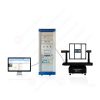
High Precision Rotation Luminaire Goniophotometer
LSG-1890B
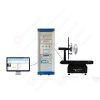
High Precision Rotation Luminaire Goniospectroradiometer
LSG-1890BCCD

Goniophotometer for Automotive and Signal Lamps
LSG-1950
Goniophotometer for Traffic Signal Lamps (Economical Model)
LSG-1950S
VAD Fire Alarm Visual Alert Device Goniophotometer
LSG-1930
Goniophotometer for Airfield Lighting
LSG-1940
Compact Goniophotometer
LSG-1200A
LED Goniophotometer
LSG-1100
Near Field Moving Detector Goniophotometer
LSG-1900B
 LEDs and Luminaire Test Solutions
 LM-79 and LM-80 Test Solutions
 LED Driver Test Solutions
 Household Appliances Test Solutions
 Mobile and Network Test Solutions
 Automotive Electronics Test Solutions
 Audio-Video and IT Test Solutions
 Cable and Wire Test Solutions
 Plugs and Sockets Test Solutions
 Power Switch Test Solutions
 Transformer Test Solutions
 Electric Toys Test Solutions
 Energy Meter Test Solutions
 Motor-Operated Tool Test Solutions
Select an organization
to browse standards
Abstract
Electrostatic discharge is the most common transient electromagnetic interference source for electronic and electrical products. As the core executive component of electrostatic discharge immunity test, the output waveform, parameter accuracy and standard procedure of electrostatic discharge gun directly determine the validity of EMC test results. GB/T 17626.2 in China and IEC/EN 61000-4-2 international standards are the basic specifications for ESD testing of general electronic equipment. Conventional test instruments suffer from complicated standard parameter configuration, poor waveform consistency and insufficient cross-industry adaptability. This paper takes LISUN ESD61000-2 electrostatic discharge generator as the research object. The instrument is pre-installed with complete domestic and international standard test procedures. The supporting electrostatic discharge gun supports one-click recall of preset severity level parameters, with output voltage ranging from 0.1kV to 30kV. Equipped with replaceable RC modules and multi-specification discharge electrodes, it meets ESD compliance test requirements for four major sectors including consumer electronics, automotive electronics, industrial control and medical devices. This paper sorts out the standardized procedure logic and core technical indicators of the equipment, attaches a comparison table of parameters for the full series, and elaborates differentiated test schemes of electrostatic discharge gun for various industries, providing practical references for ESD test equipment selection and standardized test implementation in enterprise R&D laboratories and third-party testing institutions.
Modern electronic devices integrate chips, touch screens and high-speed communication interfaces, whose tolerance to electrostatic high-voltage pulses keeps decreasing. Static electricity generated in dry environments, human friction and material contact can reach tens of thousands of volts. Instant discharge easily leads to equipment crash, data loss and permanent breakdown of semiconductor components. Therefore, electrostatic discharge immunity test is a mandatory basic item for CCC, CE and automotive component certification.
GB/T 17626.2 is identically adopted from IEC/EN 61000-4-2, which uniformly specifies the waveform, discharge modes, voltage levels and test fixture requirements of electrostatic discharge gun. It distinguishes two basic test modes: contact discharge and air discharge, and divides severity levels from 1 to 4, covering most civil and industrial electronic products. The automotive electronics industry additionally complies with GB/T 19951 (ISO 10605), which requires higher discharge voltage and dedicated RC networks. Medical devices follow medical EMC specifications that impose strict constraints on equipment stability during testing.
Traditional simple electrostatic discharge devices have no built-in standard procedures. Operators need to manually input parameters such as voltage, discharge times, intervals and polarities, which brings high operation threshold and risks of human error. Single-type discharge electrodes fail to satisfy both general electronics and automotive component testing. Targeting these industry pain points, LISUN ESD61000-2 series electrostatic discharge generator is equipped with standardized electrostatic discharge gun, pre-storing complete test flows of GB/T 17626.2 and IEC/EN 61000-4-2 to support one-click recall of preset standard parameters. Extended models are adapted to special test standards for automotive electronics, and complete test fixtures are matched to realize one-stop ESD compliance testing for multiple industries. Combined with original technical documents, this paper systematically analyzes the equipment procedure architecture, performance parameters and industry implementation schemes.
Core Test Principle of Electrostatic Discharge Gun
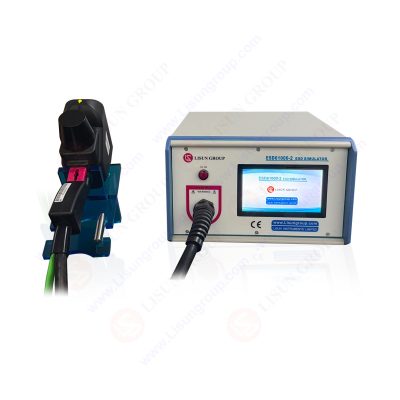
The electrostatic discharge gun serves as the terminal executive part of the electrostatic discharge generator. Its interior integrates a standard 330Ω/150pF discharge network. Cooperating with the high-voltage module of the main unit, it generates high-voltage pulses with nanosecond rising edges, whose pulse rise time is controlled within 0.6~1ns to fully meet the waveform limits specified by GB/T 17626.2. The instrument is equipped with two basic types of electrodes: sharp tip electrode for contact discharge, which directly hits the metal housing and interface contacts of equipment; round tip electrode for air discharge, which breaks the air gap of insulated housing to simulate discharge caused by human proximity. The ESD61000-2C model is additionally equipped with a Φ30mm large round tip electrode to meet ISO 10605 automotive test requirements.
Tests are divided into direct discharge and indirect coupling discharge. Horizontal and vertical coupling plates are used to simulate electrostatic interference from surrounding objects. The whole test flow, voltage gears and discharge times can be loaded with one click via built-in standard procedures of the main unit without manual parameter conversion, ensuring comparability and repeatability of test data for different operators and sample batches.
One-Click Standard Procedures Built in GB/T 17626.2 / IEC/EN 61000-4-2
LISUN ESD61000-2 main unit is equipped with a Chinese-English switchable LCD display, with a complete built-in library of domestic and international standard test procedures. The electrostatic discharge gun supports both manual and automatic trigger modes, and four core preset procedures are listed as follows:
• IEC Standard Level Mode: Pre-stored full parameters of severity level 1 to 4, contact discharge at 2/4/6/8kV, air discharge at 2/4/8/15kV, automatically matched alternating positive and negative polarities, 1s standard discharge interval and 10 discharges per test point, one-click startup after power-on;
• 20PPS Fast Scan Mode: Continuous discharge at 20 times per second to quickly scan equipment housings, buttons and interfaces, rapidly locating electrostatic sensitive weak points, suitable for troubleshooting of R&D prototypes;
• Programmable Custom Mode: Supports storage of industry-specific parameters such as ISO 10605 for automotive electronics and YY 9706.102 for medical devices, multiple test schemes can be saved and directly recalled for subsequent tests;
• Count Cycle Aging Mode: Discharge times adjustable from 1 to 9999, discharge intervals freely set from 0.05s to 99.99s, applied for long-term electrostatic reliability verification of products.
The main unit is equipped with RS232 and USB communication interfaces, which can be connected to automatic test systems to complete full-automatic cyclic tests with electrostatic discharge gun, automatically recording equipment failure phenomena and simplifying EMC report compilation.
Comparison Table of Core Technical Parameters for Full ESD61000-2 Series
Table 1 Key Technical Parameters of LISUN ESD61000-2 Series Electrostatic Discharge Generators
| Parameter Item | ESD61000-2 (General Basic Model) | ESD61000-2A (High-Voltage General Model) | ESD61000-2C (Special Model for Automotive Electronics) | Applicable Standards |
| Output Voltage Range | 0.1~20kV, tolerance ±5% | 0.1~30kV, tolerance ±5% | 0.1~30kV, tolerance ±5% | GB/T 17626.2, IEC/EN 61000-4-2 |
| Output Polarity | Positive, Negative, Alternating Positive & Negative | Positive, Negative, Alternating Positive & Negative | Positive, Negative, Alternating Positive & Negative | IEC 61000-4-2 |
| Standard RC Module | Fixed 330Ω/150pF | 4 groups of replaceable RC networks with multiple specifications | Full set of multi-specification RC combinations | ISO 10605, GB/T 19951 |
| Electrode Configuration of Electrostatic Discharge Gun | Sharp tip, standard round tip | Sharp tip, standard round tip | Sharp tip, standard round tip, Φ30mm large round tip | GB/T 19951-2019 |
| Applicable Industry Standards | Basic ESD test for general electronics | General electronics, industrial high-voltage equipment | Dual standards for consumer electronics and automotive components | IEC/EN 61000-4-2, ISO 10605 |
| Built-in Procedure Functions | Single shot / Count / 20PPS / IEC Level / Programming Mode | All general functions + 30kV high voltage output | Full functions + supporting procedures for vehicle coupling plates | Original factory standardized procedure library |
| Power Supply Specification | AC220V (110V optional) 50/60Hz | AC220V (110V optional) 50/60Hz | AC220V (110V optional) 50/60Hz | General laboratory power supply specification |
As shown in the above table, the basic ESD61000-2 model matched with electrostatic discharge gun can meet Level 4 standard tests of GB/T 17626.2 for general products such as mobile phones, home appliances and small industrial control equipment. The 2A high-voltage model adapts to stringent high-voltage test scenarios of high-power industrial equipment. The 2C model optimizes electrodes and RC accessories for automotive components, matched with ESD-FCP electrostatic discharge island, and is compatible with both general and automotive standards. The electrostatic discharge gun of the three models are interchangeable, reducing laboratory equipment procurement and operation maintenance costs.
The original factory provides a third-party CNAS accredited calibration report. The output waveform of the equipment strictly complies with standard limits. Taking 8kV forward discharge as an example, the peak current is 29.40A and the pulse rise time is 0.89ns. The repeatability error of positive and negative voltage waveforms is less than 5%, and the test data are valid for laboratory qualification recognition.
Consumer Electronics Industry (Mobile Phones, Tablets, Smart Home Devices, Wearables)
Housings of mobile phones, smart watches, small home appliances and other consumer electronics are mostly made of plastic and glass insulating materials, while metal middle frames and charging interfaces are conductive areas. National standards require Level 4 ESD tests: 8kV contact discharge and 15kV air discharge. Laboratories select the basic ESD61000-2 model, call the one-click IEC Level 4 preset procedure, replace the standard round tip electrode of electrostatic discharge gun to perform air discharge on screens and housing gaps, and use the sharp tip electrode for contact discharge on metal middle frames and USB interfaces. A complete test platform is built with the ESD-DESK standard electrostatic test table. After testing, equipment functions are judged to be normal or not according to standard Class A/B/C/D, which is a core link of EMC certification before product launch.
Automotive Electronics Industry (Vehicle Central Control, Sensors, BMS, Vehicle Cameras)
Automotive components are placed in dry and closed cabins for a long time with higher electrostatic risks, which need to meet dual standards of GB/T 17626.2 and GB/T 19951 (ISO 10605), with maximum test voltage up to 30kV. ESD61000-2C is recommended for equipment selection. Replace the Φ30mm large round tip electrode of electrostatic discharge gun and install the ESD-FCP automotive electrostatic field coupling plate, call the built-in special test procedure for vehicles, set long-cycle discharge to simulate extreme dry working conditions of complete vehicles, and verify the resistance of wiring harnesses and control modules against high-voltage electrostatic shocks.
Industrial Control Industry (PLC, Inverters, Industrial Touch Screens, Sensors)
Factory workshops have heavy dust and dry air leading to severe static accumulation. Industrial control equipment generally complies with ESD Level 3~4 standards, and high-power equipment needs to withstand higher voltage shocks. Adopt ESD61000-2A high-voltage model, use electrostatic discharge gun to complete discharge tests on equipment cabinets, operation panels and communication interfaces. The programming mode stores mass production test parameters for production lines, and indirect coupling discharge is carried out with metal reference ground plates to verify stable operation of equipment under complex industrial power grid conditions.
Medical Device Industry (Patient Monitors, Diagnostic Equipment, Physical Therapy Instruments)
Medical devices follow YY 9706.102 medical EMC specifications, with ESD test levels of 6kV contact discharge and 8kV air discharge. No signal distortion, measurement data deviation or automatic restart of equipment is allowed during the whole test process. The Chinese-English interface of ESD61000-2 facilitates operation by medical institution staff. The single-shot counting mode of electrostatic discharge gun accurately controls discharge times, and low-level discharge is applied to weak signal ports such as electrocardiogram and blood oxygen to avoid distortion of physiological signals caused by pulse interference.
To fully implement GB/T 17626.2 and IEC/EN 61000-4-2 standard tests, LISUN provides three types of supporting assemblies matched with electrostatic discharge gun and ESD61000-2 main unit:
First, ESD-DESK electrostatic test table, equipped with 1600×800mm test bench, metal reference ground plate, horizontal and vertical coupling plates, meeting standard grounding and indirect discharge test layout requirements;
Second, ESD-CALA electrostatic gun calibration kit, matched with oscilloscope and 20dB attenuator to periodically calibrate the output current and rising edge waveform of electrostatic discharge gun, ensuring long-term compliance and validity of test data;
Third, ESD-FCP automotive electrostatic field coupling plate, only compatible with ESD61000-2C, used for indirect electrostatic discharge simulation of automotive components.
Complete standardized test flow: Safety inspection of equipment grounding → one-click recall of built-in standard procedure according to product industry → replacement of matched electrode for electrostatic discharge gun → setting of discharge interval and total times → 20PPS fast scan to locate sensitive points → formal graded discharge test → recording of equipment faults and judgment of performance levels in accordance with standards. For complete EMS immunity tests, electrical fast transient burst generator can be matched to finish remaining test items and export unified standardized test reports.
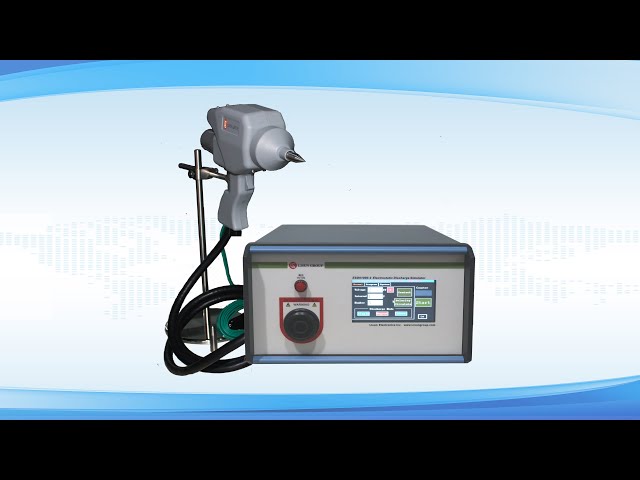
LISUN ESD61000-2 series electrostatic discharge generator takes electrostatic discharge gun as the core test executive unit, with fully embedded complete test procedures of domestic and international general standards GB/T 17626.2 and IEC/EN 61000-4-2. It supports one-click recall of severity level parameters, greatly simplifying manual parameter configuration operations. With wide output voltage ranging from 0.1kV to 30kV, replaceable standardized RC modules and multi-specification discharge electrodes, it covers ESD immunity compliance test demands of four mainstream industries including consumer electronics, automotive electronics, industrial control and medical devices.
The complete set of equipment is equipped with full standard test fixtures and traceable CNAS calibration data, which is suitable for third-party testing institutions to issue qualified test reports as well as manufacturing enterprises for R&D prototype verification and production line factory sampling inspection. The built-in standardized procedures guarantee repeatability and comparability of test results among different operators and laboratories, effectively lowering the operation threshold of ESD electrostatic testing, and providing stable and reliable hardware support for various electronic and electrical products to complete EMC compliance certification and improve practical service reliability.
Tags:ESD61000-2Your email address will not be published. Required fields are marked *

 English
 中文简体
中文简体 English
 Русский
 Español
 Português
 Türkçe
 العربية
 Deutsch
 Polski
 Italiano
 Français
 한국어
한국어 ไทย
ไทย Tiếng Việt
 日本語
日本語