LM-79 Moving Detector Goniophotometer (Mirror Type C)
LSG-6000
High Precision Rotation Luminaire Goniophotometer
LSG-1890B
High Precision Rotation Luminaire Goniospectroradiometer
LSG-1890BCCD

Goniophotometer for Automotive and Signal Lamps
LSG-1950
Goniophotometer for Traffic Signal Lamps (Economical Model)
LSG-1950S
VAD Fire Alarm Visual Alert Device Goniophotometer
LSG-1930
Goniophotometer for Airfield Lighting
LSG-1940
Compact Goniophotometer
LSG-1200A
LED Goniophotometer
LSG-1100
Near Field Moving Detector Goniophotometer
LSG-1900B
 LEDs and Luminaire Test Solutions
 LM-79 and LM-80 Test Solutions
 LED Driver Test Solutions
 Household Appliances Test Solutions
 Mobile and Network Test Solutions
 Automotive Electronics Test Solutions
 Audio-Video and IT Test Solutions
 Cable and Wire Test Solutions
 Plugs and Sockets Test Solutions
 Power Switch Test Solutions
 Transformer Test Solutions
 Electric Toys Test Solutions
 Energy Meter Test Solutions
 Motor-Operated Tool Test Solutions
Select an organization
to browse standards
Abstract
Automotive rubber seals are an essential part of the vehicle sealing system, widely installed on doors, windows, trunk lids, sunroofs and other positions. They perform functions of waterproofing, dustproofing, sound insulation and buffering. Once the seals fail, issues such as rainwater leakage, increased wind noise and dust ingress may occur. In severe cases, the service life of on-board electrical components will be indirectly affected, bringing negative impacts on driving safety and riding experience. Ozone in the atmosphere continuously oxidizes polymer chains of rubber. Under tensile stress, ozone cracking appears on rubber, which is one of the main causes for failure of outdoor rubber products. An Ozone Aging Test Chamber can reproduce ozone erosion environments in the laboratory, and simulate the actual stress state of seals with static and dynamic stretching devices to complete accelerated aging evaluation. Focusing on the LISUN OTC-150A Ozone Aging Test Chamber, this paper describes the working principle and hardware structure of the Ozone Aging Test Chamber. Combined with standards including GB/T 7762-2014, GB/T 13642-2015 and ISO 1431-1:2012, it introduces the complete test procedure for automotive rubber sealing strips. It also expands other application scenarios of the Ozone Aging Test Chamber in rubber, textile, cable and other fields, providing references for auto parts R&D, incoming quality inspection and third-party testing institutions to carry out ozone cracking resistance tests.
Most automotive rubber seals are made of rubber materials with unsaturated molecular structures. During vehicle operation and door opening/closing, the seals remain under continuous or reciprocating tensile deformation for a long time. Even low-concentration ozone in natural environment can undergo oxidation reactions with unsaturated double bonds inside rubber, generating tiny cracks on the material surface. The cracks gradually expand inward with service time and eventually lead to damage of the sealing structure. Natural exposure tests require samples to be placed in outdoor sites, and obvious cracking can only be observed after months or even years, which hardly meets the testing requirements for rapid iterative development of auto parts.
The Ozone Aging Test Chamber generates ozone gas with controllable concentration via discharge tubes. Equipped with temperature and humidity control systems and sample stretching mechanisms, it simulates the destructive effect of atmospheric ozone in a closed dark cavity and completes accelerated aging tests within a short period. The Ozone Aging Test Chamber is widely used in rubber, textile, cable and other industries. It is adopted to verify ozone cracking resistance of automotive rubber sealing strips, ozone color fastness of outdoor textiles and ozone aging resistance of cable sheaths. It provides scientific data for material R&D and quality inspection, helps enterprises control product weather resistance, and effectively guarantees stable performance and safe service life of products during long-term service. For the automotive industry, the use of an Ozone Aging Test Chamber for ozone cracking inspection of seals enables early screening of unqualified formulations and parts, reducing risks of subsequent vehicle failures from the source. The LISUN OTC-150A Ozone Aging Test Chamber is a mature commercial testing device supporting three modes: static stretching, dynamic stretching and intermittent dynamic stretching. It complies with domestic and international rubber test standards, suitable for formulation comparison in laboratory R&D as well as batch incoming inspection of components.
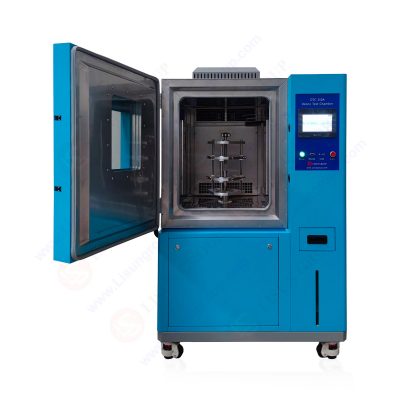
OTC-015A_Ozone Test Chamber
An Ozone Aging Test Chamber mainly consists of an ozone generation unit, temperature & humidity regulation unit, gas circulation unit, sample stretching actuator and data acquisition & control system. The equipment generates ozone by silent discharge tubes. Sensors monitor ozone concentration inside the cavity in real time, and a forced air circulation system ensures uniform mixing of ozone gas in the chamber to maintain a stable ozone concentration environment. The temperature and humidity module controls internal environmental parameters of the cabinet. The sample fixture system can apply fixed or reciprocating tensile strain to rubber specimens to simulate the actual stress of seals after vehicle assembly. The whole test is performed in a light-tight closed chamber to eliminate interference of external factors such as illumination on aging results.
After installation, automotive rubber seals are always under certain tensile deformation. When ozone contacts the stressed rubber surface, oxidation reactions preferentially occur at stress concentration positions and generate tiny surface cracks. After cracks form, ozone continuously invades the interior of cracks and promotes further deepening and widening, eventually destroying the rubber sealing structure. The static stretching mode simulates the continuous compression and stretching of sealing strips after door closure, corresponding to the static tensile test standard GB/T 7762-2014. The dynamic stretching mode simulates periodic deformation caused by vehicle vibration and repeated door opening and closing, complying with dynamic tensile test standard GB/T 13642-2015. The two working modes cannot replace each other. In actual inspection, the corresponding test mode shall be selected according to the real working state of seals. An Ozone Aging Test Chamber must support both modes to fully reproduce the service conditions of components.
The LISUN OTC-150A Ozone Aging Test Chamber is equipped with an independent ozone generator. Ozone concentration can be adjusted within the range of 10‑1000 pphm with control accuracy of ±2‑3 pphm. Under forced air circulation, gas flow velocity remains 600±100 mm/s to ensure uniform ozone distribution inside the cavity. Temperature control range is 0‑60℃ with precision ±1℃; humidity control range is 20%‑90%RH (at 20‑40℃), with humidity deviation ±5%RH. The sample actuator supports static stretching, dynamic stretching and intermittent dynamic stretching. Specimen elongation can be adjusted from 5% to 45%, stretching frequency ranges from 0 to 30 times per minute, and maximum stretching stroke is 0‑90 mm, satisfying test requirements for automotive rubber sealing strip specimens of different sizes. The device is equipped with a 7-inch dedicated touch controller, USB export interface and RJ45 network port. Test data can be saved in EXCEL format for local export or remote storage via host computer. The inner chamber adopts corrosion-resistant material to resist long-term oxidative corrosion by ozone. The equipment has an exhaust system to discharge residual ozone in the chamber after testing to protect operator safety. The table below lists key specifications of main models of LISUN Ozone Aging Test Chamber.
| Parameter Item | OTC‑150A | OTC‑500A |
|---|---|---|
| Working Chamber Dimension (mm) | 500×500×600 | 700×800×900 |
| Power Supply | Single-phase 220‑240V, 50/60Hz, 5kVA | Three-phase 380V, 50/60Hz, 6.5kVA |
| Ozone Concentration Range | 10~1000pphm (±2~3pphm) | 10~1000pphm (±2~3pphm) |
| Gas Flow Velocity | 600±100mm/s | 600±100mm/s |
| Temperature Range | 0℃~60℃ (±1℃) | 0℃~60℃ (±1℃) |
| Humidity Range | 20%~90% RH (20‑40℃) ±5%RH | 20%~90% RH (20‑40℃) ±5%RH |
| Stretching Test Modes | Static, dynamic, intermittent dynamic stretching | Static, dynamic, intermittent dynamic stretching |
| Specimen Elongation | 5~45% | 5~45% |
| Stretching Frequency | 0~30 cycles/min | 0~30 cycles/min |
| Data Export Method | USB, RJ45 network port | USB, RJ45 network port |
Before carrying out ozone cracking resistance test of automotive rubber seals with the Ozone Aging Test Chamber, sample preparation should be completed first. Cut seal specimens in accordance with corresponding standards, record original appearance of specimens, test initial tensile strength by tensile tester and retain baseline performance data. Specimen surfaces shall be free of oil stains and scratches to prevent artificial defects from interfering with final cracking judgment. Multiple parallel specimens shall be prepared to improve statistical reliability of test results.
Complete pre-inspection of equipment, check connection status of ozone generator, sensors and stretching fixtures, and calibrate ozone concentration, temperature and humidity. Set test parameters according to standard requirements. For automotive rubber seals, commonly used ozone concentration is 50 pphm, test temperature is generally set at 23‑40℃, humidity condition is limited in accordance with standards. Select static or dynamic stretching mode, set specimen elongation, stretching frequency and total test duration. Mount specimens on fixtures with spacing no less than 15 mm between specimens, ensuring ozone gas can fully contact the surface of each specimen. Close the chamber door. After temperature and humidity parameters inside the cavity stabilize, start the ozone generator and begin formal timing once ozone concentration reaches the set value. Do not open the chamber door during the whole test to avoid ozone leakage and disturbance of internal cavity environment. The equipment automatically records ozone concentration, temperature, humidity and operating status of the stretching mechanism.
Upon completion of test timing, activate the equipment exhaust system to fully discharge residual ozone in the chamber. Open the chamber door and take out samples only after ozone concentration inside the cavity drops to the safety limit. Condition the taken specimens under standard environmental conditions (23℃±2℃, 50%±5%RH). Then observe cracks on rubber surface with magnifying glass or microscope, record crack existence, crack density and maximum crack depth, re-test tensile strength and compare with initial data to evaluate ozone cracking resistance grade of specimens. Besides auto rubber parts, the Ozone Aging Test Chamber can also perform ozone resistance test for cable sheaths and ozone color fastness test for outdoor textiles, complying with GB/T 2951.21-2008, GB/T 11039.3-2005, ISO 105-G03 and other standards. One single device can realize ozone resistance testing for multiple categories of materials.

Ozone has strong oxidative corrosion. Regular maintenance of the Ozone Aging Test Chamber directly affects accuracy of test data and equipment service life. Ozone sensors shall be calibrated periodically to guarantee accurate concentration reading; sensor drift will directly cause deviation of test conditions from standard requirements. Inspect internal chamber seals and pipelines to prevent ozone leakage. Check and lubricate the stretching transmission mechanism regularly to ensure stable reciprocating stretching motion and consistent elongation. Clean the inner chamber after tests to remove rubber debris. The exhaust system of equipment must remain fully functional. Operators shall fully exhaust ozone before opening the chamber door to avoid personal injury caused by ozone inhalation. The chamber door shall not be opened during equipment operation. Calibration records, test program files and operation data shall be fully retained to meet traceability requirements of test reports. Key parameters specified by standards such as ozone concentration, temperature and elongation shall not be modified arbitrarily. Parameter changes will alter aging stress and make test results incomparable.
The ozone cracking resistance of automotive rubber seals is directly related to vehicle sealing performance and auxiliary driving safety. Natural exposure tests feature long cycles and can hardly match the rapid R&D and verification rhythm of auto parts. The Ozone Aging Test Chamber can precisely simulate ozone corrosion environment in a closed cavity, and reproduce the stress state of installed seals with static and dynamic stretching mechanisms to quickly complete accelerated evaluation of ozone cracking resistance. The LISUN OTC-150A Ozone Aging Test Chamber features adjustable ozone concentration, stable temperature & humidity control system and complete sample stretching mechanism. It is compatible with domestic and international standards including GB/T 7762-2014, GB/T 13642-2015 and ISO 1431-1:2012. It is not only used for reliability evaluation of automotive rubber seals. The Ozone Aging Test Chamber is widely used in rubber, textile, cable and other industries. It is adopted to verify ozone cracking resistance of automotive rubber sealing strips, ozone color fastness of outdoor textiles and ozone aging resistance of cable sheaths. It provides scientific data for material R&D and quality inspection, helps enterprises control product weather resistance, and effectively guarantees stable performance and safe service life of products during long-term service. In practical inspection work, testers shall standardize sample preparation, strictly set test parameters according to standards, implement periodic equipment calibration and maintenance, and scientifically interpret cracking and performance variation results. Only in this way can the value of the Ozone Aging Test Chamber be fully exerted, providing reliable test support for auto part quality control and driving safety assurance.
Tags:OTC-150AYour email address will not be published. Required fields are marked *

 English
 中文简体
 English
 Русский
 Español
 Português
 Türkçe
 العربية
 Deutsch
 Polski
 Italiano
 Français
 한국어
 ไทย
 Tiếng Việt
 日本語