LM-79 Moving Detector Goniophotometer (Mirror Type C)
LSG-6000
High Precision Rotation Luminaire Goniophotometer
LSG-1890B
High Precision Rotation Luminaire Goniospectroradiometer
LSG-1890BCCD

Goniophotometer for Automotive and Signal Lamps
LSG-1950
Goniophotometer for Traffic Signal Lamps (Economical Model)
LSG-1950S
VAD Fire Alarm Visual Alert Device Goniophotometer
LSG-1930
Goniophotometer for Airfield Lighting
LSG-1940
Compact Goniophotometer
LSG-1200A
LED Goniophotometer
LSG-1100
Near Field Moving Detector Goniophotometer
LSG-1900B
 LEDs and Luminaire Test Solutions
 LM-79 and LM-80 Test Solutions
 LED Driver Test Solutions
 Household Appliances Test Solutions
 Mobile and Network Test Solutions
 Automotive Electronics Test Solutions
 Audio-Video and IT Test Solutions
 Cable and Wire Test Solutions
 Plugs and Sockets Test Solutions
 Power Switch Test Solutions
 Transformer Test Solutions
 Electric Toys Test Solutions
 Energy Meter Test Solutions
 Motor-Operated Tool Test Solutions
Select an organization
to browse standards
Abstract
Manufactured products will be exposed to complex climatic stresses such as high and low temperatures, alternating dry and wet conditions, and long-term damp heat throughout their whole service life. Conventional room-temperature testing cannot predict failure risks under extreme environments. As core equipment for simulating artificial climates, the environmental temperature chamber can accurately reproduce dynamic temperature and humidity changes in nature and accelerate the assessment of weathering reliability of materials and products. Taking LISUN GDJS-015B temperature-humidity alternating test chamber, an industrial-grade environmental temperature chamber, as the research object, this paper elaborates on the equipment structure, core technical parameters, standard compatibility and industrial testing applications. Combined with comparative analysis of specification parameter tables, it analyzes its performance advantages, summarizes the practical value of this environmental temperature chamber in reliability R&D verification of LED lighting, automotive electronics and electrical components, and provides standardized environmental testing schemes for product R&D, quality inspection and compliance certification.
1 Introduction
Outdoor lamps, vehicle-mounted electronics, PCB components, polymer materials and other products operate under a wide range of service environments. Low temperature may cause embrittlement and shrinkage, high temperature triggers aging, high humidity leads to corrosion, and alternating temperature and humidity between day and night will induce hidden faults such as solder joint cracking, insulation failure, material deformation and accelerated light attenuation. Natural exposure testing takes months or even years, which fails to match the rapid iteration cycle of products. Relying on controllable refrigeration, heating and humidification systems to build accelerated artificial climate environments, the **environmental temperature chamber** realizes temperature and humidity gradient and alternating cycles via program editing, reproducing years of natural aging damage within a short period. It is standardized equipment indispensable for environmental adaptability verification of industrial products.
The LISUN GDJS series temperature-humidity alternating test chambers are multi-functional composite environmental temperature chambers, among which GDJS-015B is a large-volume double-door model with an inner cavity volume of 1.5 m³, suitable for batch sample aging tests over long durations. It fully covers mainstream testing standards including national standard GB/T 2423, international IEC, LED industry LM-80, automotive electronic AEC-Q102 and others, and is widely adopted in reliability R&D verification of optoelectronics, automotive and electrical and electronic industries. This paper systematically analyzes the hardware configuration, parameter indicators and testing procedures of this environmental temperature chamber.
2 Equipment Structure and Core Hardware Configuration of LISUN GDJS-015B Environmental Temperature Chamber
The GDJS-015B environmental temperature chamber adopts a split control structure consisting of a main cabinet and an independent touch control screen. Imported components are adopted for the whole machine material, sensors and power systems to guarantee stable performance during long-term continuous testing. The core hardware configurations are listed as follows:
1. Cabinet Structure: The inner liner is made of SUS304 stainless steel with excellent corrosion resistance, and the outer shell is cold-rolled steel with plastic spraying. The thermal insulation layer is compounded with rigid polyurethane foam and ultra-fine glass fiber. High-temperature silicone rubber sealing on the door frame prevents temperature and humidity leakage. Adjustable support feet and moving rollers are installed at the bottom to facilitate sample loading/unloading and equipment positioning.
2. Control System: Self-developed temperature controller plus PLC dual-core touch screen with Chinese and English operation interfaces. It supports data transmission via USB, RS232 and RS485, enabling remote monitoring by external computers and storage of test curves. Full-process temperature and humidity data can be recorded in real time for traceability.
3. Sensing System: PT100 platinum resistance temperature sensors with high precision and anti-interference performance are equipped. Finland Vaisala humidity sensors are adopted instead of traditional wet-dry bulb sensors, requiring no daily maintenance. A matched automatic water supply system stably achieves humidity control ranging from 20% to 98%RH.
4. Cold and Heat Circulation System: Independent nichrome alloy heaters are used for heating with uniform temperature rise without local overheating. Refrigeration relies on fully enclosed air-cooled compressors manufactured by Tecumseh (France) to maintain stable temperature change rates. Low-noise centrifugal impellers are installed in the circulating air duct to ensure uniform temperature and humidity inside the chamber.
5. Multi-layer Safety Protection: Full-link protection against electric leakage, short circuit, heater over-temperature, motor overload, compressor overvoltage and overcurrent is integrated. The equipment will automatically stop and trigger alarms upon abnormal testing conditions to avoid damage to samples and the chamber itself.
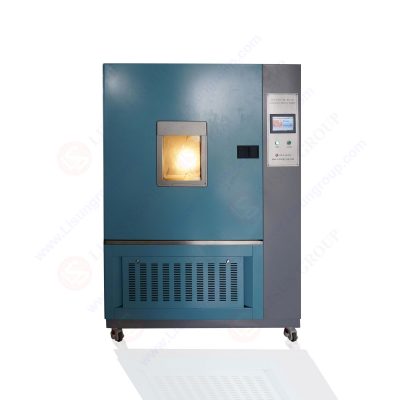
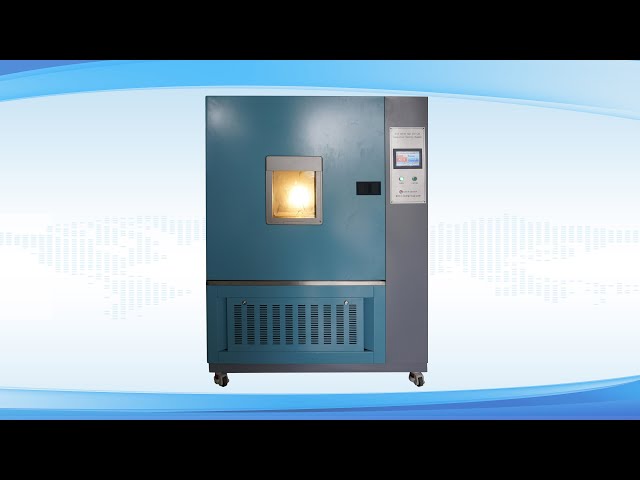
GDJS-015B Temperature Humidity Chamber | Thermal Chamber
3 Comparison Table of Core Specifications of GDJS Series Environmental Temperature Chambers
Table 1 Core Parameter Table of GDJS Series Programmable Damp Heat Environmental Temperature Chamber
| Model | GDJS-100 | GDJS-225 | GDJS-500 | GDJS-010 | GDJS-015B | GDJS-020 |
| Internal Working Dimensions (cm) | 41×55×45 | 50×60×75 | 70×80×90 | 100×100×100 | 100×100×150 | 100×100×200 |
| Overall External Dimensions (cm) | 105×105×156 | 105×102×200 | 132×132×217 | 167×152×231 | 245×160×231 | 160×254×214 |
| Rated Operating Power (kW) | 5.5 | 7 | 13.5 | 15 | 16.5 | 26.5 |
| Standard Temperature Range | Model A: -20~150℃; Model B: -40~150℃; Model C: -60~150℃; Model D: -70~150℃ | Unified for All Series | Unified for All Series | Unified for All Series | Unified for All Series | Unified for All Series |
| Temperature Fluctuation / Uniformity | ±0.5℃ / ±2℃ | ±0.5℃ / ±2℃ | ±0.5℃ / ±2℃ | ±0.5℃ / ±2℃ | ±0.5℃ / ±2℃ | ±0.5℃ / ±2℃ |
| Temperature Rise Rate | 1.0~3.0℃/min | 1.0~3.0℃/min | 1.0~3.0℃/min | 1.0~3.0℃/min | 1.0~3.0℃/min | 1.0~3.0℃/min |
| Temperature Drop Rate | 0.7~1.0℃/min | 0.7~1.0℃/min | 0.7~1.0℃/min | 0.7~1.0℃/min | 0.7~1.0℃/min | 0.7~1.0℃/min |
| Humidity Control Range | 20%~98%RH | 20%~98%RH | 20%~98%RH | 20%~98%RH | 20%~98%RH | 20%~98%RH |
| Humidity Deviation | -2%~-3%RH | -2%~-3%RH | -2%~-3%RH | -2%~-3%RH | -2%~-3%RH | -2%~-3%RH |
As shown in the table above, the GDJS-015B environmental temperature chamber has an internal volume of 1.5 m³, supporting synchronous testing of large batches of lamps and vehicle-mounted modules. Its 16.5 kW rated power supports long-term continuous damp heat alternating aging. The unified control accuracy of temperature and humidity fluctuation and uniformity meets high-precision environmental simulation requirements. Four low-temperature range options with wide temperature coverage adapt to testing scenarios for cold-region, outdoor and military products.
Table 2 Main Domestic and International Testing Standards Compatible with GDJS-015B Environmental Temperature Chamber
| Standard Category | Standard No. | Standard Name | Testing Scenario |
| Chinese National Standard | GB/T 2423.1-2008 | Environmental Testing for Electric and Electronic Products — Low Temperature Test | Low temperature resistance verification |
| Chinese National Standard | GB/T 2423.4-2008 | Alternating Damp Heat Test (12h Cycle) | Damp heat alternating aging |
| Chinese National Standard | GB 7000.1-2023 | Luminaires — General Requirements and Safety & Environmental Testing | Reliability test of LED lamps |
| Chinese National Standard | GB/T 28046.4-2011 | Road Vehicles — Electrical and Electronic Equipment Environmental Test — Climatic Load Test | Automotive component testing |
| International Standard | IEC 60068-2-30 | Environmental Testing — Alternating Damp Heat Cycle Test | General electronic component testing |
| Industry Standard | IES LM-80-08 | Measuring Lumen Maintenance of LED Light Sources | Long-term aging test of LED light sources |
| Automotive Standard | AEC-Q102-2020 | Stress Test Qualification for Optoelectronic Components | Vehicle optoelectronic component testing |
4 Application Process of GDJS-015B Environmental Temperature Chamber in Product Reliability Verification
Taking lumen depreciation and damp heat reliability testing of LED street lamps as an example, the standardized testing process is divided into four stages:
1. Pre-test Preparation: Select 10 LED street lamps from the same batch and test initial luminous flux, insulation resistance and driving power consumption. Set the LM-80 standard program on the GDJS-015B environmental temperature chamber: constant environment of 60℃ and 20%RH for continuous 1000-hour operation. Calibrate temperature and humidity sensors, and inspect the water supply system and safety protection functions.
2. Sample Loading and Operation: Place lamps evenly on the built-in shelf of the chamber to avoid blocking air circulation. Close the double doors and start the programmed test. The equipment automatically records temperature, humidity and operation duration data every hour, and outputs real-time temperature and humidity curves on the touch screen.
3. Periodic Performance Inspection: Take out samples every 200 hours to test lumen maintenance rate, shell sealing condition and solder joint state, and record performance attenuation data. After completing all cycles, disassemble the samples to inspect corrosion and aging of internal PCB, adhesive layers and aluminum substrates.
4. Data Evaluation and Judgment: Compare parameters before and after aging. If luminous flux attenuation is lower than standard limits, no rusting or cracking occurs, and circuit parameters remain stable, the product is judged to pass environmental adaptability verification. In case of failure, reproduce the working conditions via the environmental temperature chamber to locate defects in materials or structural design.
Apart from LED lighting, this environmental temperature chamber is also applicable to testing of vehicle-mounted controllers, sensors, polymer plastics and insulating materials. Low temperature cycles verify low-temperature toughness of materials; 85℃/95%RH damp heat cycles accelerate metal oxidation and sealing failure; alternating high and low temperatures simulate thermal fatigue damage caused by seasonal temperature differences, greatly shortening the life evaluation cycle of products.
5 Equipment Advantages and Industrial Application Value
5.1 Core Advantages of GDJS-015B Environmental Temperature Chamber
1. Large Volume for Batch Testing: The 1.5 m³ inner cavity supports synchronous aging of multiple groups of samples, greatly improving R&D and quality inspection efficiency compared with small environmental temperature chambers.
2. High-precision Maintenance-free Sensors: Vaisala humidity sensors eliminate regular replacement of wet-dry bulbs, with tiny drift during long-term continuous testing and reduced operation and maintenance costs.
3. Full Standard Compatibility: A single set of equipment covers all mainstream domestic and international environmental testing standards for electrical, lighting and automotive electronics, realizing multi-purpose with one machine.
4. Traceable Test Data: Full-process automatic storage of temperature and humidity curves meets data traceability requirements for product certification and third-party laboratories.
5. Safe Long-term Continuous Operation: Comprehensive protection for electrical, refrigeration and heating systems supports 7×24-hour uninterrupted aging tests, suitable for long-term service life verification.
5.2 Industrial Application Value
At the product R&D stage, accelerated stress testing carried out by this environmental temperature chamber exposes defects in material formula, structural design and sealing process in advance to optimize product design. In mass production quality inspection, it serves as batch sampling equipment to control consistency of weather resistance among batches. For export certification of products, complete temperature and humidity test data generated by the chamber satisfy international certification requirements such as IEC and LM-80, cutting compliance testing costs. For material manufacturers, different plastics, sealants and metal coatings can be compared in terms of aging rate under alternating damp heat via the environmental temperature chamber to select high weather-resistance raw materials.
6 Conclusion
The environmental temperature chamber is core test equipment to realize accelerated verification of environmental adaptability and reliability of materials and products. Featuring large volume, wide temperature range, high precision, compatibility with multiple standards and stable continuous operation, LISUN GDJS-015B temperature-humidity alternating test chamber addresses pain points of traditional small environmental temperature chambers such as insufficient test capacity, cumbersome maintenance and limited standard coverage. By programmatically simulating full-scenario climatic stresses including low temperature, high temperature, constant damp heat and alternating dry and wet conditions, the equipment can accurately quantify product weather resistance performance, providing standardized testing support for R&D iteration, factory quality inspection and international compliance certification of LED lighting, automotive electronics, electrical components and polymer materials.
Follow-up compound stress testing schemes can be expanded based on this environmental temperature chamber, combining vibration, dust-proof and other environmental equipment to build a multi-factor coupled aging system, further fitting the actual service environment of products and improving the accuracy of reliability testing.
Tags:GDJS-015BYour email address will not be published. Required fields are marked *

 English
 中文简体
中文简体 English
 Русский
 Español
 Português
 Türkçe
 العربية
 Deutsch
 Polski
 Italiano
 Français
 한국어
한국어 ไทย
ไทย Tiếng Việt
 日本語
日本語