LM-79 Moving Detector Goniophotometer (Mirror Type C)
LSG-6000
High Precision Rotation Luminaire Goniophotometer
LSG-1890B
High Precision Rotation Luminaire Goniospectroradiometer
LSG-1890BCCD

Goniophotometer for Automotive and Signal Lamps
LSG-1950
Goniophotometer for Traffic Signal Lamps (Economical Model)
LSG-1950S
VAD Fire Alarm Visual Alert Device Goniophotometer
LSG-1930
Goniophotometer for Airfield Lighting
LSG-1940
Compact Goniophotometer
LSG-1200A
LED Goniophotometer
LSG-1100
Near Field Moving Detector Goniophotometer
LSG-1900B
 LEDs and Luminaire Test Solutions
 LM-79 and LM-80 Test Solutions
 LED Driver Test Solutions
 Household Appliances Test Solutions
 Mobile and Network Test Solutions
 Automotive Electronics Test Solutions
 Audio-Video and IT Test Solutions
 Cable and Wire Test Solutions
 Plugs and Sockets Test Solutions
 Power Switch Test Solutions
 Transformer Test Solutions
 Electric Toys Test Solutions
 Energy Meter Test Solutions
 Motor-Operated Tool Test Solutions
Select an organization
to browse standards
Abstract
With the rapid development of plant factories, greenhouse supplementary lighting and indoor horticulture, the spectral quality and photosynthetic radiation parameters of horticultural lighting sources directly affect crop growth rate, yield and quality. PAR, PPFD, YPFD, spectral band irradiance and red-to-blue radiation ratio are core evaluation indicators during the R&D, production acceptance and on-site commissioning of horticultural lighting. Traditional benchtop spectrometers are only suitable for laboratory environments and cannot support rapid on-site inspections in greenhouses and plant factories. A Handheld Spectroradiometer combines laboratory-grade measurement accuracy with portability, enabling multi-dimensional optical parameter collection directly at growing sites. This paper takes the LISUN LMS‑6000 Handheld Spectroradiometer as the research object. It explains the optical principle of the Handheld Spectroradiometer, the definition of test parameters related to horticultural lighting, compares functional differences between instrument versions, introduces key points of on-site testing operations and practical application scenarios. It provides references for horticultural light source development, project acceptance and light environment assessment at planting sites.
Plant photosynthesis mainly relies on photosynthetically active radiation (PAR) within the 400‑700 nm wavelength range. Instead of radiant energy alone, photon quantity dominates photosynthetic reactions. PPFD represents the number of photosynthetically active photons received per unit area per unit time, which is the key physical quantity for evaluating the actual light reception level at the crop canopy. YPFD is calculated by weighting the photosynthetic efficiency of photons at different wavelengths to reflect the comprehensive contribution of the spectrum to plant yield. Spectral band irradiance can obtain radiation values for blue, green and red bands separately, while the red-to-blue radiation ratio is used to judge whether the red-blue proportion matches specific crop varieties. During the commissioning of plant factories, changes in lamp suspension height, lamp aging and installation offset will cause uneven PPFD distribution over the canopy. Relying only on factory test reports cannot reflect the real on-site light environment, so portable instruments are required for multi-point field measurement.
The LMS‑6000 series handheld CCD spectrometer is a portable on-site spectrum testing device launched by LISUN. This Handheld Spectroradiometer adopts a long-focal crossed asymmetric CT optical system. The spectroscopic structure effectively reduces stray light interference and achieves a balance between laboratory-grade measurement precision and handheld portability. The unit is equipped with a 5-inch high-definition IPS capacitive touch screen and a built-in large-capacity rechargeable lithium battery, supporting up to 20 hours of continuous operation. Its compact body allows technicians to carry it for routine inspections inside greenhouses and enclosed plant factories. The local storage capacity reaches 8 GB, which can store thousands to tens of thousands of test reports. After measurement, data can be uploaded to the supporting PC software for further spectral analysis and export. This series adopts a modular version design with different configurations for diverse testing needs. Among them, the LMS‑6000P horticulture version Handheld Spectroradiometer is specially developed for horticultural lighting. Besides general lighting parameters including illuminance, correlated color temperature, chromaticity coordinates and color rendering index, it can directly output dedicated horticultural lighting parameters such as PAR, PPFD, YPFD, spectral band irradiance and red-to-blue radiation ratio without manual post-calculation, lowering the computational burden for field operators.
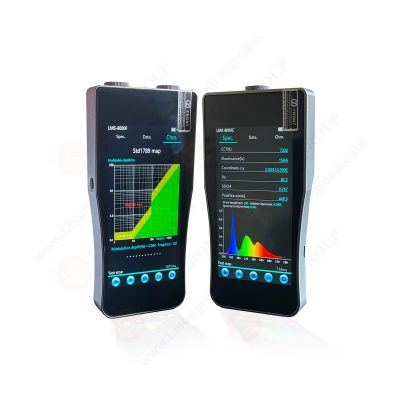
LMS-6000 Portable CCD Spectroradiometer
In terms of optical performance, this Handheld Spectroradiometer achieves wavelength accuracy of ±0.5 nm and spectral resolution of ±0.2 nm, with a sampling interval adjustable at 0.1 nm. Its excellent stray light suppression enables precise capture of spectral details of horticultural light sources, including peak wavelength, full width at half maximum and photon proportion of each band. In addition to the LMS‑6000P, the LMS‑6000S version adds retinal blue light hazard assessment on the basis of the full set of horticultural lighting parameters, suitable for scenarios requiring both crop cultivation and occupational photobiological safety evaluation. The LMS‑6000SF full-function version further integrates flicker analysis to support synchronous detection of flicker issues caused by LED driving power supplies in plant factories.
| Parameter Item | Specification |
|---|---|
| Optical Spectroscopy Platform | Long-focal crossed asymmetric CT spectroscopic system |
| Wavelength Accuracy | ±0.5 nm |
| Spectral Resolution | ±0.2 nm |
| Sampling Interval | 0.1 nm (adjustable) |
| Overall Dimension | 135 mm*80 mm*23 mm |
| Power Supply Battery | 4000 mAh rechargeable lithium battery, up to 20 hours continuous operation |
| Local Storage | 8 GB, supporting 5000‑100000 test reports |
| Wavelength Range of LMS‑6000P Horticulture Version | 350‑850 nm |
| Core Horticultural Lighting Parameters for LMS‑6000P | PAR, PPFD, YPFD, spectral band irradiance, red-to-blue radiation ratio |
| Host PC Software | Bilingual English/Chinese, compatible with Win7/Win8/Win10/Win11, supports test report export |
The orientation of the test probe greatly affects results when conducting horticultural lighting measurements with a Handheld Spectroradiometer. The photosensitive surface of the probe shall be kept horizontal to simulate the posture of plant leaves receiving incident light. Operators should avoid blocking the light source with hands or the instrument body and reduce interference from reflected light off walls and ground. For large planting areas, single-point sampling is insufficient. Grid sampling is recommended to collect PPFD values at multiple positions, calculate the average and map the light field distribution. This helps judge the uniformity of lamp layout and identify zones with excessive or insufficient illumination.
Before testing, confirm that the instrument has been calibrated and select the horticultural lighting test mode for LMS‑6000P. The built-in algorithm automatically calculates PAR, PPFD, YPFD, band irradiance and red-to-blue radiation ratio, displaying numerical readings and spectral curves directly on the screen. During measurement, record lamp suspension height and driving current parameters for subsequent adjustment reference. Saved data can be imported into computer software after field work to export spectrograms and photosynthetic parameters for R&D comparison and engineering acceptance filing. It should be noted that PPFD decays rapidly with increasing distance from the light source. After adjusting lamp height, re-measurement at canopy height using the Handheld Spectroradiometer is mandatory; theoretical calculation cannot replace on-site measurement.
During the R&D phase of horticultural lighting luminaires, researchers use the Handheld Spectroradiometer to compare prototypes with different spectral recipes. By adjusting the output proportion of red, green and blue bands and reading PPFD, YPFD and red-to-blue radiation ratio, suitable spectral schemes for lettuce, strawberry, medicinal plants and other crops can be screened. Compared with large integrating sphere systems, the Handheld Spectroradiometer enables fast comparison of multiple prototypes and shortens the R&D cycle. Luminaire manufacturers can adopt this Handheld Spectroradiometer for sampling inspection on production lines to verify whether photosynthetic radiation parameters meet design targets and control finished product quality.
Plant factories and greenhouses represent the primary application scenarios for the Handheld Spectroradiometer. For new project acceptance, inspectors carry the Handheld Spectroradiometer into planting zones and take multi-point measurements at canopy height to verify whether the overall light environment satisfies design specifications. For operational greenhouses, LED luminaires degrade gradually over service time and PPFD declines accordingly. Regular inspections with the Handheld Spectroradiometer monitor light decay and support decisions on lamp replacement or height adjustment. Many research institutes conducting plant photobiology experiments also use the Handheld Spectroradiometer to continuously monitor the actual light environment of test and control groups, eliminating experimental errors caused by light source drift and ensuring reliable test data.
For special scenarios with human activities inside plant factories, the LMS‑6000S Handheld Spectroradiometer can be selected. It delivers the full set of horticultural lighting parameters while assessing retinal blue light hazards to balance crop growth and occupational photobiological safety. If flicker risks exist in driving circuits, the LMS‑6000SF full-function version supports simultaneous flicker depth and flicker index testing, allowing multiple indicators to be checked with a single instrument.

Horticultural lighting performance depends not only on nominal lamp parameters, but primarily on the actual PAR, PPFD and spectral distribution received by the crop canopy. Built upon the long-focal crossed asymmetric CT spectroscopic system, the Handheld Spectroradiometer integrates laboratory-grade spectral measurement capability into a portable device. The LISUN LMS‑6000P Handheld Spectroradiometer directly outputs dedicated horticultural lighting parameters including PAR, PPFD, YPFD, spectral band irradiance and red-to-blue radiation ratio, solving the limitation that large benchtop instruments cannot perform on-site inspection. During practical testing, operators shall standardize probe placement and adopt multi-point sampling to avoid interference from reflected light and shading, ensuring authentic and stable measurement results. The Handheld Spectroradiometer provides an efficient inspection tool for horticultural lighting R&D, production quality control, engineering acceptance and routine patrol at planting bases, and promotes refined light environment regulation across the horticultural lighting sector.
Tags:LMS-6000Your email address will not be published. Required fields are marked *

 English
 中文简体
 English
 Русский
 Español
 Português
 Türkçe
 العربية
 Deutsch
 Polski
 Italiano
 Français
 한국어
 ไทย
 Tiếng Việt
 日本語