LM-79 Moving Detector Goniophotometer (Mirror Type C)
LSG-6000
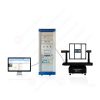
High Precision Rotation Luminaire Goniophotometer
LSG-1890B
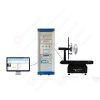
High Precision Rotation Luminaire Goniospectroradiometer
LSG-1890BCCD

Goniophotometer for Automotive and Signal Lamps
LSG-1950
Goniophotometer for Traffic Signal Lamps (Economical Model)
LSG-1950S
VAD Fire Alarm Visual Alert Device Goniophotometer
LSG-1930
Goniophotometer for Airfield Lighting
LSG-1940
Compact Goniophotometer
LSG-1200A
LED Goniophotometer
LSG-1100
Near Field Moving Detector Goniophotometer
LSG-1900B
 LEDs and Luminaire Test Solutions
 LM-79 and LM-80 Test Solutions
 LED Driver Test Solutions
 Household Appliances Test Solutions
 Mobile and Network Test Solutions
 Automotive Electronics Test Solutions
 Audio-Video and IT Test Solutions
 Cable and Wire Test Solutions
 Plugs and Sockets Test Solutions
 Power Switch Test Solutions
 Transformer Test Solutions
 Electric Toys Test Solutions
 Energy Meter Test Solutions
 Motor-Operated Tool Test Solutions
Select an organization
to browse standards
Abstract: The sand and dust test chamber is a key device for simulating dust environments and conducting product dustproof performance testing. Relying on the coordination of a closed test chamber and a circulating dust blowing system, it achieves uniform dust distribution and recycling, and can accurately perform dustproof tests of IP5X, IP6X, IP5KX and IP6KX ratings. Taking the LISUN SC-015 sand and dust test chamber as the research object, this paper expounds its structural design, working principle, core technical parameters and standard adaptability, analyzes its application value in product R&D verification and quality control, and provides technical references for dustproof performance testing of products in electronics, electrical engineering, automobile manufacturing and other fields, helping products operate stably in dusty environments.
1. Introduction
In dusty environments such as industrial production and outdoor operations, the dustproof performance of electronic and electrical products, luminaires, automotive parts and other equipment directly determines their operational stability and service life. As a core indicator for measuring product dust resistance, IP dust ratings include basic levels IP5X and IP6X, as well as high-protection levels IP5KX and IP6KX, which have strict test requirements and high demands on the accuracy and stability of test equipment. The sand and dust test chamber, as a special testing device for simulating dust environments, can scientifically evaluate the performance changes of products under dust erosion and is a key instrument for product R&D, design, quality inspection and factory verification.
With its mature closed chamber design, efficient circulating dust blowing system and comprehensive IP rating test capability, the LISUN SC-015 sand and dust test chamber has become a mainstream testing device in electronics, electrical engineering, automobile manufacturing and other fields. It not only meets relevant domestic and international standards, but also can flexibly adjust parameters according to test requirements, providing reliable test conditions for the verification and optimization of product dustproof performance. It is of great significance to improve product environmental adaptability and ensure stable operation throughout the equipment life cycle.
2. Core Working Principle and Structural Design of the Sand and Dust Test Chamber
2.1 Core Working Principle
The core testing capability of the sand and dust test chamber comes from the coordinated operation of the closed test chamber and the circulating dust blowing system. Its essence is to artificially simulate the dust distribution in natural or industrial environments, expose the tested sample under specified dust concentration, test time, vacuum pressure and other conditions, and then detect the dust sealing performance of the sample.
The closed test chamber provides an independent, leak-free test space for dust testing, effectively avoiding interference from the external environment and ensuring stable dust concentration inside the chamber. The circulating dust blowing system realizes uniform suspension and recycling of dust through the cooperation of fans, vibration devices and heating devices. The vibration device prevents dust from sticking to the chamber wall, and the heating device avoids dust agglomeration, ensuring that the dust distribution in the chamber always meets standard test requirements. For different test requirements of IP5X, IP6X, IP5KX and IP6KX, the sand and dust test chamber can simulate dust erosion environments of different intensities by adjusting parameters such as vacuum pressure, pumping speed and test duration to complete corresponding protection level tests.
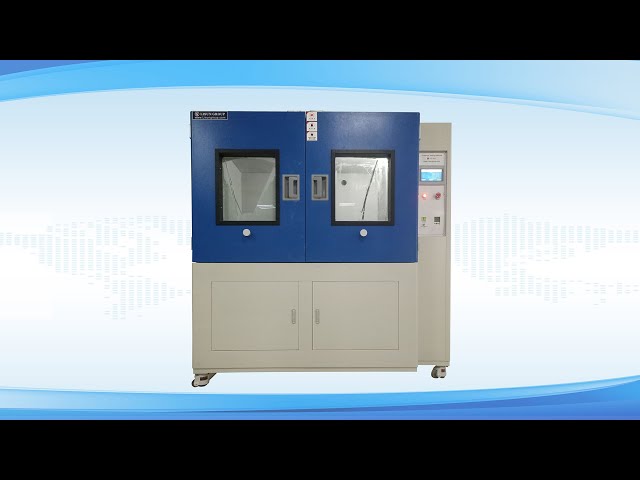
2.2 Structural Design Features of LISUN SC-015 Sand and Dust Test Chamber
The LISUN SC-015 sand and dust test chamber adopts a modular structure design, balancing test accuracy and operation convenience. Its core structure consists of a test chamber, circulating dust blowing system, vacuum system, control system and heating system. All components work together to ensure the scientificity and stability of the test.
• Test Chamber: The outer shell is made of high-quality steel plate with spray painting, which is corrosion-resistant, beautiful and durable. The inner chamber and sample rack are made of stainless steel, effectively preventing rust caused by long-term dust testing and easy to clean. The chamber is equipped with a tempered glass observation window and LED lighting for real-time monitoring of the internal test status. A dust replacement device is installed at the bottom, allowing 100% replacement of used dust to ensure dust purity for subsequent tests.
• Circulating Dust Blowing System: Equipped with a dedicated dust blowing fan and adjustable vibration device. The vibration time is freely adjustable from 0 to 999 hours, effectively preventing dust from sticking to the chamber wall and agglomerating, ensuring uniform dust concentration in the chamber. It adopts free-falling dust spraying, matched with a metal screen of 50μm wire diameter and 75μm pitch to accurately control dust particle size and simulate a real dust environment.
• Vacuum System: Equipped with a professional vacuum pump, with adjustable vacuum pressure of 0~10kPa and pumping speed of 0~4800L/H, providing an accurate vacuum environment for high-level negative pressure dustproof tests such as IP6X and IP6KX, meeting the standard requirements for testing dustproof performance of products under negative pressure.
• Control System: Adopts a 7-inch touch screen + Panasonic PLC intelligent control scheme, which can independently control the dust blowing fan, dust vibration and total test time. It supports free setting of continuous/cyclic dust blowing time, automatic alternation of vibration and stop. The maximum test time can be set to 99 hours and 59 minutes, with a timing accuracy of ±1 second, ensuring convenient and precise operation.
• Heating and Safety System: The circulating air duct is equipped with a clamp-type mica heating ring, which can control the chamber temperature at RT+10~60℃, effectively avoiding dust agglomeration. It also provides dual safety protection against leakage and short circuit, ensuring equipment operation and personnel safety.
3. Technical Parameters and IP Rating Test Capability of LISUN SC-015 Sand and Dust Test Chamber
3.1 Core Technical Parameters
The LISUN SC-015 sand and dust test chamber offers multiple models including SC-500, SC-010, SC-015 and SC-020 for different test scenarios and sample sizes. Each model has differentiated designs in working dimensions and power supply. The core technical parameters cover all requirements for IP5X to IP6KX tests. The basic configuration parameters of each model are shown in Table 1.
| Model | Working Dimensions (mm) | Installation | Power Supply | Suitable Test Samples |
| SC-500 | 800*800*800 | Fixed | Single-phase 220V/50Hz | Small electronic components, lamp accessories |
| SC-010 | 1000*1000*1000 | Fixed | Single-phase 220V/50Hz | Medium electrical cabinets, small automotive parts |
| SC-015 | 1000*1500*1000 | Vertical / Horizontal | Three-phase 380V/50Hz | Large electrical cabinets, automotive engine parts |
| SC-020 | 1000*2000*1000 | Fixed | Three-phase 380V/50Hz | Large industrial equipment, complete vehicle accessories |
The series uses dry talc powder as test dust, with a dosage of 2~4kg/m³, complying with the requirements of GB, IEC and other standards for test dust. The test sample power supply can be flexibly connected according to the input voltage of the sample, with a current not exceeding 10A, suitable for power-on tests of different types of samples. It also supports customized walk-in sand and dust test chambers to meet the test needs of oversized samples with strong adaptability.
3.2 Full‑range IP Dustproof Test Capability
The core value of the sand and dust test chamber is to realize multi‑level IP dustproof tests. The LISUN SC-015 sand and dust test chamber can directly perform basic IP5X and IP6X dustproof tests. It can also be customized as model SC-015-56K to meet the ISO 20653 standard and complete high‑protection IP5KX and IP6KX tests, realizing full‑range dustproof test coverage. The core capabilities of different rating tests are as follows:
• IP5X Test: A dust environment with a concentration of 2~4kg/m³ is built through the circulating dust blowing system. The sample is exposed in this environment for the specified time to detect whether the internal dust deposition meets the standard (deposition ≤5mg), verifying the product’s ability to prevent limited dust ingress.
• IP6X Test: Relying on the vacuum system to pump the chamber to the specified negative pressure (0~10kPa adjustable), the sample is exposed in the dust environment to ensure no visible dust ingress inside the sample, verifying the product’s fully dustproof capability.
• IP5KX / IP6KX Test: The customized SC-015-56K is designed according to Figure 1 of ISO 20653. Based on dust testing, it combines high‑pressure airflow simulation to verify the product’s protection under high‑pressure dust scouring, suitable for products used in high‑dust environments such as automobiles and mines.
In addition, the LISUN SC-015 sand and dust test chamber can flexibly adjust the total test time (0~999H), vibration time, vacuum pressure and other parameters to meet the differentiated requirements of different products and standards for test duration and environmental intensity, with accurate and repeatable test results.
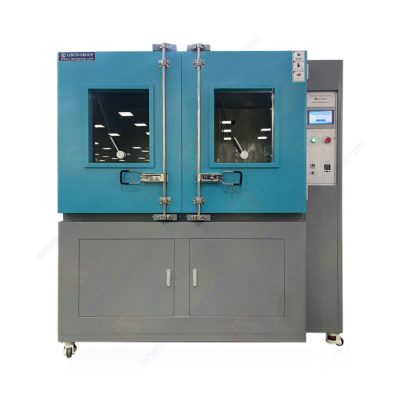
Figure: Sand dust test chamber
4. Standard Adaptation and Industrial Applications of the Sand and Dust Test Chamber
4.1 Full Adaptation to Domestic and International Standards
The validity of test results from the sand and dust test chamber depends on strict compliance with relevant domestic and international standards. The LISUN SC-015 sand and dust test chamber fully meets domestic and international dustproof test standards, ensuring the scientificity and authority of test results. Its core compatible standards include:
• Domestic standards: GB4208-2008 Degrees of protection provided by enclosures (IP Code), GB7000.1 Luminaires – Part 1: General requirements and tests Clause 9.2.1/9.2.2, GB2423.37-89 Environmental testing for electric and electronic products – Part 2: Tests – Test L: Dust and sand, GB/T 4942.2-93 Degrees of protection provided by enclosures for low-voltage equipment.
• International standards: IEC60529:1989 +A1:1999 +A2:2013 Degrees of protection provided by enclosures (IP Code), ISO 20653 (customized version).
The above standards clearly specify dust type, particle size, concentration, test duration, vacuum pressure and other parameters for dust testing. The technical parameters and test procedures of the LISUN SC-015 sand and dust test chamber strictly follow the standard requirements and can be directly used for product compliance testing, with test results widely recognized in the industry.
4.2 Multi‑field Industrial Applications
As a core device for product dustproof performance testing, the sand and dust test chamber is widely used in electronics, electrical engineering, lighting manufacturing, automobiles, motorcycles, industrial control and other fields. With its comprehensive IP rating test capability and flexible parameter adjustment, the LISUN SC-015 sand and dust test chamber has become an important tool for product R&D verification and quality control in various industries:
• Electronics and Electrical Engineering: Used for dustproof testing of electrical cabinets, electrical components, inverters and other products to verify their sealing performance in industrial workshop dust environments, avoiding short circuits and poor contact caused by dust ingress, ensuring stable industrial operation.
• Lighting Manufacturing: Performs IP5X/IP6X tests on outdoor street lamps, industrial lighting and other products to verify their dust resistance in outdoor sand and industrial dust environments, preventing dust from entering the lamp body and affecting lighting effect and service life.
• Automotive and Motorcycle: Used for IP5KX/IP6KX testing of engine parts, on-board electrical appliances, charging piles and other products, simulating the working state in high‑dust environments such as deserts and mines to ensure dustproof sealing performance and driving safety.
• Quality Inspection Institutions: Used as special equipment for third‑party testing institutions to carry out IP dust rating certification, providing authoritative dustproof performance test reports and helping products obtain market access qualifications.
In various applications, the sand and dust test chamber not only provides data support for product R&D and design by identifying weak points in dust sealing and guiding structural and sealing optimization, but also serves as a key link in quality control to conduct sampling inspection on factory products, ensuring that dustproof performance meets design and industry standards and enhancing market competitiveness.
5. Application Value of the Sand and Dust Test Chamber in Product R&D and Quality Control
5.1 Providing Scientific Basis for Product R&D and Verification
In the product R&D stage, the sand and dust test chamber can simulate different dust environments and IP rating requirements to verify dustproof performance in advance, helping R&D personnel identify defects in sealing structure and material selection. For example, in automotive parts R&D, the IP6KX test using the LISUN SC-015 sand and dust test chamber can detect weak points in sealing strips and interfaces, optimize the design in time, avoid failures and recalls after launch, greatly shorten the R&D cycle and reduce costs.
5.2 Building a Key Line of Defense for Product Quality Control
In production and factory delivery, the sand and dust test chamber acts as a core quality inspection device for batch sampling, ensuring that factory products meet dustproof performance requirements. Standardized dust testing effectively eliminates unqualified products, prevents them from entering the market, and improves brand reputation. Test data can also be used for quality traceability, supporting the optimization of the enterprise quality system.
5.3 Helping Products Adapt to Dusty and Complex Environments
With the expansion of product application scenarios, the demand for dustproof performance in industrial mines, outdoor deserts, construction sites and other dusty environments is increasing. By accurately simulating various dust environments, the sand and dust test chamber allows products to complete sufficient environmental adaptability tests before launch, ensuring stable operation against dust erosion, extending service life and improving customer satisfaction.
6. Conclusion
The sand and dust test chamber, as a core high‑precision device for simulating dust environments and conducting IP rating dustproof tests, relies on the coordinated design of a closed test chamber and a circulating dust blowing system to achieve uniform dust distribution and recycling, providing reliable test conditions for full‑range IP5X, IP6X, IP5KX and IP6KX dustproof tests. With reasonable structural design, accurate parameter control, comprehensive standard adaptability and wide industrial compatibility, the LISUN SC-015 sand and dust test chamber is an excellent choice for dustproof performance testing in electronics, electrical engineering, automobile manufacturing and other fields. It can not only complete multi‑level IP dustproof tests, but also be flexibly customized according to test requirements to meet the needs of different samples and scenarios.
Against the background of increasing demand for product R&D verification and quality control, the application value of the sand and dust test chamber is becoming more prominent. It not only provides scientific data support for optimizing product dustproof performance, but also builds a key defense line for product quality control, helping products operate stably in complex and dusty environments. In the future, with the continuous upgrading of IP protection standards and the expansion of product application scenarios, the sand and dust test chamber will develop toward intelligence, integration and customization, such as introducing real‑time dust concentration monitoring, intelligent data recording and analysis functions, further improving test accuracy and efficiency, and providing stronger technical support for improving the environmental adaptability of products in various industries.
Tags:SC-015Your email address will not be published. Required fields are marked *

 English
 中文简体
中文简体 English
 Русский
 Español
 Português
 Türkçe
 العربية
 Deutsch
 Polski
 Italiano
 Français
 한국어
한국어 ไทย
ไทย Tiếng Việt
 日本語
日本語