LM-79 Moving Detector Goniophotometer (Mirror Type C)
LSG-6000
High Precision Rotation Luminaire Goniophotometer
LSG-1890B
High Precision Rotation Luminaire Goniospectroradiometer
LSG-1890BCCD

Goniophotometer for Automotive and Signal Lamps
LSG-1950
Goniophotometer for Traffic Signal Lamps (Economical Model)
LSG-1950S
VAD Fire Alarm Visual Alert Device Goniophotometer
LSG-1930
Goniophotometer for Airfield Lighting
LSG-1940
Compact Goniophotometer
LSG-1200A
LED Goniophotometer
LSG-1100
Near Field Moving Detector Goniophotometer
LSG-1900B
 LEDs and Luminaire Test Solutions
 LM-79 and LM-80 Test Solutions
 LED Driver Test Solutions
 Household Appliances Test Solutions
 Mobile and Network Test Solutions
 Automotive Electronics Test Solutions
 Audio-Video and IT Test Solutions
 Cable and Wire Test Solutions
 Plugs and Sockets Test Solutions
 Power Switch Test Solutions
 Transformer Test Solutions
 Electric Toys Test Solutions
 Energy Meter Test Solutions
 Motor-Operated Tool Test Solutions
Select an organization
to browse standards
Abstract
Electronic and electrical products, lamps, electrical cabinets, auto and motorcycle parts are continuously exposed to sand and dust in outdoor and industrial environments. Dust intrusion may lead to circuit short circuits, insulation failure, mechanical jamming and other malfunctions. Testing of IP5X and IP6X dust protection grades on enclosures has become a core link of product reliability verification. Taking the LISUN SC-015 dust chamber as the test equipment, this paper follows standards including GB/T4208-2008 and IEC60529:2013. It elaborates the working principle of the dust chamber, test procedures and test schemes for various types of samples. Combined with measured data to compare dust failure characteristics of different products, the paper clarifies the application value of dust chamber in R&D finalization, factory inspection and certification testing, and provides test basis for standardized optimization of enclosure sealing structure and dust-proof inspection of various products.
1 Introduction
Mining plants, road surfaces, desert areas, open construction sites and other scenarios are filled with suspended talcum powder, fine sand and airborne particulate matter all year round. Once there are defects in the seal of outer shells for electronic components, outdoor lamps, low-voltage electrical cabinets, motorcycle sensors, automotive lamps and other products, ultrafine dust will penetrate into equipment through gaps, blocking heat dissipation channels, causing contact oxidation and declining insulation performance, which greatly shortens the service life of equipment.
Domestic and international unified standards stipulate that IP5X and IP6X dust resistance tests must be completed in a sealed dust chamber. Circulating suspended dust and negative pressure pumping systems are adopted to simulate real dust penetration working conditions. The LISUN SC-015 dust chamber is mainstream testing equipment suitable for medium and large-size samples, with an internal working dimension of 1000×1500×1000 mm. It can hold multiple specifications of samples simultaneously, supporting temperature regulation, automatic dust shaking, vacuum negative pressure and long-time timed testing, covering full-range IP dust resistance testing demands of electronics, lighting, low-voltage electrical appliances and auto parts. Based on standardized tests carried out in the SC-015 dust chamber, this paper systematically analyzes testing methods and judgment standards for dust protection performance of various products.
2 Test Equipment and Standard Basis
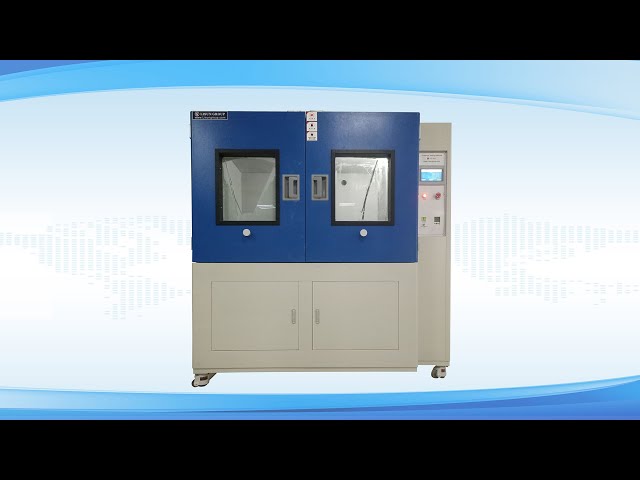
2.1 Core Test Equipment: LISUN SC-015 Dust Chamber
The SC-015 dust chamber is designed in strict accordance with IEC60529 and GB2423.37-89 standards, consisting of five major modules: sealed test cavity, dust circulation system, heating temperature control system, vacuum pumping system and PLC touch control system. Key technical parameters are as follows:
• Cavity material: 304 stainless steel inner liner, painted steel outer shell, detachable dust collecting unit at the bottom for convenient dust replacement;
• Standard dust: 75 μm sieve mesh to filter dry talcum powder with 50 μm metal wire, standard dosage of 2kg/m³; talcum powder can be reused no more than 20 times per batch;
• Ambient control: adjustable temperature from RT+10℃ to 60℃, built-in dust chamber to prevent dust caking and adhesion on chamber walls;
• Vacuum system: adjustable negative pressure 0~10kPa, pumping speed 0~4800L/H, meeting IP6X negative pressure standard of extracting 80 times the enclosure volume of air;
• Control unit: 7-inch touch screen with Panasonic PLC, independent timing for dust blowing, vibration and total test duration, maximum test time 99h59min;
• Power supply: 380V three-phase power supply, compatible with vertical/horizontal placement of large samples such as complete electrical cabinets and integrated vehicle lamp assemblies.
The equipment is equipped with tempered glass observation window and built-in LED lighting, allowing full visual observation of sealing status of samples under dust cloud environment. Samples can be powered on synchronously during testing to simulate actual breathing pressure difference generated by equipment heat emission during operation.
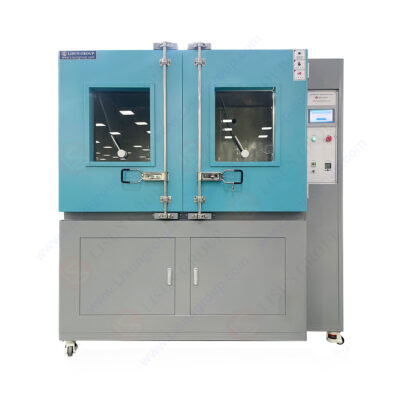
SC-015_AL
2.2 Adopted Testing Standards
• International Standard: IEC60529:1989+A1:1999+A2:2013 Degrees of protection provided by enclosures (IP Code);
• General Domestic Standards: GB/T4208-2008 Degrees of protection provided by enclosures (IP Code), GB2423.37-89 Environmental testing for electric and electronic products Test L: Dust and sand test;
• Industry Special Standards: GB7000.1 Luminaires Part 1: General requirements and tests, GB/T4942.2-93 Degrees of protection for low-voltage equipment, GB/T10485 Environmental test specifications for automotive lighting components.
3 Standardized Dust Test Procedures Based on Dust Chamber
Unified test steps for IP5X/IP6X testing with SC-015 dust chamber are listed below:
3.1 Sample Pretreatment and Clamping
• Visual inspection: Check whether the enclosure sealing rings, cable glands, cover plates and screw joints have damage, lack of glue or excessive assembly gaps;
• Classification of shell types: Type I shells (equipment generating internal negative pressure during operation, e.g. heat-emitting lamps, motor electronic controls) shall be reserved with air extraction holes; Type II shells with balanced internal and external air pressure require no negative pressure connection;
• Sample fixing: Mount electronic components, lamps, small electrical cabinets and auto parts on stainless steel sample racks inside the chamber according to actual installation posture. The spacing between multiple samples shall be ≥100mm to ensure uniform dust coverage on test pieces.
3.2 Parameter Setting of Dust Chamber Test
• Dust feeding: Feed dry talcum powder at a dosage of 2kg/m³ based on cavity volume, and remove coarse agglomerated particles via standard metal sieve;
• Temperature setting: Set 40℃ uniformly for outdoor equipment, preheat dust through heating air ducts to avoid dust damp caking;
• Circulation and dust shaking: Turn on periodic dust blowing fans and intermittent dust chamber to maintain evenly suspended dust cloud inside the chamber;
• Negative pressure control (IP6X only): Connect vacuum pump to reserved air extraction holes on samples, continuously extract air equivalent to 80 times the enclosure volume, and use pressure difference to drive dust penetration through shell gaps; IP5X only adopts natural dust suspension without applied negative pressure.
3.3 Test Duration and Post-test Judgment
Standard test duration for IP5X is 8 hours, while IP6X lasts 24 hours. After testing, turn off fans and vacuum system, stand still for 30 minutes for natural dust settlement, then take out samples for disassembly inspection:
• IP5X Pass Criteria: A small amount of dust deposition is allowed inside, but dust shall not cover circuit boards, terminals and transmission structures. Continuous 4-hour power-on operation shows no short circuit, overheating or functional abnormality;
• IP6X Pass Criteria: No visible dust intrusion inside the shell, no dust accumulation traces at sealing joints, cable inlets and drain holes.
4 Comparative Measured Data of Various Products Tested in Dust Chamber
In this test, LISUN SC-015 dust chamber was adopted to carry out IP6X dust resistance test simultaneously on 3 pieces of mainstream products from 5 industries under unified test conditions: temperature 40℃, talcum powder dosage 2kg/m³, negative pressure 5kPa, continuous test for 24 hours. Test statistical results are shown in Table 1.
Table 1 IP6X Dust Resistance Test Results of Various Products in SC-015 Dust Chamber
| Sample Category | Quantity & Specification | Enclosure Sealing Design | Internal Dust Condition After Test | Power-on Function Test Result | Test Conclusion | Root Cause of Failed Samples |
| Outdoor LED Street Lamp (Luminaire) | 3 sets, 100W power | Integral silicone seal, rubber sheath for wiring holes | Trace dust at lamp compartment edge for 1 set, no dust for 2 sets | Strobe light failure on the sample with trace dust, normal for others | 2 passed, 1 failed | Excessive assembly gap of wiring sheath |
| Small Low-Voltage Electrical Cabinet | 3 units, 400×600×200mm | Integrated foam adhesive strip seal | No dust intrusion on all samples | Circuit breakers and contactors operate normally | All passed | No segmented splicing gaps on sealing foam strips |
| Automotive Reverse Radar Sensor (Auto Part) | 3 pieces, on-board electronic components | Integrated injection molded shell + O-ring | Dust accumulation inside 2 pieces, trace dust in 1 piece | Signal reception failure on all 3 pieces | All failed | High hardness O-ring with insufficient assembly compression |
| Industrial Frequency Converter (Electrical & Electronic Product) | 3 units, 0.75kW | Split shell plane sealing | Minor dust at circuit board corner of 1 unit, clean interior for 2 units | Abnormal noise of cooling fan on dusty sample, normal for others | 2 passed, 1 failed | Uneven screw tightening torque leading to partial gaps |
| Motorcycle Instrument Assembly (Auto & Motorcycle Part) | 3 sets | Simple double-sided adhesive seal | Massive dust intrusion on all samples | Black screen and malfunctioning buttons | All failed | No dedicated elastic sealing components, only double-sided adhesive for blocking |
As shown in Table 1, under the harsh dust negative pressure environment simulated by the SC-015 dust chamber, dust failure of products mainly stems from three issues: improper selection of sealing accessories, defective assembly processes and simple adhesive sealing structures. Low-voltage electrical cabinets equipped with integrated foam strips and complete silicone rings all passed IP6X testing, representing the optimal dust-proof structural solution. The dust chamber can accurately reproduce real outdoor dust penetration conditions, rapidly expose defects in enclosure sealing design and provide quantitative test data support for structural improvement of products.
5 Application Advantages of SC-015 Dust Chamber in Industrial Testing
• Compatible with multi-category large-size samples: The 1000×1500mm horizontal internal space can fully accommodate complete electrical cabinets, full sets of automotive lamps and large industrial lamps without disassembling samples, restoring the real sealing state of whole machines. Small electronic components and sensors can be tested in batches on layered racks to improve inspection efficiency.
• Full coverage of standard parameters: Dust concentration, negative pressure, temperature, dust shaking and timing all comply with national IP5X/IP6X standards and IEC international standards. Test data can be directly used for CNAS third-party certification reports and export inspection of products.
• Rapid verification for R&D iteration: In the product design stage, enterprises can compare dust resistance effects of different sealing strips, shell structures and assembly processes rapidly via the SC-015 dust chamber, shortening product finalization cycle and reducing rework costs caused by field failures outdoors.
• Convenient operation and maintenance: The detachable dust collecting bin at the bottom allows full replacement of talcum powder to avoid test concentration interference from mixed new and old dust. Multiple sets of industry-specific test templates can be stored in PLC automatic programs, supporting one-click switching of test processes for lamps, auto parts and electrical cabinets.
6 Conclusion and Prospect
The dust chamber is indispensable standardized testing equipment for verifying the dust protection performance of enclosures for electronic and electrical products, lighting fixtures, low-voltage electrical cabinets, automotive and motorcycle parts. Featuring large-volume cavity, complete negative pressure temperature control system and fully automatic control functions, the LISUN SC-015 dust chamber can accurately simulate real dust penetration working conditions and stably complete IP5X and IP6X two-level dust resistance grade testing.
Comparative tests of various samples in the SC-015 dust chamber prove that the dust resistance performance of enclosures mainly depends on sealing structure form, sealing accessory material and assembly technology. Simple double-sided adhesive, O-rings with insufficient compression and split structures with uneven tightening are highly prone to dust intrusion failure. Enterprises can carry out advance reliability tests relying on dust chamber, optimize shell sealing design and improve outdoor environmental adaptability of products from the source.
Subsequent derivative model 56K dust chamber based on SC-015 series can be equipped with strong dust impact testing conforming to ISO20653 standards, expanding high-grade dust resistance testing scenarios for commercial vehicles and construction machinery parts, and further improving the dust reliability verification system covering all industries.
Tags:SC-015Your email address will not be published. Required fields are marked *

 English
 中文简体
中文简体 English
 Русский
 Español
 Português
 Türkçe
 العربية
 Deutsch
 Polski
 Italiano
 Français
 한국어
한국어 ไทย
ไทย Tiếng Việt
 日本語
日本語