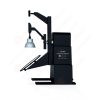
LM-79 Moving Detector Goniophotometer (Mirror Type C)
LSG-6000
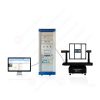
High Precision Rotation Luminaire Goniophotometer
LSG-1890B
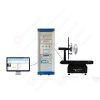
High Precision Rotation Luminaire Goniospectroradiometer
LSG-1890BCCD

Goniophotometer for Automotive and Signal Lamps
LSG-1950
Goniophotometer for Traffic Signal Lamps
LSG-1950S
VAD Fire Alarm Visual Alert Device Goniophotometer
LSG-1930
Compact Goniophotometer
LSG-1200A
LED Goniophotometer
LSG-1100
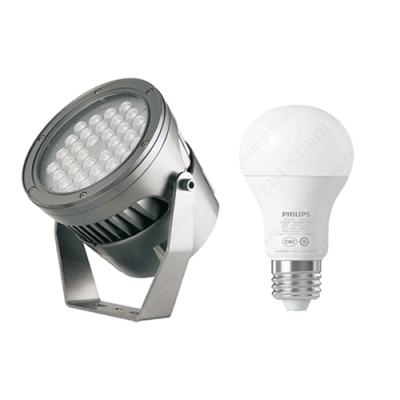 LEDs and Luminaire Test Solutions
 LM-79 and LM-80 Test Solutions
 LED Driver Test Solutions
 Household Appliances Test Solutions
 Mobile and Network Test Solutions
 Automotive Electronics Test Solutions
 Audio-Video and IT Test Solutions
 Cable and Wire Test Solutions
 Plugs and Sockets Test Solutions
 Power Switch Test Solutions
 Transformer Test Solutions
 Electric Toys Test Solutions
 Energy Meter Test Solutions
 Motor-Operated Tool Test Solutions
Select an organization
to browse standards
Abstract
As an efficient and accurate element analysis equipment, the metal XRF analyzer plays a crucial role in industrial testing, environmental monitoring and other fields relying on its unique working principle. Taking the LISUN EDX-2A energy dispersive X-ray fluorescence spectrometer as the research object, this paper elaborates in detail the core principle of the metal XRF analyzer for determining the elements contained in the sample based on the different characteristic X-ray wavelengths of various elements, and measuring the element content by comparing the intensity of element spectral lines. Combined with the specific parameters, application scenarios and actual measurement data of the equipment, it demonstrates its application value in RoHS testing, element analysis and other fields, providing a reference for the testing work in related industries.
1. Introduction
In modern industrial production and product quality testing, it is essential to quickly and accurately identify the elemental composition and content in substances. As a testing equipment based on X-ray fluorescence spectroscopy technology, the metal XRF analyzer can realize element analysis of samples in various forms such as solids, liquids and powders without complex pretreatment of samples. The LISUN EDX-2A energy dispersive X-ray fluorescence spectrometer, as a typical representative of such equipment, integrates multiple functions including RoHS testing, element analysis and coating thickness measurement. Its core working mechanism is to identify element types by utilizing the specificity of characteristic X-ray wavelengths of different elements, and determine element content through spectral line intensity comparison, which is widely used in electronics and electrical appliances, metal processing and other industries.
2. Working Principle of Metal XRF Analyzer
The working core of the metal XRF analyzer is based on the phenomenon of X-ray fluorescence emission. When the primary X-rays emitted by the X-ray tube irradiate the surface of the sample, the atoms in the sample will absorb the energy of the primary X-rays, causing the inner electrons of the atoms to be excited and transition, and the atoms are in an unstable excited state. Subsequently, the outer electrons will transition to the inner holes, and the energy released during the transition is radiated in the form of characteristic X-rays.
Due to the differences in the atomic structure of different elements, the energy released during electron transition is different, and the corresponding characteristic X-ray wavelengths are also unique, which is the basis for qualitative element analysis. The metal XRF analyzer captures these characteristic X-rays through a detector, and can accurately determine the types of elements contained in the sample according to the different wavelengths. At the same time, there is a certain quantitative relationship between the intensity of element spectral lines and the content of the element in the sample. By comparing the measured spectral line intensity with that of standard samples and combining with relevant quantitative analysis models, the content of each element in the sample can be accurately determined.
The LISUN EDX-2A adopts a Si-pin detector with a resolution of 149 electron volts, which can accurately distinguish the characteristic X-ray wavelengths of different elements. Its content analysis range covers 2ppm–99.99%, which can meet the element content detection needs of most samples.
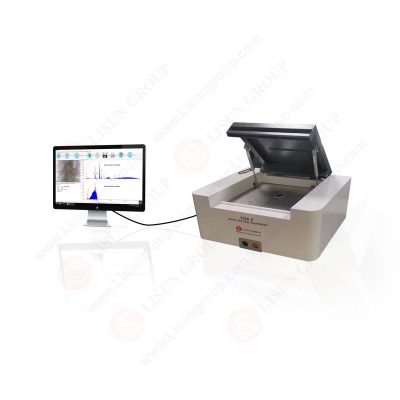
RoHS Testing Equipment EDX-2A
3. Technical Parameters and Performance of LISUN EDX-2A Metal XRF Analyzer
3.1 Core Technical Parameters
As a non-vacuum desktop metal XRF analyzer, the LISUN EDX-2A has significant advantages in structural design and detection performance. Its detailed technical parameters are shown in the following table:
| Specification Parameters | Specific Values |
| Equipment Type | Non-vacuum desktop |
| Equipment Weight | 50Kg |
| Detection Time | 200 seconds |
| Sample Chamber Size | 610*320*100mm (LWH) |
| Testing Environment | Atmosphere |
| Detector Type | Si-pin |
| Resolution | 149 electron volts |
| Output Tube Voltage and Current | 50KV/600uA (automatically adjustable) |
| Test Sample Types | Solids, liquids, powders |
| Content Analysis Range | 2ppm–99.99% |
| Typical Application | RoHS testing |
3.2 Performance Advantages
• High Resolution and Accurate Detection: The equipment adopts European and American imported core technologies and original parts. The high resolution of 149 electron volts ensures the accurate identification of characteristic X-rays of different elements, effectively avoiding element misjudgment.
• Convenient Operation and Visual Monitoring: Equipped with a high-definition camera and an in-chamber lighting system, it can real-time view the test position of the sample, facilitating operators to accurately locate the test area and improve detection efficiency.
• Safety and Reliability: It has reliable power overcurrent and short-circuit protection functions to ensure the safe operation of the equipment. At the same time, the equipment includes pure silver samples and EU standard samples with EU calibration certificates, ensuring the accuracy and authority of detection results.
• Wide Adaptability: It can be compatible with various types of samples such as solids, liquids and powders without complex pretreatment, meeting the detection needs of different industries.
4. Practical Application of Metal XRF Analyzer——Taking RoHS Testing as an Example
4.1 Background of RoHS Testing
RoHS is a mandatory standard formulated by the European Union, whose full name is “Restriction of Hazardous Substances”. It aims to restrict the use of 6 harmful substances including lead, mercury, cadmium, hexavalent chromium, polybrominated biphenyls (PBBs) and polybrominated diphenyl ethers (PBDEs) in electrical and electronic equipment. Among them, the limit content of lead, mercury, hexavalent chromium, PBBs and PBDEs is 1000ppm, and the limit content of cadmium is 100ppm. The LISUN EDX-2A metal XRF analyzer can conduct rapid screening and detection of the above harmful elements by using X-ray fluorescence spectroscopy in accordance with “Test Methods for Toxic and Hazardous Substances in Electronic Information Products” (SJ/T 11365-2006).
4.2 Actual Measurement Data and Analysis
Plastic components in electronic and electrical products were selected as test samples, and the LISUN EDX-2A was used for RoHS harmful element detection. Some actual measurement data are shown in the following table:
| Restricted Substances | Measured Content (ppm) | Limit Content (ppm) | Qualified or Not |
| Mercury (Hg) | 32 | 1000 | Yes |
| Hexavalent Chromium (CrVI) | 45 | 1000 | Yes |
| Cadmium (Cd) | 8 | 100 | Yes |
| Lead (Pb) | 68 | 1000 | Yes |
| Polybrominated Biphenyls (PBBs) | 29 | 1000 | Yes |
| Polybrominated Diphenyl Ethers (PBDEs) | 35 | 1000 | Yes |
It can be seen from the actual measurement data that the content of each harmful element in the plastic component is lower than the limit content specified by the RoHS standard, and the product meets the environmental protection requirements. By accurately capturing the characteristic X-ray wavelengths of various harmful elements, the LISUN EDX-2A determines the element types, and accurately calculates the element content by comparing the spectral line intensity of standard samples. The detection results are reliable and the detection process is efficient and fast, providing strong support for enterprise product quality control.

5. Conclusion
Based on the specificity of characteristic X-ray wavelengths of different elements and the quantitative relationship between spectral line intensity and element content, the metal XRF analyzer realizes rapid and accurate detection of the elemental composition and content of samples. As an excellent metal XRF analyzer, the LISUN EDX-2A energy dispersive X-ray fluorescence spectrometer has many advantages such as high resolution, convenient operation, safety and reliability, and performs prominently in RoHS testing and other fields. Its characteristics of no complex sample pretreatment, wide detection range and high detection accuracy can meet the needs of efficient detection in modern industrial production, providing important guarantee for enterprises to reduce detection costs and improve product quality. With the continuous development of detection technology, the metal XRF analyzer will be widely used in more fields, providing more powerful technical support for industrial development and environmental protection.
Your email address will not be published. Required fields are marked *

 English
 中文简体
中文简体 English
 Русский
 Español
 Português
 Türkçe
 العربية
 Deutsch
 Polski
 Italiano
 Français
 한국어
한국어 ไทย
ไทย Tiếng Việt
 日本語
日本語