LM-79 Moving Detector Goniophotometer (Mirror Type C)
LSG-6000
High Precision Rotation Luminaire Goniophotometer
LSG-1890B
High Precision Rotation Luminaire Goniospectroradiometer
LSG-1890BCCD

Goniophotometer for Automotive and Signal Lamps
LSG-1950
Goniophotometer for Traffic Signal Lamps (Economical Model)
LSG-1950S
VAD Fire Alarm Visual Alert Device Goniophotometer
LSG-1930
Goniophotometer for Airfield Lighting
LSG-1940
Compact Goniophotometer
LSG-1200A
LED Goniophotometer
LSG-1100
Near Field Moving Detector Goniophotometer
LSG-1900B
 LEDs and Luminaire Test Solutions
 LM-79 and LM-80 Test Solutions
 LED Driver Test Solutions
 Household Appliances Test Solutions
 Mobile and Network Test Solutions
 Automotive Electronics Test Solutions
 Audio-Video and IT Test Solutions
 Cable and Wire Test Solutions
 Plugs and Sockets Test Solutions
 Power Switch Test Solutions
 Transformer Test Solutions
 Electric Toys Test Solutions
 Energy Meter Test Solutions
 Motor-Operated Tool Test Solutions
Select an organization
to browse standards
Abstract
Electromagnetic compatibility (EMC) is a core indicator for market access and stable operation of electrical and electronic products. Conducted emission and radiated emission, as the two major core items of electromagnetic interference (EMI) detection, respectively characterize the interference characteristics of equipment propagating through power lines/signal lines and spatial electromagnetic wave radiation. Taking the LISUN EMI-9KB EMI Conducted and Radiated Interference Test System as the research object, this paper expounds the detection principle and standard basis of conducted emission and radiated emission, analyzes the configuration parameters, test process and application advantages of the EMI-9KB system, and clarifies its technical supporting role in EMC compliance testing and interference source precise positioning of products. It provides a reference for EMI detection and EMC rectification of electrical and electronic products.
1. Introduction
With the continuous improvement of integration degree and operating frequency of electrical and electronic products, the electromagnetic interference generated during equipment operation has become increasingly prominent. Conducted emission refers to electromagnetic disturbance propagated by interference signals through conductors such as power lines, signal lines and ground lines, which easily pollutes the power grid and interferes with peripheral wired connected equipment. Radiated emission means interference signals spread outward in the form of electromagnetic waves, affecting the normal operation of wireless communication, precision instruments and surrounding electronic equipment.
EMC testing needs to quantitatively measure the amplitude and spectral characteristics of conducted emission and radiated emission to determine whether they comply with the limits of domestic and international standards. As an automatic EMI conducted and radiated interference test system, LISUN EMI-9KB is suitable for the detection demands of electrical lighting, information technology equipment and other products. It covers full-band interference signal acquisition and analysis, and has become the core equipment for conducted emission and radiated emission compliance testing in laboratories and enterprise production lines.
2. Detection Principle and Standards of Conducted Emission and Radiated Emission
2.1 Basic Detection Principle
Conducted emission detection focuses on the low frequency band of 9kHz~30MHz. The LISN artificial mains network is used to couple the power line disturbance voltage of the equipment under test, capture conducted interference signals such as harmonics and spike pulses, and quantify the propagation intensity of interference along the line. Radiated emission mainly covers the medium and high frequency band of 30MHz~300MHz. Relying on CDNE-M316 coupling/decoupling network, three-loop antenna and other accessories, it collects electromagnetic wave signals radiated by equipment into space, analyzes the radiated field strength and spectral distribution, and realizes quantitative evaluation of spatial interference characteristics.
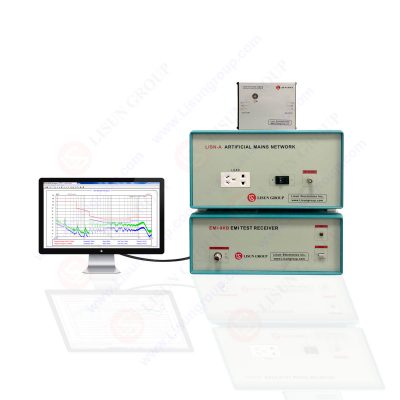
EMI-9KB EMI Test Receiver
2.2 Applicable Compliance Standards
The detection of conducted emission and radiated emission must strictly follow international and domestic general standards. The EMI-9KB system has a built-in standard database that can directly match detection limits. The main applicable standards are shown in the table below:
| Standard No. | Scope of Application | Test Item |
| GB17743 / CISPR15 | Electrical lighting and similar equipment | Conducted Emission, Radiated Emission |
| GB6113.101-2008 / CISPR16-1 | Radio disturbance measuring equipment and methods | General test for Conducted Emission & Radiated Emission |
| EN55015 | Radio disturbance limits for lighting equipment | Conducted Emission, Radiated Emission |
| EN55022 / FCC Part15 | Information technology equipment | Conducted Emission, Radiated Emission |
3. Configuration and Core Technical Parameters of EMI-9KB Test System
3.1 System Hardware Configuration
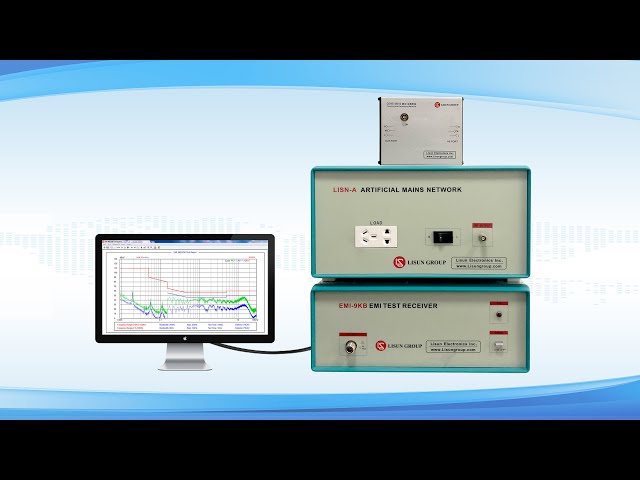
LISUN EMI-9KB EMI Conducted and Radiated Interference Test System is an integrated automatic testing device. The complete configuration includes: EMI-9KB EMI receiver (9kHz~300MHz), LISN artificial mains network, CDNE-M316 coupling/decoupling network, isolation transformer, attenuator and coaxial cable. It can be matched with extended accessories such as SDR-2000B EMI shielding room, VVLA-30M three-loop antenna and AB-CLP absorbing clamp to meet the refined detection demands of conducted emission and radiated emission in different scenarios.
3.2 Core Technical Parameters
With high-precision hardware design, the EMI-9KB system ensures the measurement accuracy of conducted emission and radiated emission. The key technical parameters are as follows:
• Frequency range: 9kHz~300MHz, covering the full band of conducted emission and the core medium and low frequency range of radiated emission;
• Frequency stability: 1×10⁻⁶; frequency resolution is set by segment: 30Hz for 9kHz~150kHz and 1kHz for 150kHz~30MHz;
• Test error: ±2dB, meeting the industrial metrology accuracy requirements;
• Detection mode: supporting Peak (PK), Quasi-Peak (QP) and Average (AV) modes, matching standard limit judgment rules;
• Level measurement range: 20dBμV~140dBμV, suitable for detection of interference signals with high and low amplitude;
• Software compatibility: Chinese and English operation software, compatible with Win7 to Win11 systems, automatically generating test reports in international standard format.
• Meanwhile, the equipment adopts a fully enclosed high-conductivity material body with excellent shielding performance, fundamentally avoiding the influence of self-interference on conducted emission and radiated emission test results.
4. Application Process of EMI-9KB in Conducted Emission and Radiated Emission Detection
4.1 Pre-test Preparation
Place the electrical and electronic equipment under test in an EMI shielding room, complete power supply wiring, and connect the EMI-9KB receiver in series with the LISN artificial mains network. For radiated emission testing, arrange CDNE-M316 coupling/decoupling network and three-loop antenna. In accordance with CISPR15:2018 standard, it replaces the traditional CDN network and adapts to radiated interference testing of lighting equipment from 30MHz to 300MHz.
4.2 Automatic Detection and Data Analysis
Start the system software, select the corresponding product test standard, and set three adjustable scanning bandwidths of 200Hz, 9kHz and 120kHz with scanning frequency step from 20Hz to 2MHz. The system automatically completes full-band scanning of power line disturbance voltage for conducted emission and spatial field strength for radiated emission, draws spectral curves in real time, and automatically compares with standard limits to judge compliance.
4.3 Interference Source Location and Rectification Support
For frequency bands with excessive conducted emission, rely on system spectral data to lock interference sources such as power line harmonics and switching power supply oscillation. For excessive radiated emission, combine antenna point test data to locate hidden troubles such as equipment shell gaps and high-speed signal line radiation, providing accurate data support for circuit optimization, shielding design and filter device selection.
5. Application Advantages and Engineering Value of the System
In the test scenarios of conducted emission and radiated emission, the EMI-9KB system has obvious advantages: first, high integration, completing two core test items in one stop without equipment splitting; second, comprehensive standard adaptation, compatible with national standards, EU, US and other certification standards to meet market access testing of products at home and abroad; third, intelligent operation with automatic scanning and automatic compliance report generation, reducing manual errors; fourth, strong expandability, which can be matched with programmable pure sine wave source meters, current probes and other accessories to adapt to the detection of home appliances, lighting, power tools and other products.
The system can be used not only for laboratory certification testing, but also for R&D stage pre-testing and mass production sampling inspection of conducted emission and radiated emission, shortening the EMC rectification cycle and reducing R&D and certification costs.
6. Conclusion
Conducted emission and radiated emission are the core dimensions of EMC detection for electrical and electronic products. Accurate quantitative measurement of such interference signals is the premise for products to enter the market compliantly. With reasonable hardware configuration, precise technical parameters and perfect standard adaptation capability, LISUN EMI-9KB EMI Conducted and Radiated Interference Test System can efficiently complete automatic detection of conducted emission and radiated emission within 9kHz~300MHz. It can not only quickly judge product compliance, but also accurately locate electromagnetic interference sources.
Adaptable to the detection demands of lighting, information technology, household appliances and other fields, the system provides reliable technical equipment support for EMC design, testing certification and quality control of electrical and electronic products, and has wide application and promotion value in the EMC testing industry.
Tags:EMI-9KBYour email address will not be published. Required fields are marked *

 English
 中文简体
中文简体 English
 Русский
 Español
 Português
 Türkçe
 العربية
 Deutsch
 Polski
 Italiano
 Français
 한국어
한국어 ไทย
ไทย Tiếng Việt
 日本語
日本語