LM-79 Moving Detector Goniophotometer (Mirror Type C)
LSG-6000
High Precision Rotation Luminaire Goniophotometer
LSG-1890B
High Precision Rotation Luminaire Goniospectroradiometer
LSG-1890BCCD

Goniophotometer for Automotive and Signal Lamps
LSG-1950
Goniophotometer for Traffic Signal Lamps (Economical Model)
LSG-1950S
VAD Fire Alarm Visual Alert Device Goniophotometer
LSG-1930
Goniophotometer for Airfield Lighting
LSG-1940
Compact Goniophotometer
LSG-1200A
LED Goniophotometer
LSG-1100
Near Field Moving Detector Goniophotometer
LSG-1900B
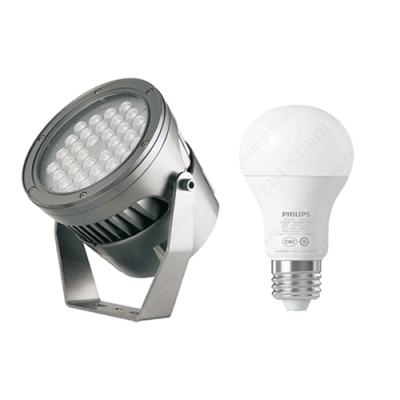 LEDs and Luminaire Test Solutions
 LM-79 and LM-80 Test Solutions
 LED Driver Test Solutions
 Household Appliances Test Solutions
 Mobile and Network Test Solutions
 Automotive Electronics Test Solutions
 Audio-Video and IT Test Solutions
 Cable and Wire Test Solutions
 Plugs and Sockets Test Solutions
 Power Switch Test Solutions
 Transformer Test Solutions
 Electric Toys Test Solutions
 Energy Meter Test Solutions
 Motor-Operated Tool Test Solutions
Select an organization
to browse standards
Abstract:
Electromagnetic interference (EMI) is a key factor restricting the reliability and compliance of electrotechnical electronic products. Conducted interference propagates through power lines and signal lines, while radiated interference propagates through space, both of which will affect normal equipment operation and electromagnetic compatibility (EMC) certification. As the core instrument for quantitative EMI measurement, EMI spectrum analyzer can realize frequency-domain analysis of interference signals, accurate amplitude calibration and standard compliance judgment. Taking LISUN EMI-9KB EMI conducted and radiated interference test system as the research object, this paper expounds the measurement principle, system composition, technical specifications and test procedures of EMI spectrum analyzer for conducted and radiated interference testing. Verified with measured data comparison, it provides technical reference for EMC design, rectification and certification testing of electrotechnical electronic products.
1 Introduction
With the high-frequency and miniaturized development of electrotechnical electronic products such as switching power supplies, variable frequency drives, LED lighting and smart home devices, high-frequency electromagnetic noise generated by internal high-speed switching and nonlinear loads emits outward through conducted and radiated paths, resulting in communication bit errors, audio noise, display abnormalities and even potential safety hazards. Strict EMC standards have been issued worldwide and domestically, including CISPR 15, GB 17743, FCC Part 15, EN 55015 and EN 55022, which mandate products to pass EMI tests.
EMI spectrum analyzer converts time-domain electromagnetic signals into frequency-domain distribution, accurately obtains the frequency, amplitude, bandwidth and distribution characteristics of interference signals, and realizes quantitative measurement of conducted and radiated interference. Traditional test equipment has disadvantages such as high self-interference, insufficient dynamic range and low automation. Taking high-performance EMI spectrum analyzer as the core, LISUN EMI-9KB builds a fully automatic EMI test system, which effectively suppresses self-interference, covers standard frequency bands and outputs internationally recognized reports, meeting compliance test requirements for lighting, household appliances, power supplies and other products.
2 Mechanism of Electromagnetic Interference and Measurement Basis
2.1 Conducted Interference and Radiated Interference
Conducted interference: Interference energy propagates through conductors such as power lines, signal lines and grounding wires, appearing as differential-mode/common-mode voltage and current, mainly in the frequency band of 9 kHz–30 MHz.
Radiated interference: Interference energy propagates in the form of electromagnetic waves through space, emitted by cables, PCB traces and housing gaps equivalent antennas, mainly in the frequency band of 30 MHz–300 MHz and above.
2.2 Measurement Standards
The system complies with CISPR 16-1, CISPR 15, GB 17743, FCC, EN 55015, EN 55022 and other standards, which uniformly specify test equipment, bandwidth, detection modes and limit curves to ensure mutual recognition of test results.
3 EMI Spectrum Analyzer Test System Based on EMI-9KB
3.1 System Composition
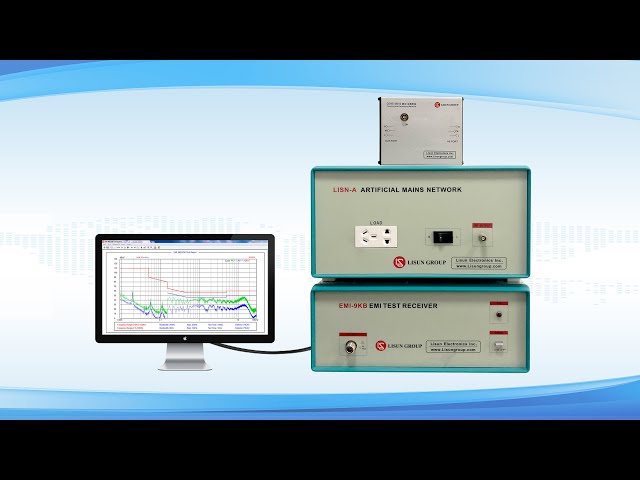
Taking dedicated EMI spectrum analyzer as the core, LISUN EMI-9KB forms a complete conducted and radiated interference test scheme with auxiliary equipment:
• EMI-9KB Electromagnetic Interference Receiver: 9 kHz–300 MHz, built-in high-performance spectrum analysis and detection module, realizing signal acquisition, spectrum analysis and amplitude measurement.
• LISN Line Impedance Stabilization Network: Isolates power grid noise, provides standard impedance and extracts conducted disturbance voltage of EUT.
CDNE-M316 Coupling/Decoupling Network: Compliant with CISPR 15:2018, equivalently completes radiated interference testing for lighting equipment from 30–300 MHz.
• Isolation transformer, attenuator and coaxial cable: Improve isolation, protect receiver and ensure stable signal transmission.
• Chinese & English automatic test software: Compatible with Win7/Win8/Win10/Win11, supporting one-click scanning, data processing and report generation.
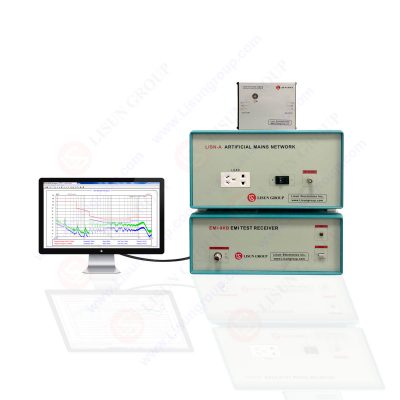
EMI-9KB EMI Test Receiver
3.2 Core Technical Specifications
Table 1 Key Technical Specifications of LISUN EMI-9KB
| Parameter | Value | Remarks |
| Frequency range | 9 kHz–300 MHz | Covers mainstream conducted and radiated test frequency bands |
| Frequency stability | 1×10⁻⁶ | Guarantees long-term measurement consistency |
| Frequency resolution | 9 kHz–150 kHz: 30 Hz; 150 kHz–30 MHz: 1 kHz | Accurately distinguishes narrowband interference |
| Test error | ±2 dB | Meets standard metrology requirements |
| Detection modes | Peak(PK), Quasi-peak(QP), Average(AV) | Compliant with CISPR/FCC standards |
| Level measurement range | 20 dBμV–140 dBμV | Covers weak to strong interference |
| Frequency step | 20 Hz–2 MHz | Adapts to different resolution requirements |
| Resolution bandwidth | 200 Hz, 9 kHz, 120 kHz | Corresponding to standard measurement bandwidth |
| System structure | Fully enclosed high-conductivity material | Excellent shielding and ultra-low self-interference |
3.3 Core Functions of EMI Spectrum Analyzer
• Spectrum conversion: Converts continuous/pulse interference into frequency-domain spectrum diagram, visually displaying interference frequency and amplitude.
• Quantitative measurement: Accurately calibrates disturbance level in dBμV, and judges compliance by comparing with standard limits.
• Multi-detection compatibility: Supports PK/QP/AV for evaluation of different standards and product types.
• Automatic test: Links peripheral equipment to complete full-band scanning, reducing manual errors and improving efficiency.
4 Quantitative Test Methods for Conducted and Radiated Interference
4.1 Conducted Interference Test (9 kHz–30 MHz)
• Wiring: EUT is connected to power supply through LISN, and the signal port of LISN is connected to the input of EMI spectrum analyzer.
• Setting: Frequency band 9 kHz–30 MHz, standard bandwidth, QP detection and limit curve loading.
• Scanning: Automatic frequency sweeping by the system, recording disturbance level at each frequency point and saving peak/quasi-peak data.
• Judgment: Conducted test passes if the curve is lower than standard limit.
4.2 Radiated Interference Test (30 MHz–300 MHz)
• Configuration: CDNE-M316 coupling/decoupling network is adopted to replace traditional radiation antennas, complying with CISPR 15:2018.
• Connection: EUT is connected with CDNE-M316 and output to EMI spectrum analyzer.
• Scanning: Automatic scanning from 30–300 MHz to obtain radiated disturbance spectrum.
• Judgment: Radiated test compliance is determined by comparison with limits.
5 Measured Results and Analysis
Taking LED driving power supply as EUT, tested by LISUN EMI-9KB, the data output by EMI spectrum analyzer are as follows:
Table 2 Measured Conducted Interference Data at Typical Frequencies (QP Value)
| Frequency | Measured Value(dBμV) | GB 17743 Limit(dBμV) | Result |
| 150 kHz | 42.3 | 45 | Pass |
| 1 MHz | 38.6 | 42 | Pass |
| 10 MHz | 35.1 | 38 | Pass |
| 30 MHz | 32.4 | 35 | Pass |
Table 3 Measured Radiated Interference Data at Typical Frequencies (QP Value)
| Frequency | Measured Value(dBμV) | CISPR 15 Limit(dBμV) | Result |
| 50 MHz | 36.8 | 40 | Pass |
| 100 MHz | 34.2 | 38 | Pass |
| 200 MHz | 31.5 | 36 | Pass |
| 300 MHz | 29.7 | 34 | Pass |
Result Analysis:
• The EMI spectrum analyzer can stably capture weak interference, with dynamic range and resolution meeting requirements.
• EMI-9KB has excellent self-interference suppression, with noise floor lower than 20 dBμV and no impact on measurement results.
• All conducted and radiated curves are below limits, and the system can accurately give compliance conclusions.
• The whole automatic test takes about 5–8 minutes, significantly higher efficiency than traditional manual test.
6 System Advantages and Engineering Value
• High precision: The core unit of EMI spectrum analyzer has ±2 dB error and high frequency resolution, suitable for R&D rectification and certification testing.
• Strong self-interference resistance: Fully enclosed shielding structure reduces system noise from the source and improves weak signal measurement capability.
• Standard compliance: Supports CISPR, GB, FCC, EN series standards with universal reports, reducing certification costs.
• High automation: One-click scanning, judgment and export by software, suitable for batch quality inspection.
• Flexible configuration: Expandable with anechoic chamber, biconical antenna, absorption clamp and current probe, covering multi-product test scenarios.
7 Conclusion and Prospect
EMI spectrum analyzer is the core equipment for quantitative measurement of conducted and radiated interference of electrotechnical electronic products, which directly determines the accuracy and reliability of EMC tests. Taking dedicated EMI spectrum analyzer as the main body, LISUN EMI-9KB constructs a high-performance, fully automatic and international standard-compliant EMI test system, which can complete quantitative measurement of conducted and radiated interference from 9 kHz to 300 MHz. It is widely applied in R&D, production and certification of lighting, household appliances, power supplies, electric tools and other products. Measured results show that the system has stable measurement, small error, strong anti-interference performance and convenient operation, which can effectively support product EMC optimization and compliance launch.
With the popularization of 5G, new energy and Internet of Things equipment in the future, interference frequency bands will be wider and signals more complex, putting forward higher requirements for EMI spectrum analyzer. High-frequency expansion, real-time spectrum analysis, AI interference location and automatic diagnosis will become development directions, continuously improving the efficiency and intelligence level of electromagnetic compatibility testing.
Tags:EMI-9KBYour email address will not be published. Required fields are marked *

 English
 中文简体
中文简体 English
 Русский
 Español
 Português
 Türkçe
 العربية
 Deutsch
 Polski
 Italiano
 Français
 한국어
한국어 ไทย
ไทย Tiếng Việt
 日本語
日本語