LM-79 Moving Detector Goniophotometer (Mirror Type C)
LSG-6000
High Precision Rotation Luminaire Goniophotometer
LSG-1890B
High Precision Rotation Luminaire Goniospectroradiometer
LSG-1890BCCD

Goniophotometer for Automotive and Signal Lamps
LSG-1950
Goniophotometer for Traffic Signal Lamps (Economical Model)
LSG-1950S
VAD Fire Alarm Visual Alert Device Goniophotometer
LSG-1930
Goniophotometer for Airfield Lighting
LSG-1940
Compact Goniophotometer
LSG-1200A
LED Goniophotometer
LSG-1100
Near Field Moving Detector Goniophotometer
LSG-1900B
 LEDs and Luminaire Test Solutions
 LM-79 and LM-80 Test Solutions
 LED Driver Test Solutions
 Household Appliances Test Solutions
 Mobile and Network Test Solutions
 Automotive Electronics Test Solutions
 Audio-Video and IT Test Solutions
 Cable and Wire Test Solutions
 Plugs and Sockets Test Solutions
 Power Switch Test Solutions
 Transformer Test Solutions
 Electric Toys Test Solutions
 Energy Meter Test Solutions
 Motor-Operated Tool Test Solutions
Select an organization
to browse standards
Abstract: The burst tester is a high-precision device core to the field of electromagnetic compatibility (EMC) immunity testing. Its core value is to simulate high-frequency burst interference encountered by electrical and electronic equipment in actual working conditions, evaluate equipment immunity performance, and serve as a key testing tool to ensure stable operation in complex electromagnetic environments. Taking the LISUN EFT61000-4 series burst tester as the research object, this paper expounds its working principle, core technical parameters, applicable standards and industrial applications, analyzes its technical advantages in EMC compliance testing, and provides a reference for anti-interference design and testing of electrical and electronic products.
1. Introduction
With the rapid development of industrial automation, automotive electronics, medical devices, consumer electronics and other fields, the operating environment of electrical and electronic equipment has become increasingly complex. Fast transient burst interference caused by grid switching, relay contact bounce, inductive load startup and shutdown has become an important factor leading to equipment malfunction, data loss and even hardware damage. As a core indicator for measuring equipment reliability, electromagnetic compatibility (EMC) immunity testing has become a necessary step in product design, production and market access.
As a special test instrument for simulating such interference, the burst tester can accurately reproduce high-frequency pulse signals in actual working conditions and scientifically evaluate the anti-interference ability of equipment. It is an indispensable key instrument in the EMC test system. The LISUN EFT61000-4 series burst tester has become a mainstream device in industrial EMC immunity testing due to its high precision, multi-standard adaptation and wide compatibility. Its technical characteristics and application value are of great significance to promoting EMC compliance of electronic and electrical products.
2. Core Function and Working Principle of the Burst Tester
The burst tester is a high-precision device specially designed for EMC immunity testing. Its core function is to simulate fast transient burst interference generated in the actual environment. By injecting standard-compliant high-frequency pulse signals into the power ports and signal ports of the device under test (DUT), it observes the working status of the equipment, evaluates its immunity to transient interference, identifies weak points in anti-interference design in the product development stage, and provides data support for equipment immunity reinforcement.
From the perspective of working principle, the burst tester generates high-frequency pulses with extremely short rise time and narrow pulse width through the pulse generation module. The pulse amplitude is boosted to the voltage level required by the standard through the pulse amplification unit, and then the burst is accurately injected into the designated port of the DUT through the coupling/decoupling network. At the same time, impedance matching between the test system and the DUT is ensured to guarantee stable transmission of interference signals.
Taking the LISUN EFT61000-4 burst tester as an example, it can generate pulses with 5ns±30% rise time and 50ns±30% pulse width. The pulse repetition rate is continuously adjustable from 1kHz to 1000kHz, which can accurately reproduce interference characteristics such as grid switching and relay operation, and truly simulate the actual electromagnetic environment of equipment.
In addition, the test process of the burst tester strictly follows relevant EMC standards. By controlling parameters such as pulse polarity, burst length and test duration, it realizes immunity tests of different levels and scenarios, ensuring the scientificity and comparability of test results.
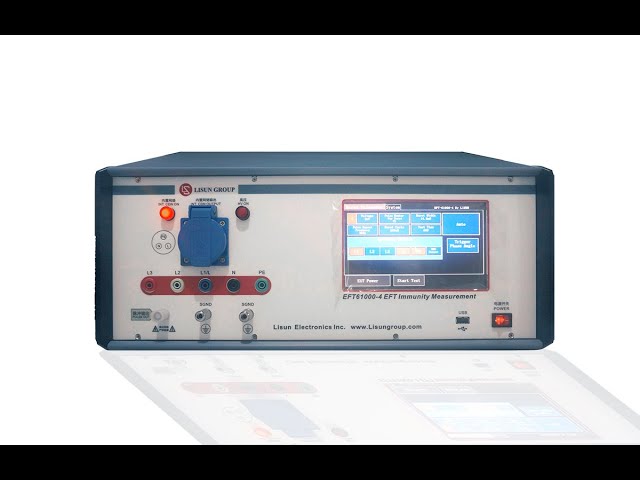
3. Technical Characteristics and Standard Adaptation of LISUN EFT61000-4 Burst Tester
3.1 Core Technical Parameters
The LISUN EFT61000-4 series burst tester includes 6 subdivided models with differentiated output voltage and coupling/decoupling network configurations for different test requirements. Its core technical parameters cover all dimensions of EMC immunity test requirements. Partial key parameters are shown in Table 1.
| Technical Parameter | Specification |
| Output Voltage | 0~5kV/0~6kV optional, suitable for different test levels |
| Pulse Repetition Rate | 1kHz~1000kHz continuously adjustable, covering full-band interference simulation |
| Pulse Polarity | Positive/negative, automatic alternating, meeting multi-scenario test requirements |
| Pulse Rise Time | 5ns±30%, accurately reproduces actual transient interference characteristics |
| Pulse Width (50Ω) | 50ns±30%, meets international standard waveform requirements |
| Coupling/Decoupling Network | Built-in 16A/32A 3-phase/5-wire, external 100A 3-phase/5-wire, suitable for different power equipment |
| Operating Power | AC220V (110V optional) ±10%, 50/60Hz, adaptable to different power grid environments |
The series supports dual internal resistance specifications: 50Ω±20% and 1000Ω±20%, matching port impedances of different DUTs. Burst length (0.01ms~20ms) and burst period (100ms~500ms) are freely adjustable to simulate burst interference of different intensity and frequency. Test time can be flexibly set from 1s to 9999s, meeting both short quick test and long-term stability test. The device supports custom test modes or IEC levels, improving flexibility and pertinence.
3.2 Standard Adaptation
The validity of test results from the burst tester depends on strict compliance with relevant EMC standards worldwide. The LISUN EFT61000-4 burst tester has built-in test programs of core standards such as GB/T 17626.4-2018, IEC 61000-4-4:2012, EN 61000-4-4:2012, and is compatible with ANSI/IEEE C62.41-1991, realizing full coverage of major regional standards in China, EU and US.
GB/T 17626.4-2018 is the Chinese national standard for EMC immunity testing, equivalent to IEC 61000-4-4:2012, which clearly specifies waveform parameters, test methods and classification of fast transient bursts. IEC/EN 61000-4-4:2012 is the general international and EU standard, an important basis for global EMC compliance testing. The device supports one-click calling of preset standard parameters without tedious manual adjustment, ensuring compliance and greatly improving efficiency.
4. Industrial Applications and Supporting Solutions of the Burst Tester
4.1 Multi-field Application Scenarios
The test capability of the burst tester covers all categories of electrical and electronic equipment. The LISUN EFT61000-4 burst tester is widely used in EMC compliance testing in consumer electronics, automotive electronics, industrial control, medical devices and other fields due to its wide parameter range and high adaptability.
In consumer electronics, power and signal ports of mobile phones, computers, smart home devices are vulnerable to grid transient interference. Testing with the burst tester ensures stable operation in household grids and avoids crashes or data loss. In automotive electronics, on-board navigation, electronic control systems, and charging piles work in complex electromagnetic environments and must pass strict immunity tests to ensure driving safety. In industrial control, PLCs, inverters, sensors are sensitive to electromagnetic interference; burst testing effectively improves anti-interference performance. In medical devices, the stability of ventilators and monitors is critical to patient safety, and EMC testing ensures trouble-free operation in hospital electromagnetic environments.
4.2 Professional Supporting Test Solutions
To ensure accuracy and standardization, the LISUN EFT61000-4 burst tester provides a complete set of professional supporting solutions.
– EFT-CLAMP capacitive coupling clamp: suitable for immunity testing of network signal lines (e.g., RJ45), fully compliant with IEC 61000-4-4:2012 and GB/T 17626.4-2018 Clause 6.4, enabling non-contact pulse injection.
– EFT-CAL calibration kit: includes 50Ω and 1000Ω high-frequency attenuators for precise calibration of pulse waveform, ensuring test signal accuracy.
– EFT-DESK standard test table: builds a standard-compliant test environment, reduces external electromagnetic interference, and improves test reliability.
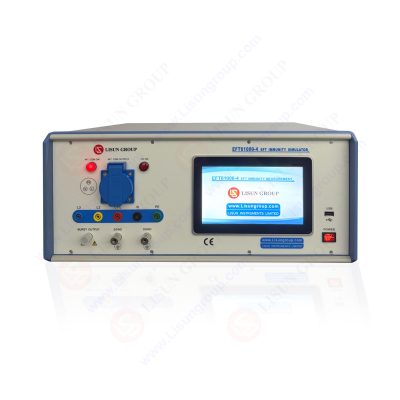
EFT61000-4_Burst tester
5. Value and Significance of the Burst Tester in EMC Testing
5.1 Ensuring Product Reliability and Market Access
Burst tester testing is a core part of product EMC compliance. It effectively identifies weak points in anti-interference design and guides enterprises to optimize circuits, shielding and grounding, improving stability in complex electromagnetic environments. Most countries and regions regard EMC testing as mandatory for market access. Passing the burst tester test and issuing a qualified report is a necessary condition for entering domestic and international markets.
5.2 Promoting Industrial EMC Technology Development
As a core EMC test device, the burst tester evolves with industry demands. With miniaturization, intelligence and high-frequency development, equipment becomes more sensitive to burst interference, pushing the burst tester toward higher precision, wider parameters and more standards. The LISUN EFT61000-4 with Chinese/English Android touch screen achieves intelligent operation and built-in multi-standard programs, promoting technological progress in the EMC testing industry.
5.3 Reducing Full Life-cycle Cost
Conducting immunity testing with the burst tester in the design stage detects defects early and completes rectification in R&D, avoiding after-sales failures, recalls and brand losses. Standardized testing improves efficiency, shortens R&D cycles, accelerates market launch and enhances enterprise competitiveness.
6. Conclusion
The burst tester, as a core high-precision device for electromagnetic compatibility immunity testing, is a key tool for simulating fast transient burst interference and evaluating the anti-interference ability of electrical and electronic equipment. Its technical characteristics directly determine the scientificity and accuracy of EMC tests.
The LISUN EFT61000-4 series burst tester is an excellent choice for EMC immunity testing with accurate waveform simulation, comprehensive standard adaptation, wide industrial applications and professional supporting solutions. It meets testing requirements in consumer electronics, automotive electronics, industrial control, medical devices and other fields.
With increasingly complex equipment and deteriorating electromagnetic environment, the application value of the burst tester will become more prominent. In the future, with the continuous upgrading of EMC standards and innovation of testing technology, the burst tester will develop toward higher precision, intelligence and integration, providing stronger support for the reliability of electronic and electrical products and promoting the continuous progress of the EMC industry.
Enterprises should attach importance to EMC immunity testing, integrate burst tester testing into the whole process of product R&D and production, improve anti-interference ability from the source, and help products achieve compliant development in the global market.
Tags:EFT61000-4Your email address will not be published. Required fields are marked *

 English
 中文简体
中文简体 English
 Русский
 Español
 Português
 Türkçe
 العربية
 Deutsch
 Polski
 Italiano
 Français
 한국어
한국어 ไทย
ไทย Tiếng Việt
 日本語
日本語