LM-79 Moving Detector Goniophotometer (Mirror Type C)
LSG-6000
High Precision Rotation Luminaire Goniophotometer
LSG-1890B
High Precision Rotation Luminaire Goniospectroradiometer
LSG-1890BCCD

Goniophotometer for Automotive and Signal Lamps
LSG-1950
Goniophotometer for Traffic Signal Lamps (Economical Model)
LSG-1950S
Goniophotometer for Airfield Lighting
LSG-1940
VAD Fire Alarm Visual Alert Device Goniophotometer
LSG-1930
Compact Goniophotometer
LSG-1200A
LED Goniophotometer
LSG-1100
Near Field Moving Detector Goniophotometer
LSG-1900B
 LEDs and Luminaire Test Solutions
 LM-79 and LM-80 Test Solutions
 LED Driver Test Solutions
 Household Appliances Test Solutions
 Mobile and Network Test Solutions
 Automotive Electronics Test Solutions
 Audio-Video and IT Test Solutions
 Cable and Wire Test Solutions
 Plugs and Sockets Test Solutions
 Power Switch Test Solutions
 Transformer Test Solutions
 Electric Toys Test Solutions
 Energy Meter Test Solutions
 Motor-Operated Tool Test Solutions
Select an organization
to browse standards
Abstract
Products are continuously subjected to multi-dimensional and multi-frequency mechanical vibration during transportation, assembly and long-term service, which easily causes structural loosening, component desoldering, functional failure and other faults. As the core excitation unit of electrodynamic vibration test systems, the vibration generator relies on the electromagnetic excitation principle to accurately reproduce various real vibration working conditions, and quantify the vibration resistance, operational stability and long-term service life reliability of spare parts and finished products. Taking the LISUN LVD-100KG electrodynamic shaker test system (Pre-Certification) as the research carrier, this paper elaborates the electromagnetic excitation working mechanism, system structure and test functions of the vibration generator, as well as supporting test standards. Combined with measured parameter data table, the test capacity of the equipment is analyzed. The application value of vibration generators in reliability verification of electronics, automotive, packaging and lighting industries is summarized, providing standardized implementation reference for environmental vibration durability tests of products.
1 Introduction
Mechanical, electronic and packaging products are exposed to complex vibration environments throughout their whole life cycle, including random bumping during highway transportation, continuous low-frequency vibration on vehicles, high-frequency resonance of operating equipment, impact vibration from loading and unloading in warehouses, etc. Long-term vibration load will lead to loose threads, cracked PCB solder joints, fatigue fracture of housings, poor electrical contact and other hidden dangers, greatly shortening the service life of products. Traditional field working condition tests have long cycles, uncontrollable variables and poor data repeatability, which cannot meet the requirements of rapid prototyping and batch reliability verification of new products.
A vibration generator converts electrical energy into controllable mechanical vibration through electromagnetic conversion, which can simulate full-range low-to-high frequency, sine, sweep and programmable cyclic vibration working conditions in laboratory environments, so as to accurately assess the anti-vibration performance of products. The LISUN LVD-100KG electrodynamic shaker test system is equipped with a high-performance vibration generator, which is divided into two configurations: four-degree space (LVD-100KG) and six-degree space (LVD-100KG-6D). It covers multi-directional vibration tests including vertical, front-back and left-right directions, meets dozens of domestic and foreign environmental test standards, and is widely used in pre-certification vibration detection of spare parts and complete machines. This paper systematically analyzes the electromagnetic simulation principle, technical indicators, test procedures and engineering applications of the vibration generator equipped on this equipment.
2 Working Principle of Electromagnetic Simulation and System Composition of Vibration Generator
2.1 Electromagnetic Excitation Mechanism of Vibration Generator
The vibration generator is the power core of the entire vibration shaker, and its physical basis is Ampere’s law of electromagnetic force: the moving coil conductor with alternating current in a constant magnetic field will generate periodic alternating excitation force, converting electric energy into reciprocating mechanical vibration to realize electromagnetic simulation of vibration conditions. The whole system forms a closed-loop control system consisting of four parts: vibration generator (shaker body), power amplifier, touch screen controller and data acquisition module:
• The controller inputs preset parameters such as frequency, amplitude, acceleration and test duration to generate standard electrical signals;
• The power amplifier amplifies the signals and transmits them to the excitation coil and moving coil inside the vibration generator;
• The magnetic cylinder of the vibration generator produces a constant DC magnetic field, and the alternating current of the moving coil cuts magnetic induction lines to generate excitation force, driving the tabletop to vibrate synchronously with samples;
• Sensors on the tabletop collect real-time vibration frequency and acceleration data and send them back to the controller for automatic closed-loop correction, ensuring that the error of vibration parameters is within the allowable range of standards.
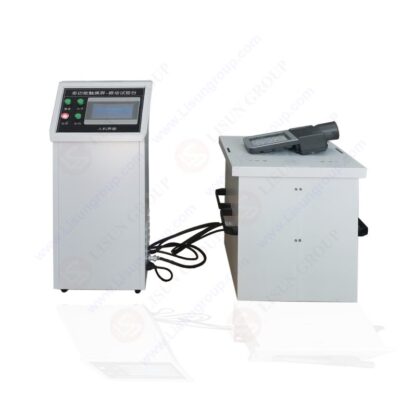
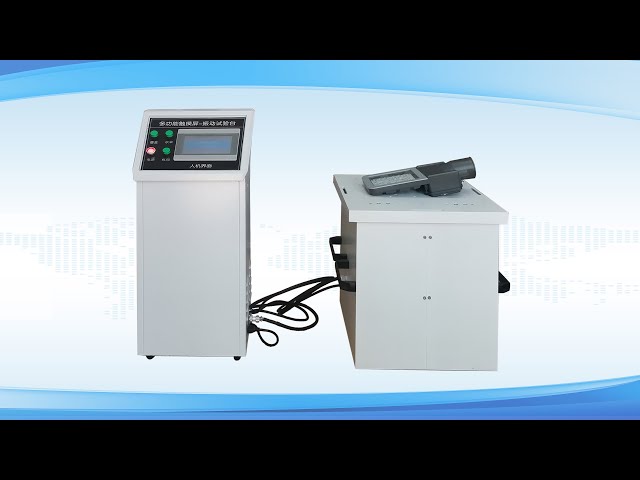
LVD 100KG Electrodynamic Vibration Generator System
The vibration generator matched with LISUN LVD-100KG adopts an air-cooled heat dissipation structure, without overheating shutdown during long-time high-acceleration tests. It supports continuously adjustable amplitude of 0~5 mm and wide-range acceleration output of 0~20 g, which can accurately simulate two typical working conditions: low-frequency transportation bumping and high-frequency equipment resonance.
2.2 Structural Distinction of LVD-100KG Vibration Generator System
The standard LVD-100KG vibration generator supports four-way vibration (vertical + single horizontal direction), and only one horizontal direction can be switched besides vertical direction. The upgraded LVD-100KG-6D six-degree space vibration generator integrates a three-axis driving mechanism, which can independently complete vertical, left-right and front-back three-dimensional vibration, fully reproducing multi-directional composite vibration loads in container and vehicle transportation. It is more consistent with real vibration environments and suitable for packaging vibration tests in accordance with ASTM and ISO standards.
3 Core Technical Parameters and Performance Table of LISUN LVD-100KG Vibration Generator
The LISUN LVD-100KG vibration generator is designed for heavy-duty spare parts and complete industrial finished products, with a maximum sample load of 100 kg, frequency control accuracy up to 0.01 Hz, and support for segmented programmable cyclic frequency sweep. Its core performance parameters are sorted out in Table 1.
Table 1 Key Technical Parameters of LISUN LVD-100KG Vibration Generator
| Parameter Item | Technical Index | Supplementary Description |
| Vibration Generator Configuration | LVD-100KG (4-way) / LVD-100KG-6D (6-way) | 6D model realizes independent three-axis vibration |
| Standard Tabletop Size | 500 mm × 500 mm | Custom non-standard sizes available |
| Adjustable Amplitude Range | 0~5 mm | Stepless continuous adjustment, suitable for low-frequency large displacement tests |
| Output Vibration Acceleration | 0~20 g | Covers high-strength vibration assessment for automotive and electronic products |
| Effective Operating Frequency Range | 1~600 Hz | General range for frequency sweep and segmented programmable tests |
| Frequency Display / Control Accuracy | 0.01 Hz display, 0.1 Hz control | Meet high-precision resonance point capture tests |
| Maximum Single Load Weight | 100 KG | Applicable to lamps, battery modules, electronic control assemblies and other large components |
| Output Vibration Waveform | Half-wave sine, full-wave sine | Random vibration module optional for expansion |
| Programmable Segmentation Function | 1~15 segments freely configurable | Support cycle reciprocating durability tests from low to high to low frequency |
| Control Terminal | Multi-functional touch screen HMI | One-click storage of test programs, automatic recording of test data |
It can be seen from Table 1 that this vibration generator takes into account three major advantages: large load, wide frequency domain and high precision. It can not only complete low-frequency transportation simulation, but also locate the natural resonance frequency of products, adapting to reliability verification requirements of various industries.
4 Vibration Simulation Test Types and Supporting Implementation Standards of Vibration Generator
Relying on the controllable electromagnetic excitation characteristics of the vibration generator, the LVD-100KG system can carry out three core vibration reliability tests, all complying with current domestic and foreign environmental test specifications, and no additional equipment modification is required for pre-certification tests.
• Sine Sweep Vibration Test: Automatic frequency rise and fall within 1~600 Hz to quickly identify the resonance frequency of spare parts and verify structural stability under continuous resonance, implemented in accordance with GB/T2423 and IEC 60068;
• Fixed-Frequency Durability Vibration Test: Lock the dangerous resonance frequency for long-term continuous vibration to assess the fatigue life of solder joints and fasteners, complying with JJG189-97 and GB/T13309 mechanical vibration shaker verification specifications;
• Programmable Cyclic Vibration Test: Freely combine multi-segment frequency, acceleration and duration to simulate composite vibration loads during the whole transportation process, applicable to ISO 2247, ASTM D4728 container random vibration, GB/T4857 packaged goods transportation test standards.
For lighting products, automotive electronics and electrical equipment, the equipment is synchronously compatible with GB/T 7000.1 lamp test and ASTM D3580 vertical product vibration standards, and test data can be directly used for compiling product test reports. For CNAS laboratory certification-level tests, the LVD-AT10 high-precision vibration generator system can be upgraded.
5 Judgment Logic of Product Reliability via Electromagnetic Simulation Test of Vibration Generator
By outputting standardized vibration loads through the vibration generator, the product vibration performance can be quantified from three dimensions:
• Judgment of Vibration Resistance: After completing vibration at rated acceleration and amplitude, if there is no housing cracking, thread loosening or connector falling off, the anti-vibration strength is judged qualified. If structural deformation or part shedding occurs, it indicates insufficient structural rigidity, and the housing needs to be optimized with reinforcing ribs added;
• Judgment of Operational Stability: Continuously monitor the power-on function of products during the whole vibration process. No power failure, signal interruption, abnormal noise or parameter drift represents stable anti-interference performance of electronic components. Virtual soldering and short circuit of circuit boards require optimization of welding processes and shock pad design;
• Judgment of Service Life Reliability: Cyclic programmable vibration simulates cumulative vibration damage over several years of service, shortens the test cycle, exposes long-term vibration fatigue defects in advance, and reduces after-sales failure rates in the market.
• Taking vehicle-mounted controllers as an example: set 10~200 Hz frequency sweep + 4-hour fixed-frequency resonance test with LISUN LVD-100KG vibration generator. If the ECU communication is normal and the housing has no cracks after the test, it can be judged to meet vehicle vibration service requirements; if internal capacitor pins break, the fixing method of components needs to be adjusted.
6 Engineering Application Scenarios of Vibration Generator
• Electrical and Electronic Industry: Vibration durability tests for PCB circuit boards, industrial control modules and energy storage battery packs to verify the reliability of solder joints and cell fixing structures;
• Automotive Spare Parts Industry: Simulate vehicle driving vibration conditions for vehicle lamps, instrument panels, vehicle sensors and electronic control assemblies;
• Packaging and Logistics Industry: Low-frequency transportation vibration simulation of finished product packaging boxes and unit goods to verify buffer protection performance in accordance with ISO and ASTM packaging standards;
• Lighting Equipment Industry: Vibration tests for all types of complete lamps, complying with GB/T 7000.1 general lamp test requirements;
• General Mechanical Spare Parts Industry: Fatigue vibration detection of small transmission parts and hardware structural components to screen weak structures prone to failure.
The LISUN LVD-100KG vibration generator has served multiple testing institutions and manufacturing enterprises for more than ten years. The touch screen controller can automatically store tens of thousands of groups of vibration test data, facilitating tracing of reliability differences among product batches.
7 Conclusion
The vibration generator realizes accurate simulation of multiple working conditions by electromagnetic excitation, which is the core equipment for vibration reliability verification of spare parts and finished products. The LISUN LVD-100KG electrodynamic shaker test system is equipped with a vibration generator featuring large load and wide frequency domain, which can complete sine sweep, fixed-frequency durability and multi-segment programmable cyclic vibration tests, fully meeting domestic and foreign pre-certification test standards including GB, ISO, IEC and ASTM.
Carrying out accelerated vibration tests in laboratories with this vibration generator can expose design defects in product structure, electronic assembly and packaging protection in a short cycle, quantify vibration resistance, operational stability and long-term service life, optimize product anti-vibration design from the source of R&D, and reduce product failure risks during transportation and service. In the reliability management and control system of machinery, automobile, packaging, lighting and other industries, the electromagnetic simulation vibration test system centered on the vibration generator has irreplaceable engineering value. In the follow-up, a comprehensive environmental composite vibration test platform can be built with a temperature and humidity chamber to further improve the full-working-condition reliability verification capacity of products.
Tags:LVD-100KGYour email address will not be published. Required fields are marked *


 English
 中文简体
中文简体 English
 Русский
 Español
 Português
 Türkçe
 العربية
 Deutsch
 Polski
 Italiano
 Français
 한국어
한국어 ไทย
ไทย Tiếng Việt
 日本語
日本語