LM-79 Moving Detector Goniophotometer (Mirror Type C)
LSG-6000
High Precision Rotation Luminaire Goniophotometer
LSG-1890B
High Precision Rotation Luminaire Goniospectroradiometer
LSG-1890BCCD

Goniophotometer for Automotive and Signal Lamps
LSG-1950
Goniophotometer for Traffic Signal Lamps (Economical Model)
LSG-1950S
VAD Fire Alarm Visual Alert Device Goniophotometer
LSG-1930
Goniophotometer for Airfield Lighting
LSG-1940
Compact Goniophotometer
LSG-1200A
LED Goniophotometer
LSG-1100
Near Field Moving Detector Goniophotometer
LSG-1900B
 LEDs and Luminaire Test Solutions
 LM-79 and LM-80 Test Solutions
 LED Driver Test Solutions
 Household Appliances Test Solutions
 Mobile and Network Test Solutions
 Automotive Electronics Test Solutions
 Audio-Video and IT Test Solutions
 Cable and Wire Test Solutions
 Plugs and Sockets Test Solutions
 Power Switch Test Solutions
 Transformer Test Solutions
 Electric Toys Test Solutions
 Energy Meter Test Solutions
 Motor-Operated Tool Test Solutions
Select an organization
to browse standards
Abstract: In the fields of material research and development as well as quality inspection including coatings, plastics, rubber and auto parts, material weather resistance is a key indicator for judging service life and overall performance. Outdoor natural aging tests take a very long time, which cannot meet the demands of efficient R&D and rapid quality inspection for modern enterprises. For this reason, UV aging test has become a mainstream accelerated aging testing device. Based on the principle of simulated environmental accelerated aging, UV aging test uses UV lamps to simulate ultraviolet radiation in natural sunlight, and adopts condensation and spray systems to reproduce rain and dew. Samples are placed in alternating cycles of light and moisture under controlled temperature to realize accelerated aging, so that weather resistance data can be obtained in a short period of time. Taking LISUN UV-263LS UV aging test as the research object, this paper illustrates its working principle, structural configuration, applicable standards and test procedures, analyzes its technical advantages combined with equipment parameters, and discusses the practical value of UV aging test in weather resistance detection of materials across various industries.
Natural factors such as sunlight, rain, dew and temperature changes continuously erode non-metallic materials. After long-term exposure, materials will suffer from discoloration, gloss loss, chalking, cracking and decreased mechanical properties. Although traditional outdoor natural aging tests can generate data close to actual service conditions, their test cycles last for months or even years, which greatly restricts formula optimization of new materials, product iteration and batch quality inspection.
To solve this industry problem, UV aging test based on environmental simulation technology has been widely applied. It artificially replicates key outdoor aging factors, and builds cyclic test procedures with ultraviolet light, condensed moisture, high temperature, high humidity and water spray to greatly shorten the aging test cycle. As a mature model, LISUN UV-263LS UV aging test fully complies with major domestic and international testing standards. It integrates multiple functional modules including illumination, condensation, spray and temperature control, and is suitable for testing requirements of coatings, plastics, rubber, automotive electronics and other products. Currently, it is core testing equipment for material weather resistance laboratories and quality inspection workshops of manufacturers.
The core design concept of UV aging test is simulated environmental accelerated aging. It accurately reproduces key outdoor aging factors and accelerates the aging process by intensifying environmental effects. The whole operation is jointly completed by three core modules: illumination, moisture and temperature.
Firstly, dedicated UV lamps are adopted to simulate natural sunlight. Ultraviolet band in solar radiation is the main cause of aging of polymer materials. Different lamp types are selected for different test requirements. UVA-340 lamps precisely simulate the ultraviolet band of ordinary natural light for conventional weather resistance tests, while UVB-313 short-wave UV lamps deliver higher radiation intensity for high-strength accelerated aging tests. Secondly, built-in condensation and water spray systems simulate rain wash and dew formation in nature. High humidity intensifies the photochemical reaction of materials and restores the real conditions of dew and rainfall outdoors day and night. Finally, all tests are carried out within a stable temperature range from room temperature plus 10℃ to 70℃, forming alternating cycles of illumination and moisture.
During the complete test, samples are placed in the test chamber to go through UV illumination stage and condensation & high humidity stage in sequence. Water spray stage can be added according to actual working conditions. The cyclic operation accelerates material aging continuously. Compared with natural aging, UV aging test condenses the aging effect of several months or years outdoors into a few days or weeks. Operators can quickly detect changes in appearance, color difference, gloss, tensile strength and other indicators, so as to efficiently evaluate the weather resistance level of materials. LISUN UV-263LS UV aging test strictly follows the above principle with stable operation of all modules and high simulation fidelity, ensuring valid test data.
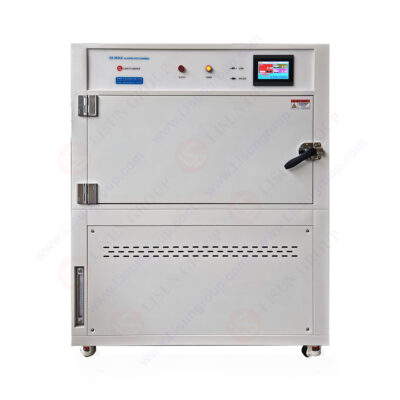
UV-263LS_UV Aging Test Chamber
Compliance with Multiple Domestic and International Testing Standards
LISUN UV-263LS UV aging test conforms to major global standards for artificial UV aging, covering national standards for machinery, plastics and rubber in China as well as industrial specifications in America, Europe, Japan and other regions. Chinese applicable standards include GB/T 14522-2008, GB/T 16422.3-2014 and GB/T 16585-1996, which specify test methods for plastic coatings on mechanical products, general plastics and vulcanized rubber respectively. International standards involve ASTM G154, ISO 4892-3, SAE J2020 and DIN 53384, meeting compliance testing requirements for automotive products, coatings and export goods with excellent universality.
Hardware Structure and Core Parameters
Both internal and external chambers of this UV aging test are made of S304 stainless steel, which features corrosion resistance and easy cleaning, enabling stable long-term operation under high humidity and ultraviolet environment. Equipped with an LCD programmable controller, the device supports custom multi-stage cyclic procedures including illumination, high temperature, high humidity, water spray, condensation and dark state, featuring simple operation and flexible program storage. The table below lists core specifications of three mainstream models of LISUN UV aging test for clear comparison:
| Parameter Item | UV-263LV | UV-263LS | UV-263LT |
| Chamber Structure | Trapezoidal inner chamber | Square inner chamber | Benchtop chamber |
| Inner Chamber Dimension (W*D*H) | 450*1140*500mm | 550*1140*450mm | 500*400*400mm |
| Outer Dimension (W*D*H) | 600*1325*1500mm | 650*1300*1750mm | 930*460*630mm |
| Temperature Range | RT+10℃~70℃ | RT+10℃~70℃ | RT+10℃~70℃ |
| Temperature Fluctuation | ≤±1℃ | ≤±1℃ | ≤±1℃ |
| Irradiance | 0.35~1.2W/㎡ adjustable | 0.35~1.2W/㎡ adjustable | 0.35~1.0W/㎡ adjustable |
| Distance between Sample and Lamp | 70mm | 70~300mm adjustable | 50mm |
| Lamp Configuration | 8 pcs American ATLAS lamp (40W) | 8 pcs American ATLAS lamp (40W) | 3 pcs domestic lamp (20W) |
| Test Duration Range | 0~9999H, M, S adjustable | 0~9999H, M, S adjustable | 0~9999H, M, S adjustable |
As indicated by the parameters, UV-263LS is a standard vertical UV aging test. The adjustable distance between samples and lamps in a wide range makes it compatible with various irregular specimens. Equipped with imported long-service-life UV lamps and integrated irradiance tester, it supports continuous irradiance adjustment, balancing test accuracy and sample compatibility. It is ideal for mass testing of various samples in laboratories. The internal humidity is steadily maintained above 75%RH to satisfy the high humidity requirements for condensation aging. The device uses ordinary distilled water, with daily water consumption of only 8 to 10 liters and low operating cost.
There are standardized operating procedures for tests conducted by UV aging test. LISUN UV-263LS is matched with complete test workflows and supporting testing instruments to ensure complete and traceable test data. The first step is sample preparation. Cut specimens in accordance with standards, and test and record initial color difference, gloss and tensile strength by using spectrophotometer, gloss meter and tensile testing machine. The second step is equipment inspection. Check the normal operation of condensation and spray systems and calibrate irradiance. The third step is parameter setting. Select UVA/UVB lamp, irradiance, temperature and cycle period as required. The commonly used cycle mode is 4-hour illumination plus 4-hour condensation. The fourth step is sample placement. Fix specimens facing UV lamps to ensure uniform internal environment of the chamber. The fifth step is test operation. Start the device and record the appearance of samples every 250 hours. After the test is completed, re-test various performance indicators of samples with supporting instruments.
After the test, evaluate the aging effect from two aspects: appearance and mechanical properties. Check whether discoloration, chalking, cracking, peeling and other defects occur on samples. Compare the changes of color difference, gloss and tensile strength before and after aging to judge whether the material weather resistance meets requirements, so as to provide data support for material formula optimization, product selection and quality acceptance.

With high efficiency, high accuracy and high simulation degree, UV aging test is widely used in multiple industries. In the coating industry, it is applied to weather resistance testing of exterior wall paints and industrial coatings. In the rubber and plastic industry, it is used to verify the outdoor service life of plastic pipes and rubber sealing parts. In the automotive industry, it tests non-metallic interior and exterior parts of vehicles. It also undertakes material reliability verification for pharmaceutical, electronic, building material and other industries.
LISUN UV-263LS UV aging test adopts simulated environmental accelerated aging principle, which fully reproduces outdoor aging factors such as sunlight, rain, dew and high temperature to realize rapid aging detection of materials. Featuring stable structure, high parameter accuracy, flexible programming, wide standard compliance and strong sample compatibility, the equipment runs economically and conveniently. Against the background of rapid development of material industry, natural aging tests can no longer keep pace with industrial development. UV aging test represented by UV-263LS effectively shortens R&D and inspection cycles, helps enterprises improve product weather resistance and market competitiveness, and will remain the core equipment for weather resistance detection of non-metallic materials in the long run.
Tags:UV-263LSYour email address will not be published. Required fields are marked *
 English
 中文简体
中文简体 English
 Русский
 Español
 Português
 Türkçe
 العربية
 Deutsch
 Polski
 Italiano
 Français
 한국어
한국어 ไทย
ไทย Tiếng Việt
 日本語
日本語