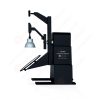
LM-79 Moving Detector Goniophotometer (Mirror Type C)
LSG-6000
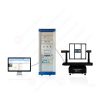
High Precision Rotation Luminaire Goniophotometer
LSG-1890B
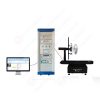
High Precision Rotation Luminaire Goniospectroradiometer
LSG-1890BCCD

Goniophotometer for Automotive and Signal Lamps
LSG-1950
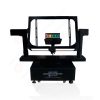
Goniophotometer for Traffic Signal Lamps (Economical Model)
LSG-1950S
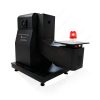
VAD Fire Alarm Visual Alert Device Goniophotometer
LSG-1930
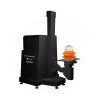
Goniophotometer for Airfield Lighting
LSG-1940
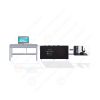
Compact Goniophotometer
LSG-1200A
LED Goniophotometer
LSG-1100
Near Field Moving Detector Goniophotometer
LSG-1900B
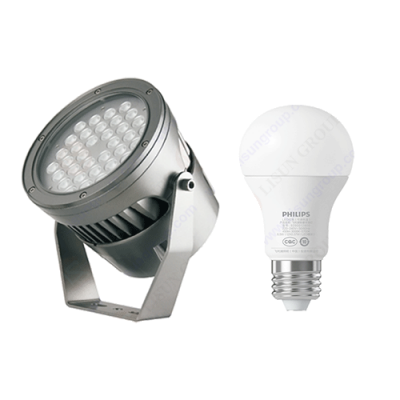 LEDs and Luminaire Test Solutions
 LM-79 and LM-80 Test Solutions
 LED Driver Test Solutions
 Household Appliances Test Solutions
 Mobile and Network Test Solutions
 Automotive Electronics Test Solutions
 Audio-Video and IT Test Solutions
 Cable and Wire Test Solutions
 Plugs and Sockets Test Solutions
 Power Switch Test Solutions
 Transformer Test Solutions
 Electric Toys Test Solutions
 Energy Meter Test Solutions
 Motor-Operated Tool Test Solutions
Select an organization
to browse standards
In the safety standard system for electrical products, the plug discharge (residual voltage) test is a mandatory test item related to user contact safety. When an electrical appliance is unplugged from the power supply under normal operating conditions, its internal energy storage capacitors will maintain a certain residual voltage. If the residual voltage is too high or the discharge time is excessively long, the user may receive an electric shock when touching the metal contacts of the plug. For this reason, IEC and GB safety standards have defined clear limit requirements for this indicator. The LS-RVT-2000W residual voltage tester (peak cut-off device) is a dedicated test instrument developed by LISUN for plug discharge testing. It can accurately simulate the actual plug-unplugging condition and is widely used in safety laboratories, factory quality inspection departments and third-party testing laboratories for household appliances, luminaires, audio-visual equipment, information technology equipment and medical devices.
The core difficulty of plug discharge testing lies in the controllability of the power-off moment. Manual unplugging in daily operation disconnects the circuit at random phase angles, which fails to reproduce the limit test condition specified in standards: disconnection at the peak of the voltage waveform. Test results are highly scattered and cannot be used for compliance judgment. The core working principle of LS-RVT-2000W is to synchronously sample the grid voltage waveform and cut off the power supply circuit of the DUT precisely at the peak point of the sine wave. Meanwhile, the insulation resistance of the circuit after disconnection meets standard requirements, fully reproducing the test conditions defined by specifications. It solves the pain points of poor repeatability and unreliable data caused by manual testing. Immediately after power cut-off, the instrument starts voltage sampling continuously, records the decay curve of the voltage across the plug terminals, automatically calculates residual voltage value and discharge duration, and directly judges whether the DUT complies with standard limits.
In terms of applicable standards, LS-RVT-2000W covers mainstream safety clauses including GB 4706 for household appliances, GB 9706 for medical electrical equipment, GB 4943.1 for information technology equipment, IEC 60950, IEC 60601 and other plug discharge sections. It is essential test equipment for CB, CCC and CE certification tests. The instrument is designed for DUTs with power rating up to 2000W, suitable for most small and medium-sized electrical finished products. Equipped with a high-precision voltage acquisition unit, it features fast sampling response and can capture millisecond-level residual voltage decay, avoiding misjudgment caused by sampling delay. The built-in display terminal supports real-time viewing of voltage waveform, peak residual voltage and discharge time. Data can be stored and exported for test report archiving and traceability, satisfying CNAS data management requirements for laboratories.
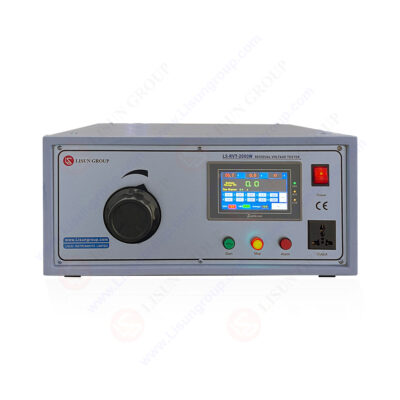
LS-RVT-2000W_AL
The test procedure of LS-RVT-2000W is straightforward. Before testing, connect the power input of the DUT to the output circuit of the tester, set grid voltage and frequency parameters, and select the peak cut-off mode. After the test starts, the instrument powers on the DUT and keeps it working stably until the energy storage capacitors are fully charged and stabilized. Then the power supply is automatically cut off at the peak of the AC voltage, and continuous sampling of residual voltage between plug terminals begins until the voltage drops below the safety threshold. The whole test runs automatically without manual intervention, eliminating errors introduced by human operation. Excellent repeatability can be achieved for repeated tests on the same sample, which is the key reason why third-party testing laboratories prefer peak cut-off residual voltage testers.
Many laboratories confuse residual voltage testing with withstand voltage test and insulation resistance test during equipment selection. The withstand voltage test evaluates the risk of dielectric breakdown under high voltage, while insulation resistance test checks the leakage performance of insulating materials. By contrast, plug discharge testing evaluates the discharge speed of energy storage components after power-off. The three tests differ completely in test objectives and risk assessment focus and cannot replace each other. Some product engineers misunderstand that low capacitance guarantees compliance of discharge performance. In fact, circuit topology, discharge loop resistance and X/Y capacitor configuration all affect the residual voltage decay curve. Quantitative verification must be carried out with dedicated instruments such as LS-RVT-2000W. For example, LED drivers, power adapters and small household appliance control boards are commonly equipped with X capacitors, which are high-risk products for plug discharge non-compliance. Pre-testing with this instrument in the R&D stage helps complete rectification before formal certification submission, avoiding certification failure and project schedule delays.
The hardware design of LS-RVT-2000W balances stability and compatibility. The main unit adopts high-isolation switching components. The insulation impedance of the switching unit remains stable after power cut-off, so the switching device itself will not reduce the residual voltage reading and lead to false pass results. It supports 50Hz / 60Hz grid frequency switching, adapting to grid specifications in China, Southeast Asia, Europe, the Middle East and other regions, meeting multi-standard test demands of export-oriented manufacturers. Compared with the higher-power model LS-RVT-4000W, the 2000W version features compact size and friendly cost, making it a cost-effective standard configuration for R&D laboratories and production line quality inspection of luminaires, power adapters, small household appliances and audio-visual equipment.
With increasingly strict safety regulation, plug discharge testing is no longer an optional item but a mandatory safety test. Non-compliant products released to the market may result in electric shock complaints and product recalls, greatly increasing the quality cost of enterprises. The LS-RVT-2000W plug discharge residual voltage tester converts the abstract “peak disconnection” requirement in standards into an automated and repeatable test workflow. It provides reliable data support for R&D validation, incoming material verification, finished product inspection and certification submission. It helps electrical product manufacturers establish complete plug discharge control capability and meet the test requirements of domestic and international safety certifications.
Tags:LS-RVT-2000WYour email address will not be published. Required fields are marked *

 English
 中文简体
 English
 Русский
 Español
 Português
 Türkçe
 العربية
 Deutsch
 Polski
 Italiano
 Français
 한국어
 ไทย
 Tiếng Việt
 日本語