LM-79 Moving Detector Goniophotometer (Mirror Type C)
LSG-6000
High Precision Rotation Luminaire Goniophotometer
LSG-1890B
High Precision Rotation Luminaire Goniospectroradiometer
LSG-1890BCCD

Goniophotometer for Automotive and Signal Lamps
LSG-1950
Goniophotometer for Traffic Signal Lamps (Economical Model)
LSG-1950S
VAD Fire Alarm Visual Alert Device Goniophotometer
LSG-1930
Goniophotometer for Airfield Lighting
LSG-1940
Compact Goniophotometer
LSG-1200A
LED Goniophotometer
LSG-1100
Near Field Moving Detector Goniophotometer
LSG-1900B
 LEDs and Luminaire Test Solutions
 LM-79 and LM-80 Test Solutions
 LED Driver Test Solutions
 Household Appliances Test Solutions
 Mobile and Network Test Solutions
 Automotive Electronics Test Solutions
 Audio-Video and IT Test Solutions
 Cable and Wire Test Solutions
 Plugs and Sockets Test Solutions
 Power Switch Test Solutions
 Transformer Test Solutions
 Electric Toys Test Solutions
 Energy Meter Test Solutions
 Motor-Operated Tool Test Solutions
Select an organization
to browse standards
Abstract
Electromagnetic compatibility (EMC) has become a mandatory market access requirement for electrical and electronic products. As the core unit of an EMI Test System, the performance of the EMI receiver directly determines the validity of conducted and radiated interference test results. CISPR 16-1-1 is the fundamental international standard for radio disturbance measuring instruments, which has been equivalently converted into GB/T 6113.101-2021 in China. It imposes mandatory constraints on key indicators of the receiver, including bandwidth, detector modes, pulse response and input impedance. Focusing on the LISUN EMI-9KB EMI Conducted & Radiated Interference Test System, this paper elaborates the technical points that must follow CISPR 16-1-1 standard during the selection of an EMI Test System, analyzes evaluation dimensions including receiver hardware, supporting accessories, software functions and overall system shielding design, introduces product features and industry applications of the EMI-9K series conducted & radiated interference test system, and provides reference for enterprises’ R&D laboratories, quality control departments and third-party testing institutions to build EMC test platforms.
A large number of switching power supplies, motors and high-speed digital circuits inside modern electrical and electronic products release electromagnetic interference signals during operation. Such interference falls into conducted interference propagating through power and signal lines, and radiated interference transmitted through space. Excessive electromagnetic interference may cause abnormal operation of surrounding electronic equipment and even bring potential safety risks. Therefore, before launching to market, information technology equipment, household appliances, lighting devices and other products must complete EMI testing to meet EMC regulatory limits of corresponding countries and regions.
Many purchasers tend to only focus on frequency coverage when selecting an EMI Test System, ignoring whether the receiver fully complies with CISPR 16-1-1 specifications. They mistakenly use ordinary spectrum analyzers as certification-grade EMI receivers. The quasi-peak detection time constant and pulse response characteristics of general spectrum analyzers are only suitable for preliminary pre-compliance testing in R&D phase and cannot be used for official compliance certification tests. The LISUN EMI-9K Series Conducted & Radiated Interference Test System is specially designed to quantitatively measure conducted interference (propagated via power/signal lines) and radiated interference (propagated through space) generated by electrical and electronic products during operation. It provides comprehensive technical support for EMC compliance testing and interference source localization. The EMI-9K series adopts fully enclosed structural design with high-conductivity materials for the chassis, delivering excellent shielding performance and fundamentally solving the problem of self-interference. It is widely used by manufacturers, R&D centers and third-party testing institutions in fields such as information technology equipment, household appliances and lighting products. It can quickly locate EMI over-limit issues such as switching power supply noise and motor radiated interference, help products pass EMC compliance certification, and prevent equipment malfunction or safety hazards induced by interference. The whole system complies with multiple product standards including GB 17743, GB 4343.1, GB/T 9254.1, CISPR 15 and CISPR 14-1, satisfying test requirements for domestic 3C certification as well as overseas CE and FCC certification projects.
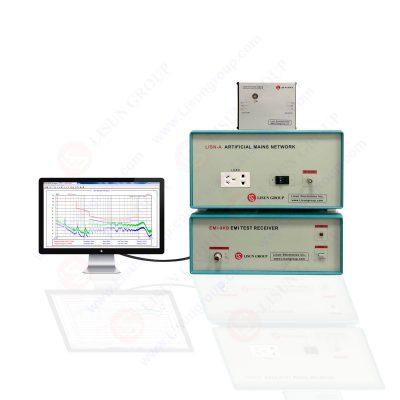
EMI-9KB EMI Test Receiver
CISPR 16-1-1:2019 sets a series of non-negotiable mandatory specifications for EMI test receivers. In terms of measurement bandwidth, the standard defines three segments of -6dB intermediate frequency measurement bandwidth: 200Hz for 9kHz‑150kHz, 9kHz for 150kHz‑30MHz and 120kHz for 30MHz‑1000MHz. Different bandwidths match corresponding charge-discharge time constants to guarantee measurement accuracy of pulse disturbance signals. For detector modes, the instrument must support Peak (PK), Quasi-Peak (QP) and Average (AV) detection. Among them, quasi-peak detection is critical for EMC certification tests. Its time constant must strictly conform to the standard to truly reflect the actual impact of radio disturbance on broadcast receivers.
The standard specifies a rated 50Ω RF port input impedance for the receiver and caps the voltage standing wave ratio under different attenuation gears to reduce measurement errors caused by RF signal reflection. Pulse response and measurement accuracy are also mandatory assessment items. For repetitive pulse interference signals, the equipment shall ensure measurement errors within the specified range. Non-compliant pulse response will directly lead to distorted test results of intermittent interference. Apart from the receiver itself, a complete EMI Test System also includes a Line Impedance Stabilization Network (LISN), CDNE coupling-decoupling network, isolation transformer, test cables and other supporting components. These accessories must also match standard requirements. Even if the receiver itself meets specifications, unqualified accessory indicators will still invalidate the whole system’s test results. Equipment self-shielding performance cannot be overlooked either. Insufficient chassis shielding of the receiver allows electromagnetic noise generated by the instrument itself to mix with signals under test, raising the system noise floor and preventing accurate identification of low-level disturbance signals.
The LISUN EMI-9K series includes four models: EMI-9KA, EMI-9KB, EMI-9KBS and EMI-9KC, targeting different test frequency bands and budget levels. EMI-9KA mainly covers 9kHz‑30MHz and is only suitable for power line conducted disturbance preliminary testing; EMI-9KB covers 9kHz‑300MHz, supporting both conducted and low-to-medium frequency radiated tests, ideal for SMEs’ R&D and pre-compliance inspection; EMI-9KBS is equipped with two-stage fixed preselectors to improve intermediate frequency rejection; EMI-9KC reaches up to 1000MHz, adding programmable automatic tracking preselectors and CDNE accessories to fulfill full conducted and radiated certification tests, meeting stringent test requirements of third-party testing laboratories. All models adopt fully enclosed high-conductivity shielding chassis to suppress internal instrument noise. The software embeds limit libraries of mainstream national and international standards and supports manual, automatic scanning, fixed-point and sweep measurement modes. The Chinese & English PC software is compatible with Win7 to Win11 operating systems and can export complete EMI test reports. The table below lists the core technical parameter comparison of this series:
| LISUN Model | EMI-9KA | EMI-9KB | EMI-9KBS | EMI-9KC |
|---|---|---|---|---|
| Frequency Range | 9kHz~30MHz | 9kHz~300MHz | 9kHz~300MHz | 9kHz~1000MHz |
| Detector Modes | PK, QP, AV | PK, QP, AV | PK, QP, AV | PK, QP, AV |
| Input Impedance | 50Ω | 50Ω | 50Ω | 50Ω |
| Input VSWR | ≤2 (RF ATT=0dB); ≤1.2 (RF ATT=10dB) | ≤2 (RF ATT=0dB); ≤1.2 (RF ATT=10dB) | ≤2 (RF ATT=0dB); ≤1.2 (RF ATT=10dB) | ≤2 (RF ATT=0dB); ≤1.2 (RF ATT=10dB) |
| Basic Measurement Accuracy (Reference Pulse Signal) | ±1.8dB | ±1.8dB | ±1dB | ±1dB |
| Preselector Configuration | None | None | Two-stage 20-channel fixed preselectors | Two-stage programmable auto-tracking preselectors |
| Standard System Composition | Receiver, LISN, isolation transformer, coaxial cable | Receiver, LISN, isolation transformer, coaxial cable | Receiver, LISN, isolation transformer, coaxial cable | Receiver, LISN, CDNE, isolation transformer, coaxial cable |
| Power Supply | 200~240VAC/50Hz/60Hz | 200~240VAC/50Hz/60Hz | 100~240VAC/50Hz/60Hz | 100~240VAC/50Hz/60Hz |
After confirming that the EMI receiver meets the basic indicators of CISPR 16-1-1 standard, users need to make comprehensive evaluation combining product types under test, laboratory positioning and future expansion requirements. First, determine the required test frequency band. If only power line conducted disturbance tests for home appliances and lamps are required, 9kHz‑30MHz meets basic demands. If both conducted and space radiated disturbance tests are needed, 300MHz or 1000MHz full-band models should be selected. Secondly, pay attention to the expandability of supporting test accessories. An EMI Test System can be optionally equipped with a three-loop antenna, absorbing clamp, RF current probe, shielding room, programmable pure sine wave source meter and other accessories for different test scenarios including low-frequency radiation test from 9kHz to 30MHz, power tool disturbance test by absorbing clamp method and signal line disturbance voltage test. Enterprises may select accessories according to their product categories.
Software capability is also an indispensable consideration. Certification laboratories require software embedded with complete standard limit libraries such as GB 17743 and CISPR15, supporting automatic comparison between measured data and standard limits and directly generating test spectrograms for report output. R&D departments need raw spectrum data export functions for engineers to locate interference frequency points and conduct EMI rectification analysis. Meanwhile, the whole EMI Test System must have metrological traceability. Receivers, LISNs, various probes and antennas should undergo periodic calibration to satisfy instrument management requirements under CNAS laboratory accreditation system. Many laboratories only calibrate the receiver main unit and ignore calibration of accessories such as LISNs and antennas, which will make test data of the whole system legally invalid.
It is also necessary to distinguish pre-compliance screening instruments from formal certification-grade systems. For product R&D phase, the mid-range EMI-9KB can be adopted for preliminary screening to detect over-limit problems such as switching power supply noise and motor radiated interference and complete rectification and optimization on filters, grounding and PCB layout at the prototype stage. Third-party testing institutions prefer the full-band EMI-9KC model, which fully satisfies all conditions for certification tests of various products. The equipment’s own shielding structural design also requires close examination. The fully enclosed high-conductivity chassis can reduce the instrument noise floor and prevent the equipment’s self-interference from being superimposed on sample test results.
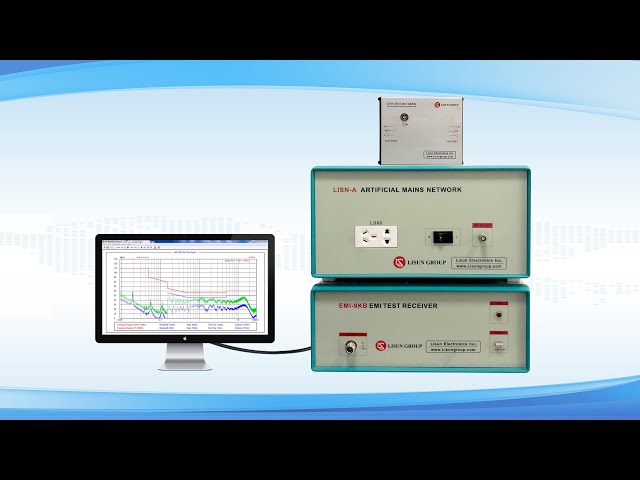
An EMI Test System is widely applied in information technology equipment, household appliances, lighting lamps, power tools and other industries. In the IT equipment sector, it is used for conducted and radiated tests of laptops, chargers, docking stations and other products to inspect high-frequency noise from switching power supplies. In household appliance and power tool industries, it detects pulse disturbance caused by motor brush sparks and drive circuits. For the lighting industry, disturbance tests are carried out on LED lamps and driver power supplies in accordance with GB 17743 and CISPR15 to prevent lamps from interfering with communication of smart home devices. During the R&D stage, engineers use the EMI Test System to locate interference sources and shorten EMI rectification cycles. In production quality control, it is applied for sampling inspection to monitor EMC consistency of mass-produced products. Third-party organizations use compliant systems to issue test reports and support products to complete domestic 3C certification as well as overseas CE and FCC market access. If CISPR 16-1-1 standard constraints are ignored during selection and non-compliant instruments are used for testing, self-test rectification may pass while third-party certification tests fail, leading to project delays and increased certification costs.
Selecting a compliant EMI Test System cannot simply take frequency parameters as the sole criterion. CISPR 16-1-1 (GB/T 6113.101-2021) standard must be taken as the core basis. Users need to verify receiver detector modes, intermediate frequency bandwidth, pulse response, VSWR and instrument shielding performance, and also evaluate LISN, CDNE, antennas and other complete supporting accessories, software reporting functions and metrological traceability capability. The LISUN EMI-9K series conducted & radiated interference test system includes multiple graded models, fully following CISPR 16-1-1 technical specifications, and can adapt to different test requirements of enterprise R&D screening, factory quality control and third-party certification laboratories respectively. A truly compliant EMI Test System helps enterprises identify hidden electromagnetic interference hazards in the early stage of product development, complete interference source localization and rectification, ensure products smoothly pass EMC compliance certification, and avoid equipment abnormality and market access risks caused by electromagnetic interference after product launch.
Tags:EMI-9KBYour email address will not be published. Required fields are marked *

 English
 中文简体
 English
 Русский
 Español
 Português
 Türkçe
 العربية
 Deutsch
 Polski
 Italiano
 Français
 한국어
 ไทย
 Tiếng Việt
 日本語