LM-79 Moving Detector Goniophotometer (Mirror Type C)
LSG-6000
High Precision Rotation Luminaire Goniophotometer
LSG-1890B
High Precision Rotation Luminaire Goniospectroradiometer
LSG-1890BCCD

Goniophotometer for Automotive and Signal Lamps
LSG-1950
Goniophotometer for Traffic Signal Lamps (Economical Model)
LSG-1950S
Goniophotometer for Airfield Lighting
LSG-1940
VAD Fire Alarm Visual Alert Device Goniophotometer
LSG-1930
Compact Goniophotometer
LSG-1200A
LED Goniophotometer
LSG-1100
Near Field Moving Detector Goniophotometer
LSG-1900B
 LEDs and Luminaire Test Solutions
 LM-79 and LM-80 Test Solutions
 LED Driver Test Solutions
 Household Appliances Test Solutions
 Mobile and Network Test Solutions
 Automotive Electronics Test Solutions
 Audio-Video and IT Test Solutions
 Cable and Wire Test Solutions
 Plugs and Sockets Test Solutions
 Power Switch Test Solutions
 Transformer Test Solutions
 Electric Toys Test Solutions
 Energy Meter Test Solutions
 Motor-Operated Tool Test Solutions
Select an organization
to browse standards
Abstract
With the continuous advancement of industrial technology and the widespread application of lighting equipment, the demand for accurate measurement of brightness of light has become increasingly prominent in fields such as industrial production, scientific research, and daily life. Handheld CCD photometer spectrometers, as efficient and precise testing instruments, play an indispensable role in measuring brightness of light. This paper takes the LISUN LMS-6000 series of handheld CCD photometer spectrometers as the research object, elaborates on the technical principles of the instruments in measuring brightness of light, analyzes in detail the performance parameters, measurement accuracy, and application scenarios related to measuring brightness of light of different models in the series, and verifies the reliability and superiority of the instruments in practical applications through specific application cases. The research results provide important reference value for relevant practitioners in selecting suitable instruments for measuring brightness of light and improving measurement efficiency and accuracy.
1. Introduction
Brightness of light, as an important indicator to describe the intensity of light perceived by the human eye, directly affects people’s visual experience and the quality of related products. In industrial manufacturing, the brightness of light of display screens, lighting fixtures, and other products needs to be strictly controlled to ensure product quality and user experience; in scientific research, accurate measurement of brightness of light is the basis for carrying out related experiments and research. Traditional methods for measuring brightness of light have limitations such as cumbersome operation, low measurement accuracy, and poor portability, which can no longer meet the needs of modern production and research.
Handheld CCD photometer spectrometers have emerged as the times require. With their advantages of small size, portability, high measurement accuracy, and rich measurement parameters, they have been widely used in various fields. The LISUN LMS-6000 series of handheld CCD photometer spectrometers, developed by LISUN Group, is a representative product in this field. It has multiple models with different functional configurations, among which the LMS-6000L model is specially designed for measuring brightness of light. This paper will focus on the application of the LISUN LMS-6000 series in measuring brightness of light, and conduct in-depth research and analysis from technical principles, product parameters, application cases, etc.
2. Technical Principles of Handheld CCD Photometer Spectrometers in Measuring Brightness of Light
2.1 Basic Working Principle
Handheld CCD photometer spectrometers mainly rely on the combination of optical systems, CCD sensors, and data processing systems to realize the measurement of brightness of light. The optical system collects the light to be measured, and through the long-focus cross asymmetric CT spectroscopic system, the light is split into different wavelength components. The CCD sensor converts the optical signal into an electrical signal, and after being processed by the data processing system, the relevant parameters such as brightness of light are calculated according to the corresponding algorithms and standards.
In the process of measuring brightness of light, the instrument first collects the light radiation flux within a specific solid angle, and then converts it into brightness values through calculation. The brightness value is usually expressed in cd/m² (candela per square meter) or fL (foot-lambert), and the LISUN LMS-6000 series can switch between different units according to user needs to meet the measurement requirements of different scenarios.
2.2 Key Technical Advantages
The LISUN LMS-6000 series adopts advanced optical design and electronic technology, which has obvious advantages in measuring brightness of light. Firstly, the long-focus cross asymmetric CT spectroscopic system ensures the accuracy of light splitting, enabling the instrument to accurately distinguish light of different wavelengths and lay a solid foundation for the accurate measurement of brightness of light. Secondly, the high-precision CCD sensor has high sensitivity and signal-to-noise ratio, which can accurately capture weak optical signals and ensure the measurement accuracy of brightness of light in a wide range. In addition, the instrument’s data processing system uses advanced algorithms, which can quickly and accurately process the collected electrical signals and convert them into reliable measurement results of brightness of light.
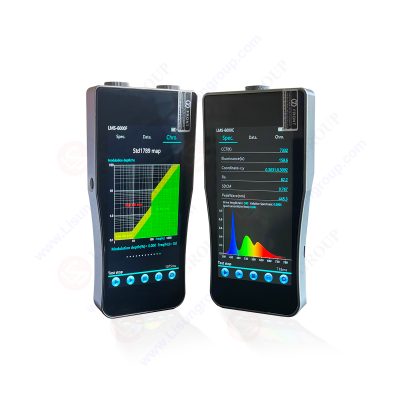
LMS-6000 Portable CCD Spectroradiometer
3. Performance Parameters of LISUN LMS-6000 Series Related to Measuring Brightness of Light
3.1 Core Parameters of LMS-6000L Model (Specialized in Measuring Brightness of Light)
The LMS-6000L model is a key product in the LISUN LMS-6000 series for measuring brightness of light. Its core parameters related to measuring brightness of light are shown in Table 1.
Table 1 Core Parameters of LMS-6000L Model for Measuring Brightness of Light
| Parameters | Specifications |
| Brightness measurement range | 0.1 – 500,000 cd/m² |
| Brightness measurement accuracy | ±0.1 cd/m² |
| English brightness unit | fL (foot-lambert) |
| Wavelength range | 380 – 780 nm |
| Color coordinate accuracy (Δx, Δy) | ±0.005 |
| Correlated color temperature (CCT) range | 1,500K – 100,000K |
| CCT measurement accuracy | ±0.6% |
| Color rendering index (CRI) range | 0 – 100.0 |
| CRI measurement accuracy | ± (0.3%rd ± 0.3) |
| Luminous linearity | ±0.6% |
| Integration time | 0.1ms – 5s |
3.2 Comprehensive Performance Parameters of the Series
In addition to the LMS-6000L model specialized in measuring brightness of light, other models in the LISUN LMS-6000 series also have certain relevance to brightness measurement while having their own functional characteristics. The comprehensive performance parameters of the series that support measuring brightness of light are shown in Table 2.
Table 2 Comprehensive Performance Parameters of LISUN LMS-6000 Series Supporting Measuring Brightness of Light
| Parameters | Specifications |
| Spectral platform | Long-focus cross asymmetric CT spectroscopic system |
| Wavelength accuracy | ±0.5nm |
| Wavelength resolution | ±0.2nm |
| Sample scanning interval | ±0.1nm |
| Stray light | <0.015% (600nm), <0.03% (435nm) |
| Display screen | 5-inch high-definition IPS capacitive touch screen, maximum resolution 480*854 |
| Power supply | 4000mAh rechargeable lithium battery, continuous working time up to 20 hours |
| Dimensions | 135mm*80mm*23mm |
| Storage space | 8GB, capable of storing 5,000 to 100,000 test reports |
| Compatible computer systems | Win7, Win8, Win10, Win11 |
| Communication method | Connect with computer via software |
3.3 Parameter Advantages in Measuring Brightness of Light
Compared with similar products on the market, the LISUN LMS-6000 series has obvious advantages in parameters related to measuring brightness of light. Firstly, the brightness measurement range of the LMS-6000L model covers 0.1 – 500,000 cd/m², which can meet the measurement needs of various low-brightness and high-brightness scenarios. Secondly, the measurement accuracy reaches ±0.1 cd/m², ensuring the reliability of measurement results. In addition, the series is equipped with a high-precision spectral platform and CCD sensor, which can effectively avoid the interference of external factors on the measurement results and further improve the accuracy of measuring brightness of light. At the same time, the instrument’s long battery life, small size, and large storage space make it more convenient and efficient in practical applications of measuring brightness of light.
4. Application Scenarios of LISUN LMS-6000 Series in Measuring Brightness of Light
4.1 Industrial Manufacturing Field
In the field of industrial manufacturing, measuring brightness of light is an important part of product quality inspection. For example, in the production process of display screens (such as mobile phone screens, computer monitors, TV screens), the brightness of light of the screen directly affects the user’s viewing experience. The LMS-6000L model can accurately measure the brightness of light of the display screen, helping manufacturers detect unqualified products in a timely manner and ensure the consistency of product quality. In addition, in the production of lighting fixtures (such as LED lamps, fluorescent lamps), the LISUN LMS-6000 series can not only measure the brightness of light of the lamps but also detect other parameters such as color temperature and color rendering index, providing comprehensive data support for manufacturers to optimize product design and improve product performance.
4.2 Scientific Research Field
In scientific research, accurate measurement of brightness of light is crucial for the success of experiments. For example, in the research of optoelectronic materials, researchers need to accurately measure the brightness of light emitted by materials under different conditions to study the optical properties of materials. The high measurement accuracy and rich parameter measurement functions of the LISUN LMS-6000 series can meet the rigorous requirements of scientific research experiments. Meanwhile, the portability of the instrument allows researchers to carry it to different laboratories or field test sites, facilitating on-site measurement and data collection.
4.3 Daily Life and Public Facilities Field
In daily life and public facilities, measuring brightness of light is also widely used. For example, in the lighting design of shopping malls, supermarkets, hospitals, and other public places, it is necessary to ensure that the brightness of light meets the relevant national standards and user needs. The LISUN LMS-6000 series can quickly and accurately measure the brightness of light in different areas of public places, providing data support for lighting design and adjustment. In addition, in the maintenance and inspection of public lighting facilities, the instrument can help staff detect problems such as insufficient brightness of light in a timely manner and carry out maintenance and replacement work to ensure the normal use of public facilities.
5. Application Cases of LISUN LMS-6000 Series in Measuring Brightness of Light
5.1 Case 1: Brightness Measurement of LED Display Screens in a Shopping Mall
A large shopping mall needed to test the brightness of light of the newly installed LED display screens to ensure that the display effect meets the requirements and does not cause visual fatigue to customers. The shopping mall chose the LMS-6000L model of the LISUN LMS-6000 series for measurement. During the measurement process, the staff held the instrument to collect data at different positions and angles of the display screen. The instrument quickly measured the brightness of light of the display screen, with the measurement results ranging from 300 cd/m² to 450 cd/m², which was within the standard range of 200 cd/m² to 500 cd/m² for public place display screens. At the same time, the instrument also measured parameters such as color temperature and color rendering index of the display screen, which were all in line with the relevant standards. The measurement results provided a reliable basis for the shopping mall to confirm the qualified quality of the LED display screens.
5.2 Case 2: Brightness Measurement of Laboratory Optoelectronic Materials
A university laboratory was conducting research on a new type of optoelectronic material and needed to accurately measure the brightness of light emitted by the material under different voltage conditions. The laboratory adopted the LMS-6000L model for measurement. The researchers adjusted the voltage of the material step by step and used the instrument to measure the brightness of light at each voltage. The instrument’s high measurement accuracy (±0.1 cd/m²) ensured that the researchers obtained accurate data on the change of the material’s brightness of light with voltage. Through data analysis, the researchers found that the brightness of light of the material increased linearly with the increase of voltage within a certain voltage range, which provided important experimental data for the subsequent research and development of the material.

6. Conclusion and Prospect
6.1 Conclusion
This paper takes the LISUN LMS-6000 series of handheld CCD photometer spectrometers as the research object, focusing on their application in measuring brightness of light. Through the research on technical principles, it is found that the instrument realizes accurate measurement of brightness of light through the combination of advanced optical systems, CCD sensors, and data processing systems. The analysis of performance parameters shows that the LMS-6000L model, as a specialized model for measuring brightness of light, has the advantages of wide measurement range, high measurement accuracy, and rich supporting parameters. The application scenarios and cases further verify that the LISUN LMS-6000 series can meet the needs of measuring brightness of light in various fields such as industrial manufacturing, scientific research, and public facilities, and has high reliability and practical value.
6.2 Prospect
With the continuous development of science and technology, the demand for measuring brightness of light will be more diverse and rigorous. In the future, the LISUN LMS-6000 series can be further optimized and upgraded in terms of measurement accuracy, functional integration, and intelligent operation. For example, improving the measurement accuracy of brightness of light to meet the needs of more high-precision scientific research experiments; integrating more measurement functions to realize simultaneous measurement of multiple optical parameters while measuring brightness of light; and adding intelligent functions such as automatic data analysis and report generation to improve measurement efficiency. It is believed that with the continuous advancement of technology, the LISUN LMS-6000 series will play a more important role in the field of measuring brightness of light and make greater contributions to the development of related industries.
Tags:LMS-6000Your email address will not be published. Required fields are marked *

 English
 中文简体
中文简体 English
 Русский
 Español
 Português
 Türkçe
 العربية
 Deutsch
 Polski
 Italiano
 Français
 한국어
한국어 ไทย
ไทย Tiếng Việt
 日本語
日本語