LM-79 Moving Detector Goniophotometer (Mirror Type C)
LSG-6000
High Precision Rotation Luminaire Goniophotometer
LSG-1890B
High Precision Rotation Luminaire Goniospectroradiometer
LSG-1890BCCD

Goniophotometer for Automotive and Signal Lamps
LSG-1950
Goniophotometer for Traffic Signal Lamps (Economical Model)
LSG-1950S
VAD Fire Alarm Visual Alert Device Goniophotometer
LSG-1930
Goniophotometer for Airfield Lighting
LSG-1940
Compact Goniophotometer
LSG-1200A
LED Goniophotometer
LSG-1100
Near Field Moving Detector Goniophotometer
LSG-1900B
 LEDs and Luminaire Test Solutions
 LM-79 and LM-80 Test Solutions
 LED Driver Test Solutions
 Household Appliances Test Solutions
 Mobile and Network Test Solutions
 Automotive Electronics Test Solutions
 Audio-Video and IT Test Solutions
 Cable and Wire Test Solutions
 Plugs and Sockets Test Solutions
 Power Switch Test Solutions
 Transformer Test Solutions
 Electric Toys Test Solutions
 Energy Meter Test Solutions
 Motor-Operated Tool Test Solutions
Select an organization
to browse standards
As a universal international standard for electrical load testing of global automotive electronic and electrical components, ISO 16750-2:2023 has updated numerous electrical stress test clauses targeting new energy vehicles and intelligent on-board controllers. Traditional discrete test equipment cannot fully cover all test items of the latest standard, and the consistency and traceability of test data fail to meet the certification requirements of vehicle OEMs and CNAS laboratories. The ISO 16750-2:2023 Test System is an integrated complete test platform adapted to the new standard. The LS-ISO16750 on-board electronic electrical performance test system launched by LISUN is a representative standardized ISO 16750-2:2023 Test System. It is developed for automotive electronic and electrical parts such as ECUs, on-board sensors, OBC on-board chargers and DC-DC converters. The complete equipment integrates multiple types of signal simulation units, which can reproduce all electrical stress conditions during vehicle operation, including voltage fluctuations, transient high-voltage pulses, ground potential offset, wiring harness intermittent interruption and circuit short circuits. The unified control platform realizes full-process automatic testing, evaluates the electrical reliability of components in accordance with domestic and foreign specifications including ISO 16750-2:2023, VW 80000 and GM 3172, and identifies failure risks such as crash, communication loss and chip damage caused by abnormal power supply and sudden load changes in advance. Meanwhile, it meets the full-scenario demands of R&D verification, mass production line quality inspection and compliance certification of third-party laboratories. Centered on the ISO 16750-2:2023 Test System, this paper compares the differences in test requirements between the old and new standards, analyzes the hardware structure and functional upgrade points of the LS-ISO16750 system, and illustrates the equipment coverage capacity with a standard item matching table.
Compared with the old standard, ISO 16750-2:2023 adds a large number of test clauses for high-voltage auxiliary components of 48V mild hybrid and pure electric vehicles, refines test conditions such as wiring harness intermittent interruption, ground offset, dynamic voltage cycles and intelligent generator voltage regulation curves, and raises metering requirements for waveform timing, voltage accuracy and switching speed. The traditional test scheme built discretely with power supplies, pulse generators and short-circuit switches suffers from asynchronous linkage of equipment, cumbersome parameter calibration and long time consumption for switching multiple test items. A single set of equipment cannot simultaneously complete various tests including power supply variation, load dump and circuit fault simulation. Enterprises need to purchase multiple instruments for matching use, which greatly increases laboratory construction costs and operation thresholds.
Market demand for standardized ISO 16750-2:2023 Test Systems keeps rising. Integrated complete equipment can integrate all simulation units into a unified cabinet, schedule all modules uniformly through upper computer software, automatically record voltage, current and timing curves of each test, and generate complete reports complying with OEM audit specifications. It fundamentally solves problems such as data discontinuity and difficulty in reproducing working conditions caused by discrete equipment, which is the core starting point for LISUN to develop the LS-ISO16750 on-board electronic electrical performance test system.
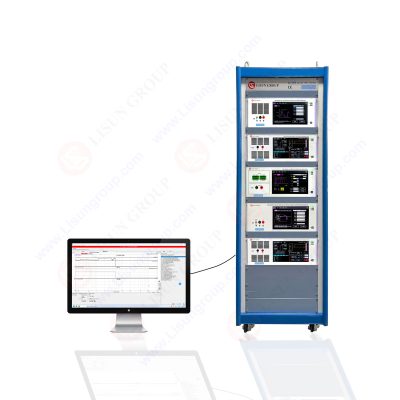
ISO 16750-2:2023 Automotive Electrical Disturbances Test System
The complete LS-ISO16750 ISO 16750-2:2023 Test System adopts a 19-inch integrated standard cabinet layout. Five core analog hardware units are installed inside. Each module can work independently or output composite electrical stress synchronously in linkage, fully covering 12 categories of basic tests specified in the new standard and additional customized test items for vehicle manufacturers such as Volkswagen and General Motors. The functions of each unit and matched standard clauses are as follows.
The first unit is the four-quadrant bipolar voltage simulator LIS-APS-4030K300, the basic power supply core of the entire ISO 16750-2:2023 Test System. It supports ±40V/30A four-quadrant bidirectional output with a maximum frequency of 300kHz, and can simulate working conditions including slow voltage rise and fall, long-term overvoltage, instantaneous undervoltage, superimposed AC ripple, reverse polarity power supply and cranking pulses. It is also equipped with high-precision voltage and current probes and oscilloscope acquisition channels to capture dynamic electrical changes at the power supply terminal of the equipment under test in real time, matching all power supply-related test clauses from Clause 4.2 to 4.7 of the standard. Customizable voltage and current specifications are available, expandable up to ±80V/150A for testing large on-board power components.
The second unit is the EMS-ISO7637-P5 load dump simulator, specially reproducing the 5a and 5b load dump pulses specified in Clause 4.6.4 of ISO 16750-2:2023 to simulate high-voltage transient surges generated by disconnection of high-power vehicle loads. It delivers a maximum discharge energy of 200 Joules with continuously adjustable voltage ranging from 10 to 210V, matching the special E-05 load dump test requirements of Volkswagen. It can be linked with the four-quadrant power supply to realize composite stress testing with normal power supply superimposed by load dump pulses.
The third unit is the PFS-80V50A wiring harness intermittent interruption simulator, divided into power line channels and signal line channels. Each power line channel supports 80V/50A while each signal line channel supports a maximum of 2A. The minimum interruption time is 1 microsecond with a switching speed no more than 200ns, corresponding to single and multi-harness interruption tests in Clause 4.9 of the standard. It also meets the E-13 pin and E-14 connector durability interruption tests of Volkswagen, simulating instantaneous power-off interference caused by loose wiring harness connectors during vehicle operation.
The fourth unit is the LIS-OFFSET ground offset simulator, which outputs ±10V/10A offset voltage based on the four-quadrant power supply architecture, fully covering the ground reference potential offset test in Clause 4.8 of ISO 16750-2:2023. It reproduces potential difference interference caused by unbalanced grounding of the whole vehicle wiring harness and poor grounding, and verifies the signal acquisition stability of sensors.
The fifth unit is the LIS-LSCS wiring harness short-circuit simulator, equipped with 30 independent channels as standard and an expandable 50-channel model as an option. It can separately set fault modes such as signal line short circuit, power line short to ground and mutual short circuit between power lines, matching circuit short-circuit related test clauses in Clause 4.10 of the standard. It automatically records the instantaneous impulse current during short-circuit to evaluate the overcurrent protection capacity of devices.
The complete ISO 16750-2:2023 Test System is equipped with Windows-based automatic control software, which allows users to edit custom test sequences and execute more than ten consecutive electrical stress tests with one click without manual switching of hardware equipment throughout the process. After testing, PDF reports with original waveform data are automatically exported to meet the CNAS data traceability requirements of third-party laboratories.
| ISO 16750-2:2023 Standard Clause | Corresponding Test Name | Matching LISUN Hardware Model | Corresponding OEM Test Items (VW 80000) |
| 4.2 | Supply Voltage Range Test | LIS-APS-4030K300 | Chapter 5 General Operating Voltage Requirements |
| 4.3.1 | Long-Term Overvoltage | LIS-APS-4030K300 | E-01 Long-Term Overvoltage |
| 4.6.4 | Load Dump Transient Surge | EMS-ISO7637-P5-80V30A | E-05 Special Load Dump Test |
| 4.8 | Ground Reference Potential Offset | LIS-OFFSET-10V10A | E-16 Ground Offset Test |
| 4.9.1 / 4.9.2 | Single / Multi-Wiring Harness Intermittent Interruption | PFS-80V50A | E-13 Pin Interruption, E-14 Connector Interruption |
| 4.10.2 / 4.10.3 | Signal Line and Power Line Short-Circuit Faults | LIS-LSCS-1730 | E-17 Circuit Short Circuit, E-22 Overcurrent Verification |
| 4.4 | AC Ripple Voltage Superimposed on Power Supply | LIS-APS-4030K300 | E-06 Ripple Voltage Test |
| 4.7 | Reverse Voltage Supply Test | LIS-APS-4030K300 | E-15 Reverse Polarity Supply Test |
Compared with traditional distributed test schemes, the integrated LS-ISO16750 ISO 16750-2:2023 Test System features four differentiated technical upgrades adapted to the test demands of the new standard and new energy vehicle products.
The first highlight is synchronous linkage control of multiple modules. The software can synchronously schedule voltage sources, load dump generators, interruption switches and short-circuit units to output composite stress simultaneously, simulating extreme working conditions where multiple electrical faults occur at the same time on real vehicles. Traditional discrete equipment cannot realize timing synchronization and thus fail to reproduce device failures under composite interference.
The second highlight is wide-range expandable hardware specifications. The core power supply unit, load dump simulator and wiring harness interruption switch all support customization of voltage and current parameters. Small current specifications of 10A for miniature sensors and high-power specifications of 150A for on-board chargers can be matched as required. A single ISO 16750-2:2023 Test System can cover component tests for 12V passenger vehicles, 24V commercial vehicles and 48V hybrid vehicles with significantly improved equipment reuse rate.
The third highlight is automatic full-process data collection and traceability. A multi-channel synchronous acquisition oscilloscope is built in to record waveform data at the moment of each voltage mutation, pulse surge and circuit short-circuit. Test reports are automatically bound with equipment calibration numbers, test timings and parameter records, fully meeting the OEM audit and CNAS laboratory metering traceability requirements, eliminating errors and tedious manual data recording procedures.
The fourth highlight is compatibility with customized standards of multiple vehicle brands. In addition to the basic ISO 16750-2:2023 clauses, the system is embedded with complete test templates for VW 80000, GM 3172, LV 124 and Nissan 28401. Engineers do not need to manually edit complex test sequences and can complete special additional tests for vehicle manufacturers by calling templates, shortening the R&D verification cycle.
The LS-ISO16750 ISO 16750-2:2023 Test System can cover test scenarios across the entire automotive electronics industrial chain. R&D laboratories of vehicle component manufacturers can use it for electrical reliability preliminary verification of prototypes, identifying defects in power supply protection, grounding circuits and wiring harness interfaces at the design stage to reduce rectification costs of real vehicle road test faults. Manufacturers of new energy battery management systems, on-board chargers and DC-DC converters can complete full electrical load verification of 48V high-voltage auxiliary components with this equipment. Producers of on-board sensors, instrument panels and body controllers can deploy it at the end of production lines to conduct standardized electrical stress screening of each product before delivery and control the consistency of mass-produced products. Third-party automotive testing laboratories can build a complete certification platform to issue authoritative test reports complying with international standards and OEM specifications, supporting customers’ supply chain access audits. Universities and automotive research institutes can apply it to experimental research on automotive electrical reliability topics, reproducing various extreme power grid stresses for mechanism research.
If enterprises need supporting ISO 7637 conducted immunity tests simultaneously, they can additionally equip the LISUN EMS-ISO7637 transient interference generator to form a complete integrated laboratory for automotive EMC and electrical performance testing. The combined equipment covers all electrical international standard test items for automotive electronics.
The new ISO 16750-2:2023 standard has updated numerous stringent electrical stress test clauses targeting new energy and intelligent automotive electronics. Traditional distributed test instruments can no longer meet the demands of complete, efficient and traceable testing, making standardized integrated ISO 16750-2:2023 Test Systems essential equipment for automotive electronics enterprises’ laboratories. As a mature complete solution launched by LISUN, the LS-ISO16750 on-board electronic electrical performance test system integrates five core functional units including four-quadrant voltage simulation, load dump pulse generation, wiring harness intermittent interruption, ground offset and circuit short-circuit simulation. It fully covers all 12 categories of electrical load test items specified in ISO 16750-2:2023 and is compatible with customized test specifications of mainstream vehicle manufacturers such as Volkswagen, General Motors and VDA. Supported by three technical highlights including multi-module synchronous linkage, expandable hardware specifications and automatic full-process data collection, it solves industry pain points of discrete equipment such as asynchronous timing, cumbersome operation and untraceable data.
For automotive electronics R&D enterprises, mass production factories and third-party testing institutions, purchasing a complete ISO 16750-2:2023 Test System enables one-time construction of an electrical reliability test platform complying with the latest international standard, greatly cutting procurement, operation and labor costs of multiple discrete instruments and accelerating the progress of international product certification. It is standardized professional equipment adapted to the current demands of automotive electrical testing.
Tags:LS-ISO16750Your email address will not be published. Required fields are marked *

 English
 中文简体
中文简体 English
 Русский
 Español
 Português
 Türkçe
 العربية
 Deutsch
 Polski
 Italiano
 Français
 한국어
한국어 ไทย
ไทย Tiếng Việt
 日本語
日本語