LM-79 Moving Detector Goniophotometer (Mirror Type C)
LSG-6000
High Precision Rotation Luminaire Goniophotometer
LSG-1890B
High Precision Rotation Luminaire Goniospectroradiometer
LSG-1890BCCD

Goniophotometer for Automotive and Signal Lamps
LSG-1950
Goniophotometer for Traffic Signal Lamps
LSG-1950S
VAD Fire Alarm Visual Alert Device Goniophotometer
LSG-1930
Compact Goniophotometer
LSG-1200A
LED Goniophotometer
LSG-1100
 LEDs and Luminaire Test Solutions
 LM-79 and LM-80 Test Solutions
 LED Driver Test Solutions
 Household Appliances Test Solutions
 Mobile and Network Test Solutions
 Automotive Electronics Test Solutions
 Audio-Video and IT Test Solutions
 Cable and Wire Test Solutions
 Plugs and Sockets Test Solutions
 Power Switch Test Solutions
 Transformer Test Solutions
 Electric Toys Test Solutions
 Energy Meter Test Solutions
 Motor-Operated Tool Test Solutions
Select an organization
to browse standards
Abstract
When vehicle electrical equipment operates, disconnection of generators or high-power loads will generate load dump pulses, commonly known as load dump interferences in the industry. Such transient high-voltage pulses easily lead to functional failures and chip burnout of ECUs, vehicle-mounted sensors, on-board chargers for new energy vehicles and other equipment. To complete compliant electromagnetic compatibility verification, the core question is How to Simulate Automotive Load Dump Pulses? to restore real power grid interference working conditions of actual vehicles. Developed by LISUN, the EMS-ISO7637 automotive electronic transient interference generator is an integrated device for EMC immunity testing of auto parts. It fully reproduces various transient conducted interference waveforms defined in ISO 7637 standards, including 5a and 5b load dump pulses, and provides standardized test environments for various vehicle-mounted electronic products. This paper discusses the generation mechanism of load dump pulses, simulation implementation schemes, equipment parameter comparison and full-scenario test applications, elaborates in detail how to simulate automotive load dump pulses with the EMS-ISO7637 equipment, compares the adaptation scenarios of different models, and provides equipment selection and test implementation references for vehicle manufacturers, third-party laboratories and electronic R&D enterprises.
During vehicle driving, sudden disconnection of high-power loads such as air conditioning compressors and vehicle lamps will release huge induced electromotive force from the excitation coil of the on-board generator, forming load dump pulses with high amplitude and long duration, corresponding to Pulse 5a and 5b waveforms specified in ISO 7637-2 standard. There are obvious differences in pulse voltage, clamping range and discharge energy of dump pulses among 12V passenger vehicles, 24V commercial vehicles and 48V new energy vehicles. If laboratories cannot accurately reproduce such waveforms, products will encounter faults such as screen blackout, communication interruption and component damage during real vehicle road tests.
The traditional discrete test circuit construction method combines DC power supply, pulse generation module and load resistor, which suffers from poor waveform consistency and difficult precise control of pulse rise time and clamping voltage, failing to meet the metering requirements of GB/T 21437.2 and ISO 7637-2. Stable and compliant testing relies on standardized integrated equipment, which is the core reason why the industry generally focuses on How to Simulate Automotive Load Dump Pulses?. The LISUN EMS-ISO7637 series automotive electronic transient interference generator can fully solve this pain point.
The LISUN EMS-ISO7637 automotive electronic transient interference generator includes three basic models, all equipped with built-in load dump pulse generation units with differentiated configurations for various test demands, and completes the whole process of How to Simulate Automotive Load Dump Pulses?. The whole device adopts a 4U integrated chassis without additional discrete components for splicing.
The complete simulation process consists of four basic steps. First, build the power supply circuit for the equipment under test. The built-in coupling and decoupling network supports basic output of 80V/30A, with optional upgrades to 50A and 100A specifications to adapt to 12V, 24V and 48V vehicle electrical systems. Second, call Pulse 5a or Pulse 5b standard templates on the 10.1-inch Chinese and English touch screen. The system embeds native ISO standard waveform parameters without repeated manual debugging. Third, adjust parameters such as pulse voltage, clamping voltage, source impedance and rise time according to vehicle types. The voltage adjustment resolution reaches 1V, and the source impedance is continuously adjustable from 0.5Ω to 40Ω, covering all test ranges of passenger vehicles and commercial vehicles. Fourth, set the number of pulse triggers and pulse duration, start automatic testing. The device synchronously records waveform curves and exports test reports without manual supervision throughout the process.
For CNAS-certified laboratories with high test precision requirements, the LIS-CAR calibration resistor kit can be matched to complete no-load and loaded waveform verification, ensuring that the output load dump pulse waveforms fully match standard tolerances and avoid certification re-test costs caused by test data deviation. In addition to basic load dump pulses, the device integrates all power line transient waveforms including Pulse 1, 2a, 3a and 3b. A single unit can complete all conducted immunity tests of ISO 7637-2 without purchasing multiple discrete instruments.
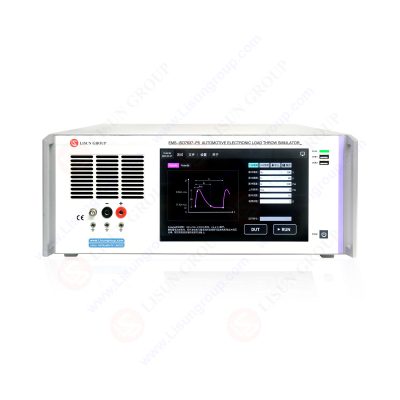
ISO 7637-2 Automotive Transient Immunity Generator
| Comparison Item | EMS-ISO7637-P1235-80V30A | EMS-ISO7637-P123-80V30A | EMS-ISO7637-P5-80V30A |
| Support for load dump pulse 5a/5b | Supported | Not supported | Supported |
| Load dump pulse voltage range | 10~210V, tolerance ±5% | No output | 10~210V, tolerance ±5% |
| Adjustable pulse clamping voltage range | 10~200V, 1V step | No output | 10~200V, 1V step |
| Pulse source impedance adjustment range | 0.5~40Ω, 0.1Ω step | No output | 0.5~40Ω, 0.1Ω step |
| Pulse rise time adjustment | 0.1ms~10s stepless adjustable | No output | 0.1ms~10s stepless adjustable |
| Maximum discharge energy | 200 Joules | No output | 200 Joules |
| Matching test objects | Full range of automotive electronics, covering all transient waveform and load dump pulse tests | Only power-off and switching transient tests, scenarios without load dump simulation demands | Special preliminary reliability verification focusing solely on load dump pulses |
| Applicable scenarios | Complete certification for whole vehicle parts laboratories and third-party testing institutions | Low-cost basic transient preliminary testing for small R&D laboratories | Special load dump reliability verification for new energy BMS and OBC |
After mastering How to Simulate Automotive Load Dump Pulses?, enterprises can rely on LISUN EMS-ISO7637 equipment to cover testing demands of the entire industrial chain. The first category is verification during the R&D phase of automotive electronics. For engine ECUs, millimeter-wave radars and instrument display screens, reproducing 5a and 5b dump pulses helps troubleshoot design defects of voltage stabilization and protection circuits in advance and reduce whole vehicle test faults in later stages. The second category is testing of high-voltage components for new energy vehicles. On-board chargers, DC-DC converters and battery management systems have higher tolerance requirements for high-voltage dump interferences. The long-time pulse output capability of the equipment can simulate long-term load dump working conditions to verify long-term operation stability of products. The third category is mass production quality inspection on production lines. The equipment embeds one-click automatic test templates, allowing production line operators without professional standard knowledge to complete load dump pulse screening of each product and stably control factory quality. The fourth category is certification tests for third-party testing laboratories. The equipment is equipped with CNAS calibration certificates, and its output test reports can be directly used for supply chain access audits of vehicle manufacturers such as Volkswagen, General Motors and Toyota. The fifth category is verification of military vehicle electronic equipment. With extended accessories, it can be compatible with transient immunity test requirements related to MIL-STD-461 to expand the application scope of the equipment.
If laboratories need to complete ISO 7637-3 non-power line capacitive and inductive coupling tests simultaneously, optional accessories such as VFTC capacitive coupling clamps and LIS-BCP110 current injection probes can be matched to build a complete automotive conducted immunity test system. If power line transient emission tests are required, LIS-TEMI series artificial network equipment can be matched to cover all test clauses in the standard appendix.
How to Simulate Automotive Load Dump Pulses? is an unavoidable core issue in automotive electronic EMC testing. Discrete test circuits have drawbacks including unstable waveforms, cumbersome parameter adjustment and incapability of passing metering certification. As an integrated professional test device, the LISUN EMS-ISO7637 automotive electronic transient interference generator fully replicates the 5a and 5b load dump pulse waveforms specified in ISO 7637 standards, accurately controls key parameters such as voltage, impedance and timing, and can meet metering requirements of various laboratories when matched with calibration kits.
In terms of equipment selection, the EMS-ISO7637-P1235-80V30A model is recommended for full-range auto parts testing, covering all transient waveforms and load dump pulse simulation. The EMS-ISO7637-P5-80V30A can be selected for special load dump reliability verification to control equipment procurement costs. The whole device features compact structure and simple deployment, adapting to different sites such as enterprise R&D laboratories, mass production lines and third-party testing institutions. While solving the problem of How to Simulate Automotive Load Dump Pulses?, it simultaneously covers all series of vehicle-mounted transient interference test demands, greatly cutting capital and time costs for enterprises to build EMC laboratories, and serving as a standardized solution for electromagnetic compatibility verification of vehicle-mounted electronic products.
Tags:EMS-ISO7637Your email address will not be published. Required fields are marked *

 English
 中文简体
中文简体 English
 Русский
 Español
 Português
 Türkçe
 العربية
 Deutsch
 Polski
 Italiano
 Français
 한국어
한국어 ไทย
ไทย Tiếng Việt
 日本語
日本語