LM-79 Moving Detector Goniophotometer (Mirror Type C)
LSG-6000
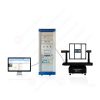
High Precision Rotation Luminaire Goniophotometer
LSG-1890B
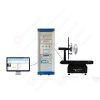
High Precision Rotation Luminaire Goniospectroradiometer
LSG-1890BCCD

Goniophotometer for Automotive and Signal Lamps
LSG-1950
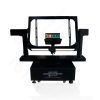
Goniophotometer for Traffic Signal Lamps (Economical Model)
LSG-1950S
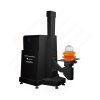
Goniophotometer for Airfield Lighting
LSG-1940
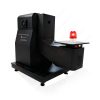
VAD Fire Alarm Visual Alert Device Goniophotometer
LSG-1930
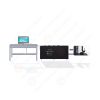
Compact Goniophotometer
LSG-1200A
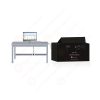
LED Goniophotometer
LSG-1100
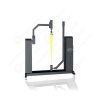
Near Field Moving Detector Goniophotometer
LSG-1900B
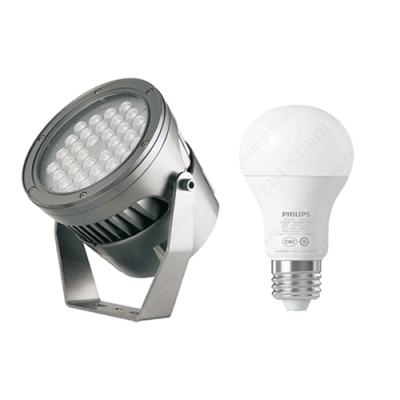 LEDs and Luminaire Test Solutions
 LM-79 and LM-80 Test Solutions
 LED Driver Test Solutions
 Household Appliances Test Solutions
 Mobile and Network Test Solutions
 Automotive Electronics Test Solutions
 Audio-Video and IT Test Solutions
 Cable and Wire Test Solutions
 Plugs and Sockets Test Solutions
 Power Switch Test Solutions
 Transformer Test Solutions
 Electric Toys Test Solutions
 Energy Meter Test Solutions
 Motor-Operated Tool Test Solutions
Select an organization
to browse standards
Electromagnetic Compatibility (EMC) is a core access indicator for electronic and electrical equipment to enter the global market. The EMI and EMC Test System performs quantitative detection of conducted and radiated interference, which directly determines the accuracy of test results and the effectiveness of product certification. Traditional EMI testing equipment generally has self-interference problems caused by internal noise leakage, module crosstalk and poor grounding, resulting in large measurement errors and distorted low-level signals. This paper systematically expounds the basic working principles of EMC and EMI test systems, and focuses on analyzing the structural design, key configuration and self-interference suppression mechanism of the LISUN EMI‑9KB EMI and EMC Test System. Combined with technical parameters and measured comparison data, it proves that the system can fundamentally reduce self-interference and meet multiple international standards such as CISPR, GB, FCC and EN, providing a reliable solution for accurate EMI testing of lighting, household appliances, information technology and other products.
With the high-frequency and high-density integration of 5G, Internet of Things and new energy equipment, the electromagnetic environment is becoming increasingly complex. Electromagnetic Interference (EMI) has become a key hidden danger affecting equipment reliability and communication quality. EMC testing is divided into EMI (emission) and EMS (immunity). Among them, EMI and EMC testing quantifies the noise level conducted through power lines and radiated in space, which is a mandatory test item for CE, FCC, CCC and other certifications.
Conventional EMI test systems suffer from obvious self-interference due to insufficient chassis shielding, internal circuit coupling and power noise interference, leading to inaccurate low-signal measurement, raised noise floor and poor repeatability. The LISUN EMI‑9KB EMI and EMC Test System adopts a fully enclosed high-conductivity shielding structure with optimized filtering and isolation design to eliminate self-interference from the source. It realizes high-precision and high-stability measurement in the frequency range of 9kHz–300MHz, meeting the standardized testing requirements of lighting, power tools, household appliances and other products.
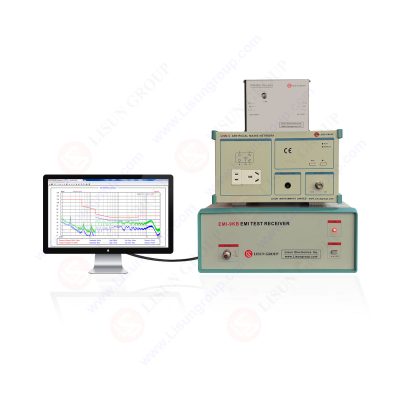
EMI-9KB_EMI Receiver Test System
Core Concepts of EMC and EMI
Electromagnetic Compatibility (EMC) refers to the ability of equipment to work normally in an electromagnetic environment without causing unacceptable interference to other equipment. EMI testing focuses on emission interference, including conducted interference and radiated interference. Conducted interference propagates along conductors such as power lines and signal lines, with a frequency range of 9kHz–30MHz. Radiated interference spreads outward in the form of electromagnetic waves, covering 30MHz–1GHz and above.
The three major elements of EMI include interference source, coupling path and sensitive equipment. The EMI and EMC Test System ensures accurate measurement by blocking internal coupling, suppressing internal noise and optimizing the receiving link.
Composition and Working Principle of EMI and EMC Test System
The EMI and EMC Test System takes the EMI receiver as the core, equipped with LISN artificial mains network, coupling and decoupling network, isolation transformer, attenuator, shielding room, test antenna and other accessories to complete automatic scanning and data analysis of conducted and radiated interference.
Conducted Test Principle: The LISN provides stable impedance for the Equipment Under Test (EUT), isolates power grid noise, extracts conducted interference signals and transmits them to the receiver. The system measures the amplitude and spectrum distribution of interference voltage to judge compliance with standard limits.
Radiated Test Principle: In a shielding room or anechoic chamber, the antenna receives electromagnetic radiation signals from the EUT. The EMI receiver completes spectrum analysis and signal detection (PK/QP/AV) to generate professional test reports that meet FCC, EN 55015 and other standards.
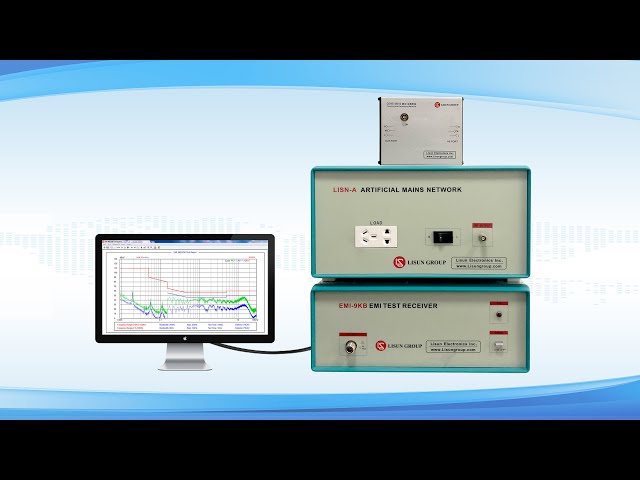
The LISUN EMI‑9KB is a fully automatic EMI and EMC Test System developed for medium and low-frequency EMI testing. The system composition and key configurations are shown in the table below.
| Component Name | Function Description |
| EMI‑9KB Receiver | 9kHz–300MHz, built-in high-precision filtering, support PK/QP/AV detection |
| LISN Artificial Mains Network | Stable line impedance, isolate grid noise, extract conducted interference signals |
| CDNE‑M316 Coupling & Decoupling Network | Compliant with CISPR 15:2018, suitable for lighting radiation testing |
| Isolation Transformer | Block ground loop and common-mode interference, reduce power noise |
| Attenuator | Prevent front-end overload and protect receiver circuit |
| Shielded Coaxial Cable | Low loss and high shielding performance, reduce transmission interference |
Self-interference mainly comes from chassis electromagnetic leakage, internal module crosstalk, power noise, poor grounding and cable radiation. The LISUN EMI‑9KB EMI and EMC Test System adopts comprehensive optimization in structure, circuit, layout and software to realize efficient self-interference suppression.
First, fully enclosed high-conductivity shielding structure. The receiver adopts an integrated closed metal shell with conductive sealing at joints to cut off radiation coupling paths, prevent internal noise leakage and external electromagnetic interference, and effectively reduce the system noise floor.
Second, multi-stage filtering and power purification. The built-in high-performance EMI filter suppresses conducted noise from the power grid. The isolation transformer eliminates ground loop current and common-mode interference. Multi-stage LC and π-type filtering modules are used to ensure signal purity.
Third, optimized grounding and impedance matching. Low-impedance grounding design reduces potential difference. All equipment modules achieve accurate impedance matching to avoid signal reflection and standing wave interference. Internal circuits are partitioned and routed reasonably to reduce high-frequency crosstalk.
Fourth, intelligent attenuation and dynamic range control. The programmable attenuator automatically adjusts according to signal strength to avoid nonlinear distortion. The software adopts dynamic noise threshold to distinguish effective signals from system self-noise.
Under the same test conditions, the noise floor and measurement error between the conventional system and the LISUN EMI‑9KB EMI and EMC Test System are compared as follows.
| Test Item | Conventional EMI Test System | LISUN EMI‑9KB EMI and EMC Test System | Improvement Effect |
| Noise Floor (9kHz–30MHz) | 28–32dBμV | 20–22dBμV | Reduced by 8–10dB |
| Noise Floor (30MHz–300MHz) | 30–35dBμV | 22–25dBμV | Reduced by 8–10dB |
| Measurement Error | ±3~5dB | ±2dB | Greatly improved accuracy |
| Test Repeatability | General | Excellent | High test stability |
The EMI and EMC Test System is the core equipment for EMC certification of electronic and electrical products. Self-interference suppression directly determines the reliability of test data. With integrated shielding design, multi-stage isolation filtering, reasonable layout and low-noise components, the LISUN EMI‑9KB effectively solves the common self-interference problems of traditional equipment. It supports high-precision testing within 9kHz–300MHz and fully complies with CISPR, GB, EN, FCC and other international standards.
In the future, with the continuous upgrading of electronic equipment, EMC testing will develop towards wider frequency band and higher sensitivity. The LISUN EMI‑9KB EMI and EMC Test System will continue to be optimized to provide stable and accurate EMC testing solutions for lighting, home appliances, new energy and other industries worldwide.
Tags:EMI-9KBYour email address will not be published. Required fields are marked *

 English
 中文简体
中文简体 English
 Русский
 Español
 Português
 Türkçe
 العربية
 Deutsch
 Polski
 Italiano
 Français
 한국어
한국어 ไทย
ไทย Tiếng Việt
 日本語
日本語