LM-79 Moving Detector Goniophotometer (Mirror Type C)
LSG-6000
High Precision Rotation Luminaire Goniophotometer
LSG-1890B
High Precision Rotation Luminaire Goniospectroradiometer
LSG-1890BCCD

Goniophotometer for Automotive and Signal Lamps
LSG-1950
Goniophotometer for Traffic Signal Lamps
LSG-1950S
VAD Fire Alarm Visual Alert Device Goniophotometer
LSG-1930
Compact Goniophotometer
LSG-1200A
LED Goniophotometer
LSG-1100
 LEDs and Luminaire Test Solutions
 LM-79 and LM-80 Test Solutions
 LED Driver Test Solutions
 Household Appliances Test Solutions
 Mobile and Network Test Solutions
 Automotive Electronics Test Solutions
 Audio-Video and IT Test Solutions
 Cable and Wire Test Solutions
 Plugs and Sockets Test Solutions
 Power Switch Test Solutions
 Transformer Test Solutions
 Electric Toys Test Solutions
 Energy Meter Test Solutions
 Motor-Operated Tool Test Solutions
Select an organization
to browse standards
Abstract:
The lux meter is a core instrument for optical parameter testing of light sources. Its measurement accuracy and parameter coverage directly determine the scientificity of lighting product testing and evaluation. This paper takes the LISUN LMS-6000 Lux meter as the research object, systematically expounds its core measurement parameters, technical performance and design advantages, analyzes its application principle in multi-dimensional optical parameter testing such as illuminance, color temperature and color rendering, and demonstrates its technical value in R&D, quality inspection and compliance certification of lighting products combined with industry standards. The results show that the LMS-6000 Lux meter features wide measuring range, high precision and multi-parameter synchronous measurement, which can fully meet the comprehensive testing requirements of optical parameters of light sources and provide reliable technical support for quality control in the lighting industry.
1. Introduction
In the fields of lighting engineering and light source product development, illuminance, color temperature, color rendering and other optical parameters are core indicators for evaluating the quality of light sources and the rationality of lighting environments. As a special instrument for measuring the optical environment and characteristics of light sources, the lux meter is key equipment for quantitative detection of the above parameters. Traditional lux meters can usually only measure a single illuminance parameter, which can no longer meet the comprehensive testing requirements of modern lighting industry for multi-dimensional optical characteristics of light sources. As a handheld CCD spectrophotometer-type lux meter, the LISUN LMS-6000 Lux meter breaks through the functional limitations of traditional instruments. It can simultaneously and accurately measure more than 20 optical parameters including illuminance, color temperature, chromaticity coordinates, color rendering index, etc. Its measuring range and accuracy meet high industry standards, making it an important testing tool in industrial production, lighting design, product inspection and other scenarios. This paper conducts a comprehensive analysis of the LMS-6000 Lux meter from the aspects of core parameters, technical performance and application scenarios, providing a reference for its application in the lighting industry.
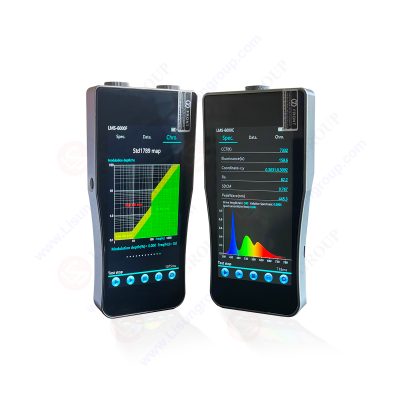
LMS-6000 Portable CCD Spectroradiometer
2. Core Measurement Parameters and System Design of the LMS-6000 Lux Meter
2.1 Full Coverage of Core Measurement Parameters
The LMS-6000 Lux meter uses the visible light band of 380–780 nm as the detection range and realizes all-round coverage of optical parameters of light sources. Its core measurement parameters include not only basic illuminance indicators, but also multi-dimensional parameters of colorimetry and spectral characteristics.
Specifically, it can achieve illuminance measurement in the range of 0.1–500,000 lx with an accuracy of ±0.1 lx. It can also accurately measure:
• Photometric parameters: illuminance E (Fc), irradiance Ee (W/m²), correlated color temperature CCT (K), deviation from blackbody Duv;
• Colorimetric parameters: chromaticity coordinates, color rendering index CRI, TM-30 (Rg, Rf), color purity, total color difference, brightness difference, red-green degree, yellow-blue degree, correlated color temperature difference;
• Spectral parameters: peak wavelength, dominant wavelength, half bandwidth, centroid wavelength, center wavelength;
• Graphic output: color tolerance diagram and spectrogram.
These functions provide intuitive data support for in-depth analysis of light source characteristics.
2.2 Integrated Hardware and Software Design
The LMS-6000 Lux meter adopts a long-focus cross asymmetric CT spectroscopic system as the core spectral platform, equipped with high-sensitivity CCD sensors to achieve accurate collection and spectroscopic analysis of optical signals.
In terms of hardware:
• 5-inch high-definition IPS capacitive touch screen (480×854) supports direct parameter setting, data viewing and report generation on the instrument;
• 4000 mAh rechargeable lithium battery supports up to 20 hours of continuous operation;
• Compact size (135 mm × 80 mm × 23 mm) ensures strong portability for laboratories and on-site testing.
In terms of software:
• Compatible with Windows 7 to Windows 11;
• Supports in-depth data analysis, storage and export via PC;
• 8 GB built-in storage can save 5,000 to 100,000 test reports, meeting the data management needs of large-scale testing.
3. Core Technical Performance and Advantages of the LMS-6000 Lux Meter
The LMS-6000 Lux meter has reached an advanced industry level in measurement accuracy, stability and compatibility. Its core technical performance parameters are shown in Table 1. Many accuracy indicators far exceed those of traditional lux meters and meet international lighting standards such as CIE-13.3 and CIE-177.
Table 1 Core Technical Parameters of LISUN LMS-6000 Lux meter
| Technical Item | Parameter Value | Technical Item | Parameter Value |
| Illuminance Measuring Range | 0.1 ~ 500,000 lx | Illuminance Accuracy | ±0.1 lx |
| Wavelength Range | 380–780 nm | Wavelength Accuracy | ±0.5 nm |
| Wavelength Resolution | ±0.2 nm | Sample Scanning Interval | ±0.1 nm |
| Chromaticity Coordinate Accuracy (Δx, Δy) | ±0.005 | Correlated Color Temperature Range | 1,500 K ~ 100,000 K |
| Color Temperature Accuracy | ±0.6% | Color Rendering Index Range | 0 ~ 100.0 |
| CRI Accuracy | ±(0.3% rd ± 0.3) | Photometric Linearity | ±0.6% |
| Stray Light | 600 nm < 0.015%; 435 nm < 0.03% | Integration Time | 0.1 ms – 5 s |
| Storage Capacity | 8 GB | Continuous Working Time | ≤ 20 h |
Combined with technical parameters and practical applications, the core advantages of the LMS-6000 Lux meter are reflected in three aspects:
• High precision and wide measuring range: It covers an ultra-wide illuminance range of 0.1 to 500,000 lx, suitable for weak ambient light to strong light sources. The accuracy of ±0.1 lx ensures reliability in low-illuminance scenes.
• Multi-parameter synchronous measurement: It breaks through the limitation of single-parameter measurement of traditional lux meters and realizes synchronous collection and analysis of photometry, colorimetry and spectral characteristics, greatly improving testing efficiency.
• High stability and anti-interference: Stray light is controlled within 0.03%, and photometric linearity error is only ±0.6%, which effectively avoids environmental interference and ensures the authenticity and repeatability of data.
4. Industry Application and Standard Adaptation of the LMS-6000 Lux Meter
4.1 Full Coverage of Multi-scenario Applications
With the characteristics of multi-parameter, high precision and portability, the LMS-6000 Lux meter can be widely used in many scenarios in the lighting industry:
• Light source R&D: Accurate measurement of color temperature, CRI and spectral characteristics helps optimize optical design and improve product quality;
• Industrial production and quality control: Full-parameter factory inspection for LEDs, fluorescent lamps, incandescent lamps and other lighting products;
• Lighting engineering design and acceptance: Testing illuminance distribution and color temperature matching for indoor, commercial, road and other lighting scenes;
• Third-party inspection and certification: Test data can be directly used for compliance certification and market access.
4.2 Full Adaptation to International and Domestic Standards
The measurement principle and accuracy of the LMS-6000 Lux meter fully comply with mainstream international lighting testing standards, including:
• CIE-13.3: Method of measuring and specifying color rendering properties of light sources
• CIE-177: Color rendering of white light LEDs
• Optical Engineering-49-3-033602: Color quality scale
• Relevant IEEE standards for high-brightness LEDs
This ensures the professionalism and authority of test results and meets the testing and certification requirements of lighting products worldwide.

5. Performance Comparison Between LMS-6000 Lux Meter and Traditional Lux Meters
Compared with traditional single-function lux meters, the LMS-6000 has significant advantages in function, accuracy and efficiency. Traditional lux meters can only measure illuminance with a narrow range, which is difficult for comprehensive evaluation of light source products. The LMS-6000 realizes synchronous measurement of “illuminance + colorimetry + spectrum”, completing more than 20 core optical parameters at one time.
In terms of accuracy:
• Traditional lux meters: illuminance accuracy is mostly ±1 lx; color temperature and CRI require additional instruments with large errors.
• LMS-6000: chromaticity coordinate accuracy ±0.005, CRI accuracy ±(0.3% rd ± 0.3), far exceeding traditional instruments.
In terms of operation:
The LMS-6000 supports handheld operation, on-board and PC data processing, and direct report export, while traditional instruments rely heavily on manual recording and post-processing.
6. Conclusion
As basic equipment for optical parameter measurement in the lighting industry, the technical performance of a lux meter directly affects the scientificity of light source testing and evaluation.
Based on the long-focus cross asymmetric CT spectroscopic system, the LISUN LMS-6000 Lux meter achieves ultra-wide range illuminance measurement from 0.1 to 500,000 lx, and can simultaneously and accurately measure more than 20 optical parameters including color temperature, color rendering index and spectral characteristics. Its measurement accuracy and stability meet international standards such as CIE.
The instrument combines portability and multi-functionality, breaking through the limitation of single-parameter measurement of traditional lux meters. It can be widely used in light source R&D, production inspection, lighting engineering design and acceptance, providing comprehensive and reliable technical support for quality control and compliance certification of lighting products.
Under the background of intelligent and high-quality development of the lighting industry, the LMS-6000 Lux meter meets the comprehensive testing requirements of the modern lighting industry with its multi-parameter, high-precision and high-compatibility characteristics. Its application and promotion will promote the standardization and efficiency of testing technology in the lighting industry and support the high-quality development of the industry.
Tags:LMS-6000Your email address will not be published. Required fields are marked *

 English
 中文简体
中文简体 English
 Русский
 Español
 Português
 Türkçe
 العربية
 Deutsch
 Polski
 Italiano
 Français
 한국어
한국어 ไทย
ไทย Tiếng Việt
 日本語
日本語