LM-79 Moving Detector Goniophotometer (Mirror Type C)
LSG-6000
High Precision Rotation Luminaire Goniophotometer
LSG-1890B
High Precision Rotation Luminaire Goniospectroradiometer
LSG-1890BCCD

Goniophotometer for Automotive and Signal Lamps
LSG-1950
Goniophotometer for Traffic Signal Lamps (Economical Model)
LSG-1950S
VAD Fire Alarm Visual Alert Device Goniophotometer
LSG-1930
Goniophotometer for Airfield Lighting
LSG-1940
Compact Goniophotometer
LSG-1200A
LED Goniophotometer
LSG-1100
Near Field Moving Detector Goniophotometer
LSG-1900B
 LEDs and Luminaire Test Solutions
 LM-79 and LM-80 Test Solutions
 LED Driver Test Solutions
 Household Appliances Test Solutions
 Mobile and Network Test Solutions
 Automotive Electronics Test Solutions
 Audio-Video and IT Test Solutions
 Cable and Wire Test Solutions
 Plugs and Sockets Test Solutions
 Power Switch Test Solutions
 Transformer Test Solutions
 Electric Toys Test Solutions
 Energy Meter Test Solutions
 Motor-Operated Tool Test Solutions
Select an organization
to browse standards
Abstract
The glow wire flammability test (GWFI/GWEPT) serves as a core testing item for fire safety certification of non-metallic materials in the electrical & electronic, home appliance, lighting and automotive electronics industries. The test imposes stringent requirements on the control accuracy of parameters such as temperature, contact force, timing and specimen separation. Conventional manually operated equipment is prone to human operational deviations, resulting in poor repeatability of test data and unstable certification pass rates. Taking the LISUN ZRS-3H glow-wire tester as the research object, this paper refers to the latest domestic and international fire safety standards including the GB/T 5169 series, IEC 60695-2 series and UL 746A. It systematically analyzes the equipment’s capability to accurately reproduce core test conditions such as the 960 °C glow wire temperature and standard 1 N contact force specified in standards. This article further elaborates on the working logic and error suppression effects of three intelligent modules: automatic timing, automatic recording of ignition/extinguishing time, and automatic retraction of the glow wire from specimens after heating. Combined with equipment specifications and industrial application cases, the advantages of this tester in terms of test data accuracy and repeatability during glow wire flammability test are demonstrated. This study provides technical references for third-party testing laboratories, material R&D enterprises and complete machine manufacturers to select compliant glow-wire testing equipment.
Overload and short-circuit faults of electrical equipment lead to continuous heat generation on internal resistors and driving components. When high-temperature heat sources contact plastic housings and insulating parts, fire hazards are likely to occur. Via a nickel-chromium alloy glow wire simulating high-temperature heat sources generated by equipment faults, the glow wire flammability test quantifies material ignition characteristics, self-extinguishing performance and risk of ignition caused by molten drips. It has become a mandatory testing item for market access worldwide. Current standards GB/T 5169.10-2023 and IEC 60695-2-10:2021 define the benchmark working conditions for glow wire flammability test: maximum test temperature of 960 °C, specimen contact force maintained at approximately 1 N, fixed glow duration of 30 seconds. Meanwhile, standards require precise capture of ignition moment and flame extinguishing duration. The glow wire must be separated from specimens in a timely manner once testing finishes to avoid excessive heating which interferes with judgment results.
Traditional old-type glow-wire testers have three obvious drawbacks: severe temperature fluctuation; contact force relying on manual counterweight with error exceeding 0.2 N; timing dependent on manual stopwatch leading to delayed recording of ignition and extinguishing moments. Operators need to manually remove specimens after testing, extending high-temperature contact duration. Ultimately, multiple glow wire flammability tests on identical specimens generate highly discrete data, and test reports may not be accepted by certification bodies including CQC, SGS and UL.
LISUN launches the cabinet-type ZRS-3H glow-wire tester, which fully complies with the latest domestic and international fire safety standards. Its hardware temperature control and pressure mechanical structure realize high-precision closed-loop control. Equipped with a full-process automatic testing system, it fundamentally eliminates human operational errors and ensures consistent data obtained from glow wire flammability test. This tester is widely adopted in material research, finished product inspection and third-party certification laboratories.
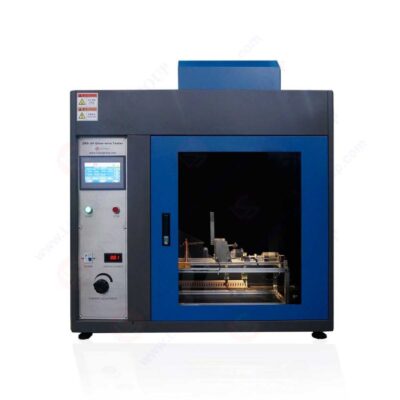
Figure: Glow Wire Test Apparatus
Core Standard List for Glow Wire Flammability Test
The glow wire flammability test consists of two categories: GWFI glow wire flammability index test for raw materials and GWEPT glow wire flammability test for finished products. The ZRS-3H fully meets all standard requirements of both test types, as shown in Table 1.
| Standard System | Standard No. | Standard Name | Corresponding Glow Wire Flammability Test Item |
| Chinese National Standard | GB/T 5169.10-2023 | Fire hazard testing for electrotechnical products – Part 10: Glow-wire apparatus and common test procedure | General apparatus specification for glow wire flammability test |
| Chinese National Standard | GB/T 5169.11-2017 | Glow-wire flammability test method for end products (GWEPT) | Glow wire flammability test for complete finished products |
| Chinese National Standard | GB/T 5169.12-2024 | Test method for glow-wire flammability index (GWFI) of materials | Glow wire flammability test for raw materials |
| Chinese National Standard | GB/T 4706.1-2024 | Household and similar electrical appliances – Safety | Market access glow wire flammability test for home appliances |
| International IEC Standard | IEC 60695-2-10:2021 | Glow-wire apparatus and common test procedure | Global general specification for glow-wire equipment |
| International IEC Standard | IEC 60695-2-11:2021 | End products glow-wire flammability test (GWEPT) | International glow wire flammability test for finished products |
| International IEC Standard | IEC 60695-2-12:2021 | GWFI materials flammability test | International glow wire flammability test for raw materials |
| North American UL Standard | UL 746A:2023 Clause 35 | Short-term property evaluation of polymeric materials | Glow wire flammability certification test for North American market |
Hardware Parameters of ZRS-3H for Reproducing Core Working Conditions of Glow Wire Flammability Test
Whether the glow wire flammability test can achieve qualified results depends on three key hardware indicators: temperature, contact force and glow wire material. The parameters of ZRS-3H fully meet standard requirements of 960 °C and 1 N, and key specifications are listed in Table 2.
| Technical Index | Standard Requirement | Measured Parameters of ZRS-3H | Value for Glow Wire Flammability Test |
| Glow wire heating temperature | Continuously adjustable from ambient temperature to 960 °C, temperature measurement error ≤ ±5 °C | Continuously adjustable from ambient temperature to 1100 °C, temperature measurement accuracy ±3 °C, resolution 1 °C | Stably maintain strict 960 °C test temperature; temperature fluctuation far below standard limits, avoiding temperature deviation during GWFI classification testing |
| Specimen contact force | 1 N ± 0.2 N | 0.95 N ± 0.1 N, limited penetration depth 7 mm | Accurately reproduce standard 1 N contact force. Excessively high force accelerates melting while insufficient force leads to poor heat conduction, both preventing biased judgment in flammability test |
| Glow wire material specification | φ4 mm Ni80Cr20 nickel-chromium alloy | φ4 mm nickel-chromium alloy (80% nickel, 20% chromium) with standard forming dimension | Uniform heat conduction; no deformation under long-term 960 °C high temperature, ensuring consistent heat source in every glow wire flammability test |
| Temperature measuring thermocouple | K-type sheathed thermocouple | φ1 mm K-class sheathed nickel-chromium/nickel-aluminum thermocouple | Real-time temperature collection at glow wire tip with closed-loop temperature control to eliminate heating delay |
| Time measurement range | 0.1 s ~ 999.9 s, accuracy ≤ ±0.2 s | Timing range for heating, ignition and extinguishing: 0.1 ~ 999.9 s, accuracy ±0.1 s | Capture instantaneous ignition and flame extinguishing, satisfying timing requirements of 30 s heating and 30 s self-extinguishing judgment for glow wire flammability test |
Parameter comparison indicates that the ZRS-3H exceeds the limit values specified in national standards and IEC standards on key control indicators of glow wire flammability test. Superior hardware foundation guarantees unified and stable test conditions.
Human errors during glow wire flammability test mainly stem from three factors: delayed manual timing, unstable contact force application and failure to separate specimens after heating. Three intelligent functions of ZRS-3H target these problems and realize fully automatic testing.
Automatic Timing & Automatic Recording of Ignition / Extinguishing Time to Eliminate Visual Timing Errors
Core judgment indicators for glow wire flammability test include Ti (ignition time) and Te (flame extinguishing time). Standards require precise recording at the moment flame emerges and the moment flame completely disappears. Visual observation by human operators creates a delay error ranging from 0.5 s to 2 s. Significant deviation exists between repeated tests, which directly affects GWFI grading judgment.
Equipped with an optical flame sensor module combined with a PLC timing system, the ZRS-3H collects test data automatically throughout the whole process:
• High-precision timing starts synchronously upon test activation; cumulative heating duration begins once the glow wire contacts the specimen.
• When the flame sensor detects open flame on the specimen, the system automatically locks ignition time Ti without manual triggering.
• Extinguishing time Te is recorded immediately after the flame disappears completely. Data is stored on the touch screen in real time and supports export of raw test records.
• Timing accuracy reaches ±0.1 s. Manual pause review is available to balance automatic operation and manual verification.

In comparative glow wire flammability tests using the same batch of flame-retardant ABS materials, the discrete difference of Te data measured via manual stopwatch reaches 2.1 s, while the difference of automatically recorded data by the tester is controlled within 0.2 s, improving data repeatability by more than 90%.
Automatic Retraction after Heating to Avoid Interference Caused by Excessive High-temperature Exposure
GB/T 5169.12-2024 clearly specifies for glow wire flammability test: the glow wire must be removed immediately once the standard contact duration of 30 seconds expires. Continuous high-temperature contact leads to persistent molten dripping and extended burning time, which causes underestimated GWFI values and distorted evaluation of material flame retardancy.
Operators need to monitor the timer and pull the specimen holder manually on traditional testers, often resulting in 2~5 seconds delayed separation. The ZRS-3H adopts a built-in electric displacement mechanism. When the countdown of preset heating duration completes, the glow wire automatically retracts away from the specimen with fixed travel without manual delay, fully meeting mandatory requirements of glow wire flammability test for home appliances specified in GB/T 4706.1-2024. Meanwhile, the limiting structure ensures a constant contact depth of 7 mm for each test, unified heat transfer contact area and further stabilized test results.
Integrated Intelligent Control System to Reduce Human Operational Variables
The tester adopts a large LCD touch screen plus remote dual control mode. The complete workflow of glow wire flammability test (heating, pressure stabilization, timing, automatic retraction, data storage) can be preset with one click. Operators only need to fix specimens before starting testing, reducing variables generated by multiple manual operations including temperature adjustment, counterweight setup and manual timing. The equipment frame is constructed with high-temperature resistant coated steel structure, free of deformation and corrosion after repeated cycling tests under 960 °C. Stable long-term working conditions reduce frequent calibration requirements during mass continuous glow wire flammability tests.
GWFI Glow Wire Flammability Grading Test for Material R&D
Plastic modification enterprises and raw material suppliers need to determine GWFI index via glow wire flammability test, classify material flame retardant grades as reference for product selection. Benefiting from high-precision temperature control and automatic recording functions, the ZRS-3H supports continuous batch testing for ABS, PC, PA, PP and glass fiber reinforced flame retardant plastics. The fluctuation of GWFI values within 10 groups of parallel tests for identical materials is controlled within 10 °C. Measured data can be directly incorporated into material test reports to support compilation of product specification sheets.
GWEPT Glow Wire Flammability Test for Home Appliance, Lighting and Electronic Finished Products
Finished products including chargers, air conditioner insulating components, LED lamp holders and switches need to pass glow wire flammability test to comply with safety standards GB/T 4706.1 and GB 7000.1. The cabinet structure of ZRS-3H isolates combustion flue gas. Its automatic retraction function prevents excessive combustion damage to test specimens. Automatic recording of ignition and sustained burning duration enables rapid judgment on whether finished products satisfy market access requirements of 960 °C glow wire flammability test.
Third-party Testing and Certification Laboratories
Certification bodies such as SGS, CQC and UL impose strict requirements on equipment precision and data traceability for issuing flame retardant certification reports of glow wire flammability test. The ZRS-3H supports complete calibration certification. It automatically stores raw time, temperature and contact force data of each test group with non-tamperable records. Test reports are recognized by certification institutions around the world, significantly lowering retest frequency and improving laboratory testing efficiency.
For standardized detection scenarios of glow wire flammability test, the LISUN ZRS-3H glow-wire tester matches the latest GB/T 5169 and IEC 60695-2 series fire safety standards from the two dimensions of hardware precision and intelligent control. It can steadily and accurately reproduce core test conditions specified in standards: 960 °C glow wire temperature and contact force of 0.95 N ± 0.1 N (equivalent to 1 N). The three intelligent functions including automatic timing, automatic recording of ignition and extinguishing time, and automatic retraction from specimens after heating fundamentally eliminate systematic errors caused by manual observation and operation, significantly improving the accuracy and repeatability of data obtained from glow wire flammability test.
Compared with conventional manually operated glow-wire testers, the ZRS-3H supports both GWFI grading test for raw materials and GWEPT flammability test for finished products. It meets compliance testing demands from multiple industries including electrical & electronic equipment, lighting, automotive electronics and third-party testing. It acts as a standardized high-precision testing equipment to satisfy domestic and international fire safety certification and guarantee reliability of flame retardancy detection. Further improvement on the whole-process traceability system of glow wire flammability test can be realized by combining optional supporting video recording function and cloud data export in future applications.
Tags:ZRS-3HYour email address will not be published. Required fields are marked *

 English
 中文简体
中文简体 English
 Русский
 Español
 Português
 Türkçe
 العربية
 Deutsch
 Polski
 Italiano
 Français
 한국어
한국어 ไทย
ไทย Tiếng Việt
 日本語
日本語