LM-79 Moving Detector Goniophotometer (Mirror Type C)
LSG-6000
High Precision Rotation Luminaire Goniophotometer
LSG-1890B
High Precision Rotation Luminaire Goniospectroradiometer
LSG-1890BCCD

Goniophotometer for Automotive and Signal Lamps
LSG-1950
Goniophotometer for Traffic Signal Lamps (Economical Model)
LSG-1950S
VAD Fire Alarm Visual Alert Device Goniophotometer
LSG-1930
Goniophotometer for Airfield Lighting
LSG-1940
Compact Goniophotometer
LSG-1200A
LED Goniophotometer
LSG-1100
Near Field Moving Detector Goniophotometer
LSG-1900B
 LEDs and Luminaire Test Solutions
 LM-79 and LM-80 Test Solutions
 LED Driver Test Solutions
 Household Appliances Test Solutions
 Mobile and Network Test Solutions
 Automotive Electronics Test Solutions
 Audio-Video and IT Test Solutions
 Cable and Wire Test Solutions
 Plugs and Sockets Test Solutions
 Power Switch Test Solutions
 Transformer Test Solutions
 Electric Toys Test Solutions
 Energy Meter Test Solutions
 Motor-Operated Tool Test Solutions
Select an organization
to browse standards
Automotive interiors widely adopt polymer materials such as fabrics, leather, plastics and foams, which are easily ignited and spread rapidly under collision, high temperature, electrical faults and other scenarios, directly threatening the life safety of drivers and passengers. Mandatory standards for interior flammability performance have been formulated in major global automotive markets. China’s GB 8410‑2006, the US FMVSS 302 and international ISO 3795 all require interior materials to pass strict combustion tests. How do you test automotive flammability? has become a key technology that vehicle manufacturers, component suppliers and testing institutions must master.
The LISUN ZRS‑4H Automotive Interior Material Combustion Tester is an inspection device specially designed by LISUN to evaluate the flammability performance of automotive interior materials. It simulates the combustion characteristics of automotive interiors under specific flame conditions. By precisely controlling flame height, burning duration and sample placement angle, it measures the burning rate, flame spread length and self‑extinguishing performance of materials. Capable of meeting parallel testing requirements of multiple national standards, it features stable and reliable data and is widely used in R&D, quality inspection and certification scenarios.
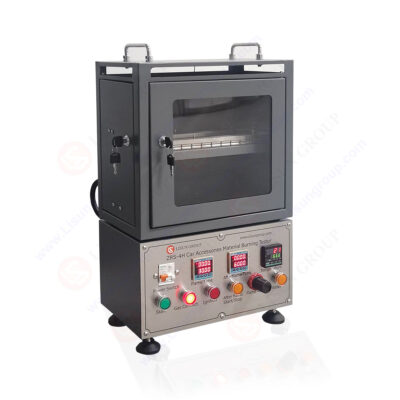
Car Interior Material Burning Tester ZRS-4H
Testing Principles
The core of How do you test automotive flammability? lies in the horizontal combustion method: standard‑sized samples are fixed in a closed combustion chamber at a specified angle, ignited at the free end for a set duration by standard flame. After removing the ignition source, the flame spread distance, burning time, self‑extinguishing time and whether molten droplets ignite absorbent cotton below are recorded. The burning rate is calculated and judged against limit requirements. This method can stably reproduce the real combustion behavior of interior materials during local vehicle fires and objectively reflect flammability levels.
Key Structure and Parameters of ZRS‑4H
Adopting an integrated combustion chamber, the ZRS‑4H integrates imported flame control modules, high‑precision timing systems, wind‑proof and heat‑insulated structures and high‑definition observation windows. It realizes full‑process automation of flame application‑timing‑state judgment, greatly reducing human errors and improving data repeatability. Its core specifications are shown in the table below:
| Item | Parameter | Standard Compliance |
| Combustion Chamber Size | 1000×500×800 mm | Meets space requirements of multiple standards |
| Sample Angle | Precisely adjustable to 30° (default) | Compliant with GB 8410‑2006, FMVSS 302 |
| Sample Size | 356±2 mm long, 100±2 mm wide, thickness ≤13 mm | Universal specification for standard samples |
| Ignition Source | Propane burner, nozzle 9.5±0.5 mm | Premixed flame with stable thermal intensity |
| Flame Height | 20±2 mm (calibrated by flowmeter and scale) | Meets standard flame requirements |
| Flame Temperature | ≥820 ℃ at 20 mm from nozzle (stable for 1 min) | Meets standard thermal intensity |
| Ignition Time | Adjustable 0~999.9 s, default 15 s | Satisfies ignition duration of mainstream standards |
| Timing Accuracy | 0.1 s | Ensures accurate rate calculation |
| Judgment Items | Burning rate, self‑extinguishing time, spread length, molten droplet ignition | Covers all safety indicators |
| Environmental Control | Wind‑proof structure + external smoke exhaust | Eliminates airflow interference |
Table: Core Technical Parameters of LISUN ZRS‑4H Automotive Interior Material Combustion Tester
Sample Preparation and Conditioning
• Sampling: Take samples from real interior parts including seats, instrument panels, door panels, ceilings and carpets to ensure consistency of material, process and texture with real vehicles; multi‑layer composite materials shall be tested integrally without delamination.
• Cutting: Cut into 356±2 mm × 100±2 mm with thickness ≤13 mm; for over‑thick materials, thin to 13 mm from the non‑fire‑facing surface while retaining the original fire‑facing surface.
• Quantity: At least 5 samples per group; for anisotropic materials (e.g. fabrics), samples shall be taken separately in warp and weft directions with no less than 3 pieces each.
• Conditioning: Place in an environment of 23±2 ℃ and relative humidity 45%~55% for 24~168 hours to eliminate historical environmental impacts and ensure result comparability.
Equipment Calibration and Preparation
• Power on for self‑inspection; check fuel gas (propane purity ≥95%), pressure reducing valve and flowmeter to ensure stable gas supply.
• Flame calibration: Ignite the burner and preheat for ≥1 min; stabilize flame height at 20±2 mm via flowmeter and scale, with temperature ≥820 ℃.
• Sample mounting: Fix samples with exposed surface downward at a 30° angle by metal clamps, aligning free ends with ignition positions; place absorbent cotton 300 mm below to monitor molten droplet ignition risks.
• Environment inspection: Close the combustion chamber door to confirm effective wind‑proof structure without obvious airflow disturbance.
Ignition and Testing Process
• In automatic/manual mode, the igniter applies standard flame to the free end of samples for default 15 s before automatically removing the ignition source.
• The system starts timing automatically when flame reaches the first marking line and stops timing when flame extinguishes or reaches the second marking line; record combustion distance and time.
• Synchronous observation: continuous combustion status, self‑extinguishing time, flame spread length, molten droplet generation and absorbent cotton ignition; record the whole process through the observation window.
Data Calculation and Qualification Judgment
1. Burning Rate Calculation Formula
Burning Rate V (mm/min) = Combustion Distance L (mm) ÷ Combustion Time T (min)
2. Thresholds of Mainstream Standards
• GB 8410‑2006: Burning rate ≤100 mm/min; self‑extinguish within 30 s after flame removal without continuous combustion.
• FMVSS 302: Burning rate ≤102 mm/min; self‑extinguish within 60 s with compliant damage length and no absorbent cotton ignition by molten droplets.
• ISO 3795: Basically consistent with GB 8410‑2006 for international mutual recognition.
3. Qualification Conclusion: Materials are judged flammability‑qualified if meeting rate, self‑extinguishing and molten droplet requirements of corresponding standards; unqualified if any indicator fails.
• Full Standard Coverage: Supports GB 8410‑2006, GB/T 27904‑2011, FMVSS 302, ISO 3795, ASTM D5132, BS 6853, DIN 75200, etc. One machine meets testing demands for domestic, European, American and rail transit applications.
• High Control Precision: Closed‑loop control of flame height, temperature and ignition time, timing accuracy of 0.1 s and accurate angle positioning ensure superior data repeatability compared with conventional equipment.
• Safe and Convenient Operation: Integrated combustion chamber, wind‑proof heat insulation and automatic flameout; high‑definition observation window and residue collection tank facilitate observation and cleaning.
• Wide Application Scenarios: Compatible with seat fabrics, instrument panel skins, plastic parts, foams, carpets, ceilings and more; applicable to vehicle manufacturers, supply chains, third‑party testing institutions and rail transit fields.
Taking PVC leather for vehicle seats and PP injection‑molded door panels as examples, tests were conducted in accordance with GB 8410‑2006 using the ZRS‑4H. Results are as follows:
| Sample | Combustion Distance (mm) | Combustion Time (s) | Burning Rate (mm/min) | Self‑extinguishing Time (s) | Molten Droplet Ignition | Judgment |
|---|---|---|---|---|---|---|
| PVC Seat Leather | 82 | 55 | 89.5 | 22 | No | Qualified |
| PP Door Panel Plastic | 65 | 42 | 92.9 | 18 | No | Qualified |
It can be seen from the data that the burning rates of both materials are lower than 100 mm/min, self‑extinguishing time is less than 30 s with no molten droplet ignition, complying with national standard requirements. The ZRS‑4H stably reproduces standard conditions, and data can be directly used for CCC certification, factory quality inspection and R&D iteration.
How do you test automotive flammability? is a key technical node of automotive safety. The testing scheme based on the horizontal combustion method and LISUN ZRS‑4H Automotive Interior Material Combustion Tester can accurately, stably and efficiently evaluate the flammability performance of interior materials. By standardized control of flame, angle and time, the equipment realizes full‑indicator detection of burning rate, self‑extinguishing performance, spread length and molten droplet risks, complying with domestic and foreign mandatory standards and certification requirements.
Against the backdrop of continuous upgrading of automotive safety, adopting high‑precision, automatic and multi‑standard compatible combustion testers is of important engineering and social significance for improving interior flammability levels, reducing fire risks and protecting occupant safety.
Tags:ZRS-4HYour email address will not be published. Required fields are marked *

 English
 中文简体
中文简体 English
 Русский
 Español
 Português
 Türkçe
 العربية
 Deutsch
 Polski
 Italiano
 Français
 한국어
한국어 ไทย
ไทย Tiếng Việt
 日本語
日本語