LM-79 Moving Detector Goniophotometer (Mirror Type C)
LSG-6000
High Precision Rotation Luminaire Goniophotometer
LSG-1890B
High Precision Rotation Luminaire Goniospectroradiometer
LSG-1890BCCD

Goniophotometer for Automotive and Signal Lamps
LSG-1950
Goniophotometer for Traffic Signal Lamps (Economical Model)
LSG-1950S
VAD Fire Alarm Visual Alert Device Goniophotometer
LSG-1930
Goniophotometer for Airfield Lighting
LSG-1940
Compact Goniophotometer
LSG-1200A
LED Goniophotometer
LSG-1100
Near Field Moving Detector Goniophotometer
LSG-1900B
 LEDs and Luminaire Test Solutions
 LM-79 and LM-80 Test Solutions
 LED Driver Test Solutions
 Household Appliances Test Solutions
 Mobile and Network Test Solutions
 Automotive Electronics Test Solutions
 Audio-Video and IT Test Solutions
 Cable and Wire Test Solutions
 Plugs and Sockets Test Solutions
 Power Switch Test Solutions
 Transformer Test Solutions
 Electric Toys Test Solutions
 Energy Meter Test Solutions
 Motor-Operated Tool Test Solutions
Select an organization
to browse standards
Abstract
Overheating of heating elements such as resistance wires and motor windings during the operation of electrical equipment continuously transfers high temperature and ignites surrounding solid insulating and combustible materials. Such non-flame thermal conduction fire scenarios cannot be evaluated by the needle flame test method, and dedicated hot wire ignition testing is required to quantify the thermal ignition resistance of materials. Taking the LISUN RSY-LT Hot Wire Ignition Tester as the research object, this paper clarifies the scenario differences between hot wire ignition testing and the needle flame test method. It analyzes the core technical advantages of the equipment relying on standard nichrome hot wires for precise temperature control, constant tension loading and automatic timing. In compliance with domestic and international standards including IEC TS 60695-2-20 and GB/T 14048.1, this paper elaborates that the equipment can accurately determine the Hot Wire Ignition Temperature (HWIT) and Hot Wire Flammability Index (HWFI) of materials, making up for the testing limitation that the needle flame test method only simulates flame impact. Combined with application scenarios covering four major industries: electrical engineering, home appliances, new energy and materials, this paper compares the applicable boundaries between the Hot Wire Ignition Tester and the needle flame test method. It demonstrates the data reliability of RSY-LT in material selection, product fire safety design and international compliance certification, and provides equipment selection reference for testing laboratories and manufacturers to build a complete flame retardant testing system.
Electrical fires can be divided into two categories: flame ignition and flameless high-temperature conduction ignition. The needle flame test method adopts a standard butane needle flame to simulate tiny open flames generated by short circuits and burn specimens. It can only evaluate the ability of materials to resist instantaneous flame impact, and cannot restore the fire risks caused by long-term overload and continuous thermal conduction of motor windings and power resistors. Inside low-voltage electrical appliances, power batteries and heating household appliances, continuous heat generation of resistance coils and slow heat penetration into insulating parts are frequent fire triggers. The corresponding testing method is hot wire ignition test, which requires a dedicated Hot Wire Ignition Tester to carry out standardized tests.
The current standard IEC TS 60695-2-20:2024 specifies the complete test procedures for Hot Wire Ignition (HWI), setting mandatory constraints on hot wire material, heating power, winding tension, test duration and specimen dimensions. Traditional simple hot wire devices rely on manual wire winding and manual temperature control. Fluctuations in tension and heating power lead to highly discrete HWIT and HWFI test data, and qualified certification reports cannot be issued. The needle flame test method follows GB/T 5169.5 and IEC 60695-11-5. These two testing methods differ completely in heat source form, test logic and judgment indicators. Enterprises carrying out flame retardant testing need to equip both a Hot Wire Ignition Tester and a needle flame tester to cover all simulated fire risk scenarios.
LISUN develops the RSY-LT Hot Wire Ignition Tester. It integrates a hot wire heating system, constant tension winding mechanism and automatic combustion monitoring module. Full-process automatic operation eliminates manual errors. The equipment can accurately reproduce hot wire working conditions specified in standards and stably measure two core indicators: HWIT and HWFI. It forms a complementary testing system together with the needle flame test method, meeting testing demands for all types of solid combustible materials from research institutes, third-party laboratories and manufacturers.
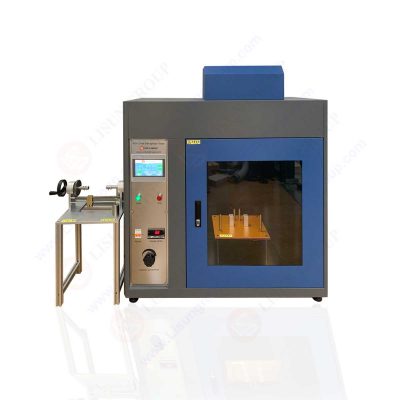
RSY-LT Hot Wire Ignition tester
Domestic and International Authoritative Standards Adapted to RSY-LT Hot Wire Ignition Tester
The hardware structure and control program of RSY-LT fully comply with complete hot wire ignition specifications, covering safety requirements in multiple fields such as low-voltage frequency conversion, new energy and polymer materials. The list of applicable standards is shown in Table 1.
| Standard System | Standard No. | Core Content of Standard | Matching Testing Equipment / Method |
| International General IEC Standard | IEC TS 60695-2-20:2024 | Complete set of HWI hot wire ignition apparatus, calibration and test guidelines | RSY-LT Hot Wire Ignition Tester |
| Chinese National Standard for Low-voltage Electrical Apparatus | GB/T 14048.1-2023 Appendix M | Hot wire ignition judgment for insulation of low-voltage switches | RSY-LT Hot Wire Ignition Tester |
| International Standard for Low-voltage Electrical Apparatus | IEC 60947.1:2020 Annex M | Thermal resistance test for insulation of contactors and circuit breakers | RSY-LT Hot Wire Ignition Tester |
| Standard for Frequency Conversion Equipment | IEC 61800-5-1:2022 Clause 5.2.5.4 | Hot wire test for internal insulation of drivers | RSY-LT Hot Wire Ignition Tester |
| Polymer Material Standard | UL 746A:2023 Clause 32 | Grading test of HWFI and HWIT for plastics | RSY-LT Hot Wire Ignition Tester |
| Chinese Domestic Needle Flame Standard | GB/T 5169.5-2020 | Simulation and judgment of tiny open flame ignition | Needle flame tester + needle flame test method |
| International Needle Flame Standard | IEC 60695-11-5:2016 | Simulation test of electric arc flame caused by short circuit | Needle flame tester + needle flame test method |
It can be seen from the comparison that the needle flame test method only covers open flame fire risks and cannot evaluate hidden dangers of ignition caused by long-term flameless heat conduction. Complete product fire safety assessment must be supplemented with hot wire ignition tests using Hot Wire Ignition Tester.
All assemblies of RSY-LT strictly meet the mandatory indicators specified in IEC TS 60695-20. All parameters can be controlled and calibrated to avoid deviations in tension, power and duration caused by manual operation. The core specifications are as follows:
• Hot wire assembly: φ0.5 mm Ni80/Cr20 alloy wire, total length 250±5 mm, thermal resistance 5.28 Ω/m, stable heating power 0.26 W/mm ±4%. A built-in automatic pre-annealing program is provided; standard annealing lasts 8~12 seconds to eliminate hot wire deformation and ensure uniform heat generation in each test.
• Winding and pressurization system: electric constant tension mechanism with stable winding tension of 5.4±0.05 N, coil spacing of 6.3±0.2 mm for 5 turns, fully complying with standard winding dimensions. It eliminates heat conduction deviation caused by inconsistent tightness of manual winding, which is an exclusive core structure not required in the needle flame test method.
• Timing and combustion monitoring: full PLC automatic timing; test duration can be freely set within 1~999.9 s with default standard duration of 120 s. Equipped with an optical flame capture module to automatically record ignition moment and continuous combustion duration. Data is stored on the touch screen in real time without manual visual recording, greatly reducing observation delay errors compared with manual operation adopted in the needle flame test method.
• Specimen and cabinet: compatible with three types of standard specimens of 125×13 mm with thickness of 0.75 mm, 1.5 mm and 3 mm. The closed combustion chamber has a volume ≥0.5 m³ to isolate airflow interference and stabilize the environment for flame observation. It shares similar closed cabinet design philosophy with needle flame testers, yet equipped with exclusive internal winding tooling.
•.Operating system: self-developed large LCD touch screen together with wireless remote control for dual operation. Operators can start and stop tests remotely during high-temperature testing to avoid scald risks. The machine body adopts high-temperature coated steel structure without corrosion and deformation after long-term high-temperature testing.

Closed-loop Hot Wire Power Control Ensures Stable HWIT and HWFI Data
The needle flame test method only requires stable flame shape, while hot wire testing has extremely low tolerance for heating power. Power fluctuation will directly change the critical ignition temperature. Equipped with a closed-loop power regulation module, RSY-LT compensates hot wire temperature variations caused by voltage fluctuations in real time. One-click hot wire annealing calibration can be carried out before each test, and power curves are automatically archived. Test data can be directly adopted for UL and IEC certification reports without repeated retests.
Electric Constant Tension Winding Eliminates Systematic Errors from Manual Winding
The needle flame test does not require specimen winding, so tension control is unnecessary. However, hot wire ignition tests require tight contact between hot wire and specimens. Deviations in tension during manual winding lead to inconsistent heat conduction areas. The electric winding mechanism of RSY-LT automatically completes 5 turns of standard coils with tension locked at 5.4 N throughout the process, unifying the thermal contact area of each group of specimens. The fluctuation of parallel test data is far lower than simple manual equipment.
Integrated Automatic Monitoring Cooperates with Needle Flame Test Method to Form Complete Testing Closed-loop
After enterprises equip both Hot Wire Ignition Tester and needle flame tester for quality inspection, both devices support automatic data export to carry out tests for two types of fire scenarios simultaneously. First, RSY-LT is used to determine the long-term thermal ignition grade (HWFI) of materials, and then the needle flame test method is adopted to verify the resistance of materials to instantaneous open flames. Two-way data supports flame retardant grading of products, fully meeting composite certification requirements specified in GB, IEC and UL standards.
Low-voltage Electrical Industry
Insulating paper for motor windings, PA66 housings of relays and circuit breaker partitions need to undergo HWI hot wire tests to simulate long-term overheating of windings. The needle flame test method is only applied for open flame tests caused by electric arcs on contact housings. Combined use of both testing methods can fully evaluate dual fire risks of low-voltage electrical appliances and help products successfully pass GB/T 14048.1 safety certification.
Home Appliance Industry
Teflon coatings on heating liners of electric rice cookers and ABS housings of air conditioner control panels are in long-term contact with heating components. RSY-LT is used to measure HWIT to judge whether decomposition and ignition will occur under high temperature. Switch panels are further tested via the needle flame test method to meet complete flame retardant requirements of GB 4706 home appliance safety standards.
New Energy Vehicles and Energy Storage Industry
PP glass fiber separators for power batteries and epoxy insulation plates of charging piles face risks of thermal runaway of battery cells and overheating of transformers. Hot Wire Ignition Tester must be adopted to evaluate ignition characteristics under continuous heat conduction. The needle flame test method is only used for local spark tests on the surface of wiring harnesses. Combination of both methods guarantees fire safety of energy storage equipment and complies with IEC 61800 and ISO 6722 standards.
R&D Laboratories for Polymer Materials
During the development of flame retardant modified materials such as PA66, glass fiber reinforced PC and rubber composites, batch HWFI tests are required to screen flame retardant formulations. RSY-LT can automatically store test data of multiple groups in batches. Combined with the needle flame test method to compare the self-extinguishing performance of materials exposed to open flames, the verification cycle for new material R&D can be greatly shortened.
The needle flame test method can only simulate scenarios of instantaneous tiny open flame impact and cannot cover the common hidden fire danger caused by long-term flameless heat conduction inside electrical equipment. As dedicated HWI testing equipment, the LISUN RSY-LT Hot Wire Ignition Tester perfectly fills this testing gap. Its hardware parameters fully satisfy standards including IEC TS 60695-2-20, GB/T 14048.1 and UL 746A. Equipped with standard nichrome hot wire, electric constant tension winding as well as fully automatic power and timing control, it can accurately measure Hot Wire Ignition Temperature (HWIT) and Hot Wire Flammability Index (HWFI) of materials, with high repeatability and certification validity of test data.
In a complete product fire safety testing system, the Hot Wire Ignition Tester and the needle flame test method are mutually complementary: the former assesses ignition risks caused by long-term high-temperature heat conduction, and the latter evaluates ignition risks from instantaneous electric arc open flames. Combined deployment of the two sets of equipment can cover flame retardant compliance testing demands of all categories of products in home appliance, electrical, new energy and material industries. The integrated automatic design of RSY-LT reduces manual operation errors and simplifies calibration procedures. It adapts to various testing scenarios including quality inspection in small and medium-sized manufacturers, third-party certification laboratories and university material research institutions, and provides a standardized and traceable hot wire ignition testing solution for material selection, product safety structural design and global market access certification.
Tags:RSY-LTYour email address will not be published. Required fields are marked *

 English
 中文简体
中文简体 English
 Русский
 Español
 Português
 Türkçe
 العربية
 Deutsch
 Polski
 Italiano
 Français
 한국어
한국어 ไทย
ไทย Tiếng Việt
 日本語
日本語