LM-79 Moving Detector Goniophotometer (Mirror Type C)
LSG-6000
High Precision Rotation Luminaire Goniophotometer
LSG-1890B
High Precision Rotation Luminaire Goniospectroradiometer
LSG-1890BCCD

Goniophotometer for Automotive and Signal Lamps
LSG-1950
Goniophotometer for Traffic Signal Lamps (Economical Model)
LSG-1950S
VAD Fire Alarm Visual Alert Device Goniophotometer
LSG-1930
Goniophotometer for Airfield Lighting
LSG-1940
Compact Goniophotometer
LSG-1200A
LED Goniophotometer
LSG-1100
Near Field Moving Detector Goniophotometer
LSG-1900B
 LEDs and Luminaire Test Solutions
 LM-79 and LM-80 Test Solutions
 LED Driver Test Solutions
 Household Appliances Test Solutions
 Mobile and Network Test Solutions
 Automotive Electronics Test Solutions
 Audio-Video and IT Test Solutions
 Cable and Wire Test Solutions
 Plugs and Sockets Test Solutions
 Power Switch Test Solutions
 Transformer Test Solutions
 Electric Toys Test Solutions
 Energy Meter Test Solutions
 Motor-Operated Tool Test Solutions
Select an organization
to browse standards
Abstract
LED light sources have gradually replaced traditional energy-saving lamps, fluorescent lamps, HID high-pressure gas discharge lamps and cold cathode fluorescent lamps, and become mainstream products for general lighting, commercial lighting and automotive lighting. The core method for light source quality control is integrated testing of complete photometric, colorimetric and electrical parameters, and a dedicated LED measurement system serves as the core hardware carrier to realize standardized and high-precision testing. Taking LISUN LPCE-2 (LMS-9000) LED CCD Rapid Photometric, Colorimetric and Electrical Comprehensive Test System as the research object, this paper analyzes the multi-category light source compatible testing capability of the LED measurement system. It elaborates the technical advantages of the system in testing energy-saving lamps, fluorescent lamps, HID high-pressure sodium lamps / mercury lamps, cold cathode fluorescent lamps and LED light sources. The cooperative working mechanism of the spectral radiometer, integrally formed integrating sphere and multi-channel electrical measurement module of the system is explained in detail. Differences in technical parameters between two configurations, high-precision LMS-9000C and scientific-grade LMS-9500C, are compared. Combined with national GB/T standards, CIE and IES LM series international standards, the authority of test data is verified. This paper demonstrates the advantages of a professional LED measurement system in data reliability and testing efficiency for LED product development, incoming quality inspection and third-party certification testing, and provides technical references for lighting enterprises, optoelectronic laboratories and testing institutions to select standardized LED measurement systems.
During product iteration in the lighting industry, traditional light sources and LED light sources coexist for a long time. Enterprise quality inspection departments and third-party laboratories need to conduct performance tests on various light sources simultaneously, while single-function testing equipment cannot meet the testing requirements of all types of light sources. Different from traditional light sources, the luminous quality, service life and energy efficiency grade of LED products are jointly determined by comprehensive photometric, colorimetric and electrical parameters including luminous flux, correlated color temperature, color rendering index, driving power and luminous flux maintenance rate. A single photometer or simple spectral device cannot fully evaluate the comprehensive quality of LED products. An integrated LED measurement system must be adopted to collect full-dimensional parameters.
Current industry standards such as GB/T 24824, CIE 177, ANSI-C78.377, IES LM-79 and LM-80 set strict indicators for light source testing equipment, with clear limits on spectral wavelength accuracy, chromaticity coordinate error, photometric linearity, stray light suppression and long-term light decay monitoring capability. Simple testing equipment composed of spliced integrating spheres and ordinary spectrometers will cause light reflection loss at splicing seams with poor stray light suppression, resulting in high dispersion of chromaticity coordinate and luminous flux data, which fails to meet the requirements for issuing international certification reports conforming to LM series standards.
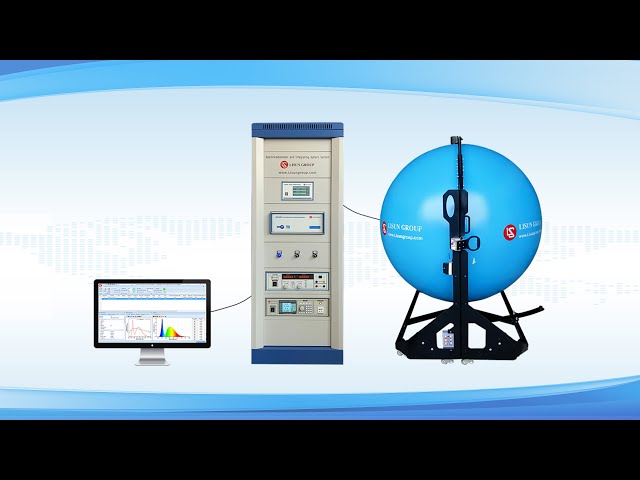
LISUN launches the LPCE-2 series LED measurement system, which integrates high-precision CCD spectral radiometer, integrally formed integrating sphere, digital electrical parameter analyzer and variable frequency AC/DC power supply. One set of equipment can complete testing of all categories of light sources including energy-saving lamps, fluorescent lamps, HID high-pressure gas lamps, cold cathode lamps and LED modules / luminaires. It is also applicable to routine photometric, colorimetric and electrical testing of LEDs and long-term luminous flux maintenance aging monitoring in accordance with LM-80. The software and hardware fully comply with domestic and international lighting testing standards, solving the pain points of insufficient equipment compatibility and precision in mixed multi-light-source testing and standardized LED certification testing.

LPCE 2(LMS 9000) Spectrophotometer & Integrating Sphere Test System
Introductions of Testable Light Source Categories
As an integrated comprehensive testing platform, the LPCE-2 LED measurement system supports mainstream lighting light sources across the industry:
1. Traditional gas discharge light sources: compact energy-saving lamps, linear fluorescent lamps, cold cathode fluorescent lamps (CCFL), HID high-pressure sodium lamps and high-pressure mercury lamps;
2. Solid-state lighting sources: LED chips, LED modules, LED bulbs, LED panel lights, plant growth LEDs and automotive LED light sources.
The system supports switching among three testing modes: spectrophotometry, photometry and spectrophotometry-photometry, adapting to testing logic for light sources with different luminescence principles, and can synchronously output four categories of complete parameters including chromaticity, photometry, electrical performance and luminous decay maintenance.
Authoritative Domestic and International Testing Standards Followed by the LED Measurement System
Market access, energy efficiency certification and quality grading of LED products require test reports issued in accordance with unified standards. The complete software and hardware design of LPCE-2 meets all mainstream photometric and colorimetric specifications. The applicable standards are shown in Table 1.
| Standard System | Standard No. / Name | Core Purpose of Standard | Corresponding Test Items of LED Measurement System |
| Chinese National Standard | GB/T 24824 | Test methods for LED modules for general lighting | Routine testing of LED luminous flux, luminous efficacy, electrical parameters and color rendering index |
| Chinese National Standard | GB/T 5702-2003 (CIE 13.3) | Method of measuring and specifying colour rendering properties of light sources | Testing of CRI and TM-30 colour fidelity index Rf / gamut index Rg |
| International CIE Standard | CIE 177 | Colour rendering of white LED light sources | Analysis of chromatic uniformity, colour purity and spectral distribution of white LEDs |
| International CIE Standard | CIE 84 | The measurement of luminous flux | Calibration testing of total luminous flux and radiant power of all types of light sources |
| North American ANSI Standard | ANSI-C78.377 | Chromaticity specifications for solid-state lighting products | Grading judgment of LED chromaticity coordinates and colour tolerance |
| North American IES Standard | LM-79-19 / LM-79-24 | Electrical and photometric measurements of solid-state lighting products | Comprehensive initial photometric, colorimetric and electrical performance testing of finished LED products |
| North American IES Standard | LM-80 | Measuring luminous flux maintenance of LED light sources | Long-term monitoring of luminous decay, correlated colour temperature drift and color rendering index attenuation |
| North American IES Standard | LM-82 | LED light decay test under constant temperature conditions | Testing light source performance under temperature variation with constant temperature integrating sphere |
| EU Standard | (EU) 2019/2015 | ErP energy label regulation | Calculation of LED energy efficiency EEI, luminous efficacy WPE and EQE efficiency parameters |
The LPCE-2 LED measurement system includes two hardware schemes: high-precision LMS-9000C and scientific-grade LMS-9500C. They are suitable for production line quality inspection of small and medium-sized enterprises and certification testing of large and medium-sized enterprises and third-party testing laboratories respectively. Core precision indicators of the two systems are shown in Table 2, all meeting the high-precision testing requirements of LED photometric, colorimetric and electrical parameters.
| Technical Index | High-precision Model LMS-9000C | Scientific-grade Model LMS-9500C | Impacts on Testing Performance of LED Measurement System |
| CCD Detector | Conventional CCD array | Hamamatsu cooled back-illuminated CCD (-10℃ constant temperature control) | Scientific-grade detector delivers lower noise and smaller testing error for low-brightness LEDs and low-power chips |
| Wavelength Accuracy | ±0.3 nm | ±0.2 nm | Higher wavelength accuracy ensures more precise measurement of spectral peak wavelength, FWHM and colour purity |
| Chromaticity Coordinate Accuracy (Standard Illuminant A) | ±0.002 | ±0.0015 | Key indicator for LED colour tolerance grading and white light consistency evaluation; smaller value means better data repeatability |
| CCT Accuracy | ±0.3% | ±0.2% | Avoids distorted test data of correlated colour temperature drift for LEDs under long-time operation |
| Photometric Linear Error | ±0.5% | ±0.2% | Error-free full-range testing for LEDs with high and low luminous flux (0.01 ~ 200000 lm) |
| Stray Light Suppression | <0.015% (600 nm), <0.03% (435 nm) | <0.015% (600 nm), <0.03% (435 nm) | Suppress interference from ambient stray light to realize stable testing for low-luminance light sources and LEDs with dark housings |
| Integration Time Range | 0.1 ~ 10000 ms | 0.1 ms ~ 60 s | Flexible exposure adjustment for ultra-high-brightness high-power LEDs and miniature low-power LEDs |
Both versions of the LED measurement system are equipped with integrally formed integrating spheres. Compared with traditional spliced integrating spheres, the integrally formed spherical surface has no splicing seams and uniform diffuse reflection coating on the inner wall. It avoids light leakage from seams and uneven local reflectivity, greatly reducing systematic errors in luminous flux and chromaticity testing. No structural deformation occurs after repeated long-term high-temperature testing, and equipment precision can remain stable for more than ten years. The system is equipped with auxiliary lamps and self-absorption correction algorithm to automatically compensate light absorption loss of LED light sources and high-power luminaires inside the integrating sphere, further improving authenticity of test data.
All-in-one Photometric, Colorimetric and Electrical Test Parameters
As a professional LED measurement system, LPCE-2 can collect three categories of core parameters in a single test, fully covering all indicators for LED quality evaluation:
• Colorimetric parameters: chromaticity coordinates x/y, correlated colour temperature (CCT), peak wavelength, dominant wavelength, FWHM, colour purity, CRI, CQS, TM-30-24 (Rf colour fidelity index, Rg gamut index) and complete spectral power distribution curve;
• Photometric parameters: total luminous flux, luminous efficacy (lm/W), radiant power, wall-plug efficiency (WPE), external quantum efficiency (EQE), energy efficiency index (EEI), plant-light dedicated PAR photosynthetic active radiation and PPF photosynthetic photon flux;
• Electrical parameters: input voltage, current, active power, power factor, harmonic distortion and displacement factor (DF);
• Long-term reliability parameters (LM-80 mode): luminous flux decay curve over time, colour temperature drift curve, color rendering index attenuation and long-term variation data of power, current and luminous efficacy.
Intelligent Design of LED Measurement System to Eliminate Manual Testing Errors
• Cooperative multi-power control: The system integrates variable frequency AC power supply and DC stabilized voltage/current power supply. AC/DC output can be switched with one click, adapting to AC-driven LED luminaires, DC LED chips and traditional AC fluorescent lamps without manual replacement of power supply equipment.
• Fully automatic data collection: The software automatically completes spectral scanning and synchronous reading of electrical parameters without manual data recording. Built-in self-absorption correction and temperature monitoring modules for the integrating sphere realize real-time compensation of photometric deviation caused by temperature.
• Automatic export of standardized reports: The software supports Chinese and English interfaces and is compatible with Windows systems from Win7 to Win11. LM-79 certification reports in PDF format and LM-80 luminous flux maintenance test reports in PDF/Excel format can be generated in one click. The tamper-proof reports can be directly used for certification by third-party institutions such as CQC, SGS and UL.
• Expandable upgrade capability: It can be matched with IS-1.5MT constant temperature integrating sphere and TMP-8 multi-channel temperature scanner to meet IES LM-82 constant temperature light decay testing requirements. One LED measurement system covers routine testing and long-term reliability aging monitoring.
Production Line Quality Inspection for LED Packaging and Luminaire Manufacturers
LED chip factories, packaging factories and lighting luminaire manufacturers need batch testing of incoming materials and finished products for photometric and colorimetric consistency. The LPCE-2 LED measurement system completes scanning within several seconds to implement batch sampling inspection on production lines. It quickly screens out non-conforming products with colour temperature shift, insufficient luminous efficacy and unqualified colour rendering index, preventing defective products from entering the market. It can also conduct spectral debugging and phosphor ratio optimization in new product development. Accurate spectral data guides LED colour matching and luminous efficacy improvement.
Simultaneous Testing of Multiple Categories for Traditional Light Source Manufacturers
For manufacturers of energy-saving lamps and HID gas discharge lamps producing new and traditional light sources on the same production line, there is no need to purchase multiple single-function testing equipment. One LPCE-2 LED measurement system can complete synchronous testing of traditional fluorescent lamps and new LED products, reducing laboratory equipment procurement costs and saving laboratory space.
Third-party Testing and Certification Laboratories
Third-party testing institutions issuing energy efficiency and lighting safety certification reports impose extremely high requirements on testing precision, standard compliance and data traceability of the LED measurement system. The spectrometer, integrating sphere and standard light source of LPCE-2 can provide metrological calibration certificates. Test data fully meets requirements of GB/T, CIE and IES standards. The issued LM-79 and LM-80 reports are recognized by certification institutions worldwide, reducing repeated retests and improving testing capacity of laboratories.
University Optoelectronic Laboratories and Plant Lighting R&D Institutions
For optoelectronic teaching in universities and plant growth LED R&D scenarios, this LED measurement system can test plant-specific optical parameters including PAR and PPF and output complete spectral curves, meeting the demand for high-precision data in teaching experiments and special lighting product development.
Quality control of LED products relies on complete and accurate integrated photometric, colorimetric and electrical testing. A professional integrated LED measurement system serves as core equipment to realize standardized testing. As a mature commercial LED measurement system, LISUN LPCE-2 (LMS-9000) LED CCD Rapid Photometric, Colorimetric and Electrical Comprehensive Test System adopts integrally formed high-precision integrating sphere and high-resolution CCD spectral radiometer on hardware. Its software fully supports GB/T, CIE and IES series lighting testing standards. One piece of equipment supports testing of all light source categories including energy-saving lamps, fluorescent lamps, HID high-pressure gas lamps, cold cathode fluorescent lamps and LEDs.
Two configurations (high-precision and scientific-grade) can meet differentiated demands of small and medium-sized enterprise production line inspection and high-end certification laboratories. The system automatically collects four categories of parameters: colorimetry, photometry, electrical performance and long-term light decay. It is equipped with functions including standardized report export, self-absorption correction and expandable constant-temperature light decay testing. It solves pain points of traditional single-function testing equipment such as insufficient precision, poor light source compatibility and incapability to generate international certification reports from three dimensions: hardware precision, automation level and standard adaptability. Against the background of quality upgrading in the LED lighting industry and normalized global energy efficiency certification, the LPCE-2 LED measurement system effectively improves accuracy and efficiency of light source testing, and delivers a complete standardized testing solution for LED product development, production quality control and market access certification.
Tags:LPCE-2 (LMS-9000)Your email address will not be published. Required fields are marked *

 English
 中文简体
中文简体 English
 Русский
 Español
 Português
 Türkçe
 العربية
 Deutsch
 Polski
 Italiano
 Français
 한국어
한국어 ไทย
ไทย Tiếng Việt
 日本語
日本語