LM-79 Moving Detector Goniophotometer (Mirror Type C)
LSG-6000
High Precision Rotation Luminaire Goniophotometer
LSG-1890B
High Precision Rotation Luminaire Goniospectroradiometer
LSG-1890BCCD

Goniophotometer for Automotive and Signal Lamps
LSG-1950
Goniophotometer for Traffic Signal Lamps (Economical Model)
LSG-1950S
VAD Fire Alarm Visual Alert Device Goniophotometer
LSG-1930
Goniophotometer for Airfield Lighting
LSG-1940
Compact Goniophotometer
LSG-1200A
LED Goniophotometer
LSG-1100
Near Field Moving Detector Goniophotometer
LSG-1900B
 LEDs and Luminaire Test Solutions
 LM-79 and LM-80 Test Solutions
 LED Driver Test Solutions
 Household Appliances Test Solutions
 Mobile and Network Test Solutions
 Automotive Electronics Test Solutions
 Audio-Video and IT Test Solutions
 Cable and Wire Test Solutions
 Plugs and Sockets Test Solutions
 Power Switch Test Solutions
 Transformer Test Solutions
 Electric Toys Test Solutions
 Energy Meter Test Solutions
 Motor-Operated Tool Test Solutions
Select an organization
to browse standards
Abstract
During vehicle operation, loose wiring harness connectors, oxidized terminals, plug insertion and removal, sudden load changes and other working conditions continuously trigger power supply abnormalities such as voltage dips, transient micro-interruptions and short-term power cuts, which easily cause failures including signal loss of vehicle ECUs and sensors, controller crash and incorrect actuator actions. To reproduce such real vehicle faults in laboratories and complete component reliability verification, the Automotive Voltage Dip and Interruption Simulator is an indispensable standardized test instrument. The PFS-80V50A Automotive Wiring Harness Micro-Interruption Simulator launched by LISUN is a professional Automotive Voltage Dip and Interruption Simulator. Designed with a high-speed electronic switch architecture and strictly complying with test specifications in Clause 4.9 of ISO 16750-2:2023, the equipment can accurately reproduce various transient on-off faults of power lines and signal lines. It is widely applied to R&D verification, factory delivery inspection and third-party compliance certification of vehicle electronic control parts equipped on passenger vehicles, commercial vehicles, construction machinery and agricultural equipment. This paper elaborates on the root causes of vehicle voltage dip and transient interruption faults, core technical features of the equipment, comparison of parameters across different models and industry-wide application scenarios, and fully analyzes the practical value of the Automotive Voltage Dip and Interruption Simulator.
The complete vehicle wiring harness consists of hundreds of groups of plugs, terminals and copper wires connected in series. Long-term vibration, temperature cycling and water vapor corrosion will increase contact resistance, resulting in millisecond or even microsecond-level voltage dips and temporary power cuts during driving. For precision electronic components such as body controllers, millimeter-wave radars and new energy BMS, even a power supply interruption of only several microseconds may lead to loss of memory data, disconnection of communication buses and failure of function reset. Once faults are found during road tests, vehicle manufacturers need to invest massive manpower to troubleshoot wiring harnesses, chips and power circuits, bringing extremely high rectification costs.
Conventional simple switches and manual plug-in fixtures cannot precisely control interruption duration and voltage change rate, and the waveforms are not reproducible, making test results unable to meet metering audit requirements of laboratories of Volkswagen, BMW, Tesla and other automakers. In contrast, the Automotive Voltage Dip and Interruption Simulator adopts programmable high-speed electronic switches to quantitatively control dip amplitude, interruption duration and on-off cycles, and its output working conditions are highly consistent with real vehicle faults. It can expose anti-interference weaknesses of components in the early R&D stage, serving as core hardware for current vehicle electrical reliability testing. As a mainstream Automotive Voltage Dip and Interruption Simulator, the PFS-80V50A has been purchased in batches by hundreds of electronic control laboratories at home and abroad.
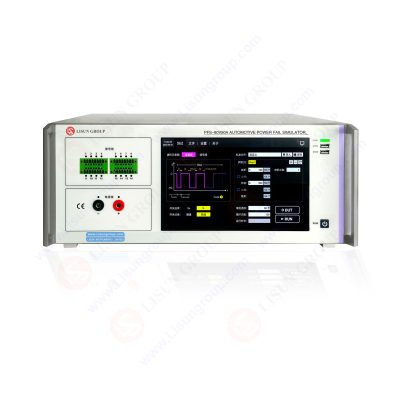
Automotive Power Fail Simulator
The PFS-80V50A Automotive Wiring Harness Micro-Interruption Simulator is independently developed by LISUN and serves as a standardized Automotive Voltage Dip and Interruption Simulator. Its hardware is divided into two major modules: power loop simulation unit and multi-channel signal loop simulation unit. The two units can operate independently or work synchronously to simulate composite power-off faults, fully covering all wiring harness interruption test clauses of domestic and international standards including ISO 16750-2:2023, VW 80000 and LV 124.
In terms of power line simulation capability, the equipment supports a maximum load of ±80V / 50A for the DUT power supply loop, built with three controllable switches S1, S- and S2, with multiple optional discharge resistors. It can simulate voltage dip working conditions caused by wiring harness open circuit, instantaneous short circuit, power cut during plugging and sudden load changes. The rising and falling edge time of switches is controlled within 200 nanoseconds, with a maximum voltage change rate of 100V per microsecond. The adjustable interruption range covers 1μs to 16s, enabling free editing of both minor power-off and long-term undervoltage working conditions to accurately reproduce various real vehicle dip waveforms. Standard calibration resistors of 1Ω and 100Ω are equipped for precision verification before and after each test to ensure test data meets traceability requirements of CNAS laboratories.
In terms of signal line simulation capability, the device integrates 16 mutually independent signal channels, each supporting a load of ±50V / 3A, suitable for testing vehicle communication wiring harnesses such as CAN, LIN and Ethernet. Two test modes are available: single-channel independent interruption and multi-channel synchronous instantaneous disconnection. Switch timing and interruption intervals can be customized and programmed via upper computer software to simulate multi-channel simultaneous signal loss caused by loosening of multiple wiring harness connectors, verifying communication fault tolerance of instruments, radars and body modules.
The complete Automotive Voltage Dip and Interruption Simulator is equipped with visual programmable software. Operators can call built-in test templates for major automakers with one click without manually editing complex timing curves. Voltage waveforms, interruption timestamps and current variation data are automatically recorded during testing, and PDF reports available for certification audit can be exported directly after the test, greatly cutting testing time for each batch of samples. The chassis adopts standard cabinet dimensions and can be combined with four-quadrant voltage simulators, load dump generators and ground offset simulators to form the complete LS-ISO16750 vehicle electrical performance comprehensive test system, realizing one-stop completion of all electrical stress tests specified by ISO 16750 standards.
| Comparison Parameters | PFS-80V50A | PFS-80V100A | PFS-80V150A | PFS-80V300A |
|---|---|---|---|---|
| Max Voltage / Current of Power Line | ±80V / 50A | ±80V / 100A | ±80V / 150A | ±80V / 300A |
| Quantity of Signal Line Channels | 16 Independent Channels | 16 Independent Channels | 16 Independent Channels | 16 Independent Channels |
| Rated Load per Signal Channel | ±50V / 3A | ±50V / 3A | ±50V / 3A | ±50V / 3A |
| Switch Edge Response Speed | <200ns | <200ns | <200ns | <200ns |
| Adjustable Interruption Duration Range | 1μs ~ 16s | 1μs ~ 16s | 1μs ~ 16s | 1μs ~ 16s |
| Applicable Product Types | Miniature Sensors, Body ECUs, Medium & Low Power Actuators | On-Board Chargers, Medium Power Powertrain Controllers | 48V Hybrid Electronic Control Units, High Power DC-DC Converters | Heavy-Duty Commercial Vehicle Vehicle Control Units |
| Compatible Automaker Standards | Small Component Tests for Volkswagen, BMW, Toyota, Tesla | New Energy Electronic Control Component Tests for General Motors, Ford | Electronic Control System Tests for Volvo, Construction Machinery | High Power Electronic Control Tests for Heavy Trucks, Agricultural Equipment |
The PFS-80V50A Automotive Voltage Dip and Interruption Simulator covers all test links of the automotive electronics industrial chain, with distinct application values in different scenarios. The first scenario is component R&D laboratories. R&D engineers can reproduce voltage dips and micro-interruptions of different durations and amplitudes via the equipment, compare the power-off resistance of different power supply chips, filter circuits and energy storage capacitor schemes, optimize circuit protection solutions at the prototype design stage, and avoid mass failure problems during complete vehicle road tests.
The second scenario is factory delivery quality inspection. Built-in standardized test templates for Volkswagen, Toyota and General Motors are available. Production line operators do not need to be familiar with complex standard provisions. After connecting the DUT ECUs and sensors to the circuit, one-click automatic testing can be initiated to quickly screen unqualified products with defects such as crash after power cut and signal loss, guarantee the consistency of electrical reliability of delivered products and reduce after-sales failure claim risks.
The third scenario is third-party automotive testing laboratories. The equipment is equipped with complete calibration supporting components, and the output waveform data of voltage dips and micro-interruptions can generate CNAS-accredited test reports to meet the supply chain access certification requirements of vehicle OEMs, supporting compliance test businesses of wiring harness interruption for various passenger vehicle and construction machinery components at home and abroad.
The fourth scenario is complete vehicle fault reproduction laboratories. When intermittent tough faults such as instrument black screen, power interruption and radar signal loss occur on real vehicles, engineers can collect real vehicle fault waveforms and import them into the Automotive Voltage Dip and Interruption Simulator for 1:1 replication, quickly locating whether the root cause of faults lies in controllers, wiring harnesses or power supply loops and greatly shortening the troubleshooting cycle.
The fifth scenario is reliability research tests in universities and automotive OEM research institutes. The programmable timing feature of the equipment supports customized extreme dips and composite working conditions of multiple consecutive transient interruptions, which can be used to study the aging failure mechanism of automotive electronic components under long-term frequent power-off environments and provide test data support for the design of new-generation electronic control products.
If laboratories need to build a complete full-item ISO 16750 test platform, the PFS-80V50A Automotive Voltage Dip and Interruption Simulator can be combined with LISUN four-quadrant voltage simulators, load dump generators, wiring harness short-circuit simulators and ground offset simulators to form the integrated LS-ISO16750 comprehensive test cabinet, covering all international and OEM test standards related to vehicle electrical loads in one stop.
Voltage dips and transient micro-interruptions caused by complete vehicle vibration and wiring harness aging are the most common power supply abnormalities of automotive electronics. Conventional manual fixtures cannot realize quantitative and reproducible standardized testing, making the Automotive Voltage Dip and Interruption Simulator a core professional instrument to solve such testing pain points. As a mature Automotive Voltage Dip and Interruption Simulator, the LISUN PFS-80V50A Automotive Wiring Harness Micro-Interruption Simulator fully complies with global mainstream vehicle electrical test specifications including ISO 16750-2, VW 80000 and LV 124, relying on three core advantages: nanosecond-level high-speed switches, independent simulation of power and signal dual channels, and built-in test templates for multiple automakers.
In terms of equipment selection, the PFS-80V50A model is preferred for R&D and production line testing of low-voltage small parts such as miniature sensors and body ECUs; high-power new energy electronic control and heavy-duty commercial vehicle components can be upgraded to 100A, 150A or 300A models according to current demands. This series of Automotive Voltage Dip and Interruption Simulators are applicable to various business scenarios including R&D verification, factory delivery inspection, third-party certification and fault reproduction. They can expose functional defects of automotive electronics under voltage dip and transient interruption conditions in advance, effectively cut R&D rectification and after-sales maintenance costs for automakers, and serve as indispensable standardized test equipment for vehicle electrical reliability laboratories.
Tags:PFS-80V50AYour email address will not be published. Required fields are marked *

 English
 中文简体
中文简体 English
 Русский
 Español
 Português
 Türkçe
 العربية
 Deutsch
 Polski
 Italiano
 Français
 한국어
한국어 ไทย
ไทย Tiếng Việt
 日本語
日本語